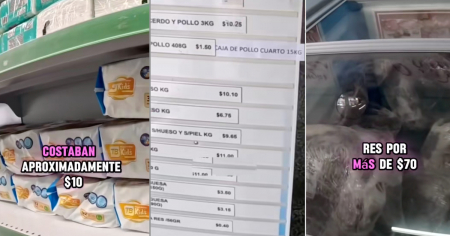
A Cuban TikToker caused a stir on social media after posting a video in which she shows, with a tone that is both amazed and ironic, a foreign currency store in the exclusive Palco Shopping Center in Havana, which, according to her, looks like "the Costco of Havana."
"Everything started like any other day in Cuba," says the user on TikTok @keycubanita4 at the beginning of the video. She recounts that she went out looking for oil and cookies for a snack, but ended up in a store "where you can find everything," including imported products, supposedly of American origin.
While recording well-stocked shelves, she closes with a phrase that raised alarms for many: “Follow me for more real adventures from this island where everything is possible… or almost.”
But that "almost" was enough to unleash the outrage of many Cubans who live a reality very different from what the video portrays. The comments quickly followed, filled with pain, irony, and social critique.
"Where can you pay in dollars in Cuba?", a user asked sarcastically.
“That's nice, but only if you have family abroad who sweat it out to send you remittances”, wrote another.
“And the blockade? And the turbulent and brutal north?” joked a third party, referring to the official narrative that blames the United States for the shortages on the island.
Many also pointed out that the Palco Shopping Center is nothing new and that its existence contrasts sharply with the scarcity experienced by most of the Cuban people, who receive their salaries in pesos while facing prices in dollars.
Others were harsher, accusing these types of videos of "whitewashing the dictatorship" by presenting a distorted image of the national reality. "These videos do nothing but serve as propaganda for the regime. They promote what seems like the Costco of Havana… oh, God, the things you have to hear on social media!"
One of the most striking comments summarizes the widespread sentiment. "For God's sake, is anything possible on that island? What is possible? Everything is impossible there: there's no electricity, no food, no transportation, no medicine. A Cuban who doesn't receive dollars can't go there. Children can't snack on Oreo cookies unless they have a mom or dad abroad who emigrated with a broken heart to provide for them. The streets are filled with trash, Havana is falling apart, there are no teachers because no one wants to teach for 10 dollars a month. What are you going to showcase in your content? The bubble you live in or the reality of the Cuban who bathes with a jug and sleeps with heat and mosquitoes?"
Widespread outrage highlights a disconnect between the opulence displayed by certain businesses in foreign currency and the harsh reality faced by millions of Cubans who cannot afford basic products. The contrast between overflowing shelves and empty pockets once again becomes a topic of controversy on social media.
Since 2025, the Cuban government has accelerated the opening of stores that operate exclusively in dollars, under the argument of "capturing foreign currency and improving supply." Establishments such as the supermarket at 3rd and 70 in Havana, "Casalinda" in the old Ten Cents, and new units in provinces such as Holguín, Villa Clara, and Ciego de Ávila, have marked this trend.
These stores only accept payments with international cards (Visa, MasterCard, MIR) or prepaid cards from abroad, which excludes most Cubans who earn in pesos. While these businesses display shelves full of imported products, the stores in national currency remain understocked, creating a strong perception of injustice and economic segmentation.
Economists like Pedro Monreal have warned that this “partial dollarization” deepens inequality by creating a parallel market accessible only to those who receive remittances or foreign currency. Citizens' complaints also highlight humiliating practices, such as receiving change in candies for cash payments in dollars, and they denounce that this strategy turns access to basic goods into a privilege reserved for a minority.
Filed under: