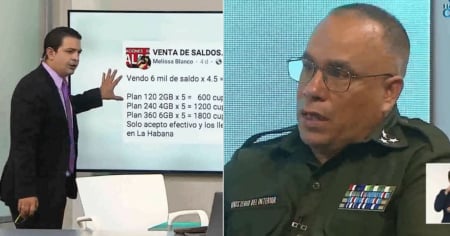
An alleged network dedicated to "scamming" ETECSA with international top-ups was exposed on Cuban television during the program "Hacemos Cuba," from Canal Caribe.
The scheme involves "a Cuban resident in the United States" with connections in the provinces of Havana, Artemisa, and Holguín.
The official source -which did not specify the number of arrests related to the case- did indicate that in three home searches in the capital, the police seized more than 40 million pesos in national currency, as well as "a car, a satellite antenna, money counting machines, computers, magnetic cards, and phones."
The case points to a network that operated through digital platforms like Soky Recargas Online, which pretended to offer international top-ups to Cubans on the island, but in reality transferred local balances, keeping the currency outside the country, according to the state-owned company.
How did it work?
The colonel of the Ministry of Interior (MININT), Marcos Yobany Rodríguez González, has stated that these platforms operated as if they were official and offered promotions similar to those of ETECSA, but the money never reached the Cuban company.
They claim that instead of making a genuine international top-up, what was actually done was a national top-up within the country, using balances accumulated by telecommunications agents or local intermediaries.
They say that in this way, the customer in Cuba received credit, but not the usual benefits that ETECSA offers in its promotions, such as "unlimited data from 12:00 a.m. to 7:00 a.m." or free WhatsApp.
"The currency remained in their hands", explained Colonel Rodríguez. "The national entity only had a distributor that recharged balance at a national level," he added.
The scheme became even more profitable due to the exchange rate differential in the informal market.
ETECSA says that if a user abroad sent $20 USD, instead of using an official distributor, they would exchange that money on the black market, where the dollar exceeds 370 CUP.
The aforementioned official source revealed that this allowed those in charge of the business to purchase multiple national packages of 110 CUP and resell the balance. In this way, they multiplied their profits while the customer in Cuba received a service of lesser value.
When the recharge isn’t what it seems
An unidentified directive from ETECSA mentioned that users began approaching the company’s offices to complain about the services promised by their relatives abroad: top-ups that did not include gigabytes, messages, or nighttime benefits.
Michel Rodríguez Averoff, director of Cybersecurity at ETECSA, explained how to identify the difference: the message accompanying a legitimate international recharge includes additional bonuses that do not appear in a national recharge.
"Many people received a national combined plan as if it were an international recharge," she clarified.
He also warned that there are only 16 official distributors authorized by ETECSA to carry out international top-ups, and that any other site or platform offering them is not legally validated by the company.
A crime that the Cuban regime classifies as "sabotage."
The chief prosecutor of the Criminal Processes Directorate, José Luis Reyes Blanco, reported that the cited events qualify as "sabotage", as they involve direct economic harm to the State and to critical infrastructure.
“The beneficiary is being victimized by the process,” the prosecutor clarified, specifying that “the entire framework surrounding the sale of the recharge is committing a crime,” he added.
Authorities emphasize that the impact is not only financial — in the foreign currency that ETECSA has failed to collect — but also affects the technical and commercial functioning of the service, which relies on that economic flow.
In addition to sabotage, the Ministry of the Interior and the Prosecutor's Office mention possible related crimes such as "fraud, illegal currency trafficking, and misuse of commercial licenses."
Investigations are ongoing, according to the Ministry of the Interior, "with the legal guarantees established by Cuban law."
The reference to such "frauds" was one of the excuses used by ETECSA to implement the unpopular measure that recently sparked a wave of public discontent by limiting top-ups in national currency to a maximum of 360 Cuban pesos (CUP) every 30 days.
In response to criticism, the Telecommunications Company of Cuba announced this Friday a new mobile data plan of 2 GB for 1,200 Cuban pesos, available starting June 20.
Frequently Asked Questions about ETECSA Fraud and the Telecommunications Crisis in Cuba
How did the fraud network related to ETECSA's international recharges operate?
The fraud network operated by simulating international top-ups through unofficial digital platforms like Soky Recargas Online. Instead of making a real international top-up, a national top-up was performed using credits accumulated by telecommunications agents or local intermediaries. In this way, the customer in Cuba received balance, but not the usual benefits from ETECSA, while the currency remained outside the country.
Why does the Cuban regime classify fraud against ETECSA as "sabotage"?
The Cuban regime classifies ETECSA fraud as "sabotage" because they believe that these activities impact a critical infrastructure such as the telecommunications system. Prosecutor José Luis Reyes Blanco stated that fraud represents a direct economic harm to the State, affecting both foreign currency revenue and the technical and commercial operation of the ETECSA service.
What measures has ETECSA taken to address the financial crisis resulting from these frauds?
To confront the financial crisis, ETECSA has imposed a limit of 360 CUP in monthly top-ups and has promoted data packages in U.S. dollars. The company argues that these measures are necessary to acquire foreign currency and sustain the network, although they have been perceived as a "covert dollarization" that increases economic inequality.
How has the Cuban population reacted to the new measures from ETECSA?
The Cuban population has reacted with indignation to the new measures from ETECSA. Many users believe that these measures exclude those who do not have access to foreign currency and reinforce economic and digital inequality in the country. Protests have been recorded on social media, along with calls to boycott international top-ups as a form of protest against the regime.
Filed under: