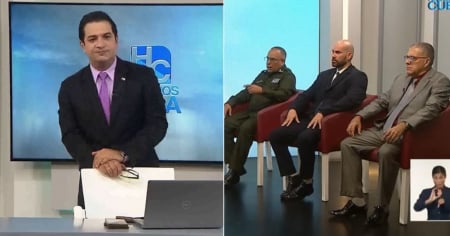
During the broadcast of the official program Hacemos Cuba this Wednesday, the regime's spokesperson, Humberto López, denounced the sale of ETECSA credits by Cuban citizens, describing it as “unacceptable” and stating that the authorities will pursue legal action against it.
In the television segment, López showcased social media posts from individuals offering mobile balance as part of schemes that, he stated, “evolve” rapidly following the implementation of new economic measures.
Although he omitted the phone numbers, he disclosed the usernames, publicly accusing them of engaging in illegal activities, without any investigatory due process to support those allegations.
"The crime is evolving and shifting," declared López, who added: "And there are people who are on this path. This falls within everything we are explaining regarding fiscal investigation."
The program featured the participation of Colonel Marcos Yobany Rodríguez González, the deputy chief of the specialized agency for economic crimes at the Ministry of the Interior (MININT), who stated that this type of activity was already anticipated by the authorities.
"We are monitoring and will respond according to the severity of each case," stated the oppressor, whose words are a direct threat to the citizens.
According to the colonel, both organized networks and individuals operating independently will be investigated: “The main thing is that they refrain from continuing to commit these kinds of acts. They need to stop,” he warned.
For his part, the chief prosecutor of the Criminal Proceedings Division of the Attorney General's Office, José Luis Reyes Blanco, stated that this is an illegal economic activity, lacking legal support, without structure or tax payments, thereby constituting a punishable offense.
Their statements can be seen as a sign that the regime is prepared to utilize its entire repressive apparatus to protect the income it derives from ETECSA top-ups, even pursuing informal practices that evade its fiscal control.
The informal sale of phone credit has become a means of survival for many Cubans, due to the lack of formal employment, economic hardship, and state control over telecommunications services.
The statements from López and the regime's officials reinforce the dictatorship's offensive against any form of informal or autonomous management outside the state framework, even in the digital sphere.
Additionally, ETECSA announced this Friday a new mobile data plan of 2 GB for 1,200 Cuban pesos, available starting June 20, which seems to be a direct response to the increasing criticism from citizens regarding the high prices of mobile internet service on the island.
Network of "scams" with fake top-ups
Also in this Wednesday's broadcast of Hacemos Cuba, an alleged network dedicated to scamming ETECSA users was exposed. The case, which is still under investigation, involves a Cuban resident in the United States with connections in several provinces of the country, including Havana, Artemisa, and Holguín.
Although the authorities did not provide details about the number of arrests made, they reported that during home searches in the capital, more than 40 million pesos in national currency were seized, along with a satellite dish, money counting machines, computers, magnetic cards, phones, and a car.
According to the version presented by the regime, this network used digital platforms like Soky Recargas Online to simulate international recharge transactions.
In reality, those involved were making domestic top-ups using balance acquired from telecommunications agents within the country, while keeping the currency sent from abroad.
The regime qualifies unofficial remittances to Cuba as "sabotage."
Similarly, the Cuban regime has escalated its rhetoric against international phone top-ups made outside of ETECSA's official channels,
The statement was made on the official program Hacemos Cuba, amidst an increasingly aggressive campaign against alternative methods of sending phone credits to the Island.
During the meeting, regime officials pointed out that these practices severely impact the finances of the state telecommunications monopoly.
They were classified as part of “criminal structures,” composed of individuals who facilitate unauthorized top-up services from abroad.
The statements come in a context where Cubans—both inside and outside the country—are turning en masse to informal platforms to send funds, given the limited functionality, high costs, and restrictions of the official system.
Frequently Asked Questions about the Sale of ETECSA Credit and Measures of the Cuban Regime
Why does the Cuban regime consider the sale of ETECSA balance unacceptable?
The Cuban regime considers the sale of ETECSA balance unacceptable because it views it as an illegal economic activity that escapes the State's fiscal control. According to the authorities, this practice poses a threat to the revenues that ETECSA should receive from international top-ups, and it will be pursued legally as part of an offensive against any informal or autonomous management in the digital realm.
What legal consequences do those involved in the sale of ETECSA balance face?
Those involved in the sale of ETECSA credits may face criminal penalties under the accusation of committing an economic crime. The regime has warned that these activities could be regarded as sabotage, as they impact a "critical infrastructure" such as the telecommunications system. Authorities are also investigating possible related crimes such as fraud and illegal currency trafficking.
How does the sale of ETECSA balance affect the Cuban economy?
The sale of ETECSA balance affects the Cuban economy by reducing the foreign currency revenues that the State earns from international top-ups, which ETECSA has pointed out as an erosion of its income. This practice also reflects the market distortions caused by economic restrictions and state control over access to telecommunications, pushing many Cubans to seek informal alternatives for survival.
What measures has the regime taken to control the sale of ETECSA credit?
The regime has implemented strict monitoring of unauthorized phone top-up operations, classifying them as sabotage. Authorities have warned that they will investigate both organized networks and individuals, aiming to curb these activities and protect ETECSA's revenues. Furthermore, a severe legal response is sought in line with the seriousness of the detected cases.
Filed under: