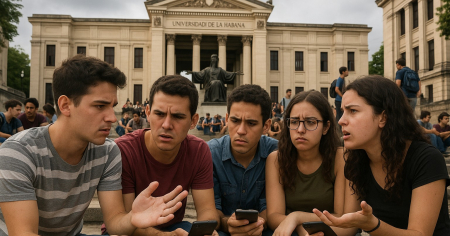
The recent decisions made by ETECSA, which limit access to the internet in Cuban pesos and favor top-ups in dollars, have sparked an unexpected student protest movement across several universities in the country.
New videos shared on social media show young people firmly demanding digital justice and accusing the authorities of acting against the interests of the people.
The images have sparked a national debate on exclusion, inequality, and institutional repression, while the slogan “I don't want any more DTI people in my house” spreads as a symbol of resistance.
The videos, recorded during meetings between students, ETECSA executives, and university authorities, reveal a growing discontent. “Today I’m not here to speak diplomatically, but with dignity,” began a young woman in one of the most widely shared segments.
"This is not an economic policy; it is an invisible policy that divides Cubans into two: those who have dollars and can access the world, and those who only have CUP and are isolated in their own homes," he added, in response to the uneasy gaze of the officials present.
The intervention, applauded by her peers, highlights the disconnect between official decisions and the reality faced by thousands of young people.
"A message sent with tears can be rejected due to insufficient balance," denounced another student, pointing out that the new monthly cap of 360 CUP on domestic top-ups makes internet access a class privilege. "We want the internet to stop being a luxury and to return to what it should be: a human right," she concluded.
Beyond the demands for connectivity, the speeches appeal to a social ethic that transcends the classroom: “We are university students, but we are not just speaking for ourselves. We are advocating for an entire country.”
The phrase was uttered by a student who criticized that ETECSA's measures were not consulted with the public, despite the existing legal protocols. “How can you think as a country if you didn’t include the country?” she directly challenged the executives.
The consequences did not take long to arrive. In Las Tunas, a student from the University of Medical Sciences reported having been harassed by agents from the Technical Department of Investigations (DTI) after participating in one of these meetings.
"I don't want any more people from the DTI in my house", she said in a video that has gone viral as a slogan. Her complaint was supported by other classmates who claimed to have experienced similar situations, describing a pattern of intimidation and control.
The incident prompted an alert from Cubalex, a human rights organization, which reported a wave of summons and pressures on young people for exercising their right to free expression. The NGO warned that these practices violate international treaties signed by the Cuban state and threaten university autonomy.
Meanwhile, universities are trying to manage the crisis. The Faculty of Mathematics at the University of Havana, which had initially called for a strike, ended up canceling it after discussions with management and internal pressures.
In Santiago de Cuba, a student accused the Universidad de Oriente of manipulating information about the events and betraying those who raised their voices.
For their part, official spokespersons have attempted to downplay the protests, claiming that they are “not genuine” and that “they respond to a media narrative” fabricated from abroad. However, the testimonies of dozens of students contradict this narrative and denounce a context of surveillance, threats, and discredit.
In a country where the minimum wage is around 2,100 pesos and a basic internet package exceeds 3,000, the student protest has highlighted an uncomfortable truth: digitalization in Cuba is advancing, but not for everyone. “This is not a whim. It’s about dignity. It’s about survival,” said a student.
The protests against ETECSA's rate hike have revealed more than just a rejection of a commercial policy: they are a sign of exhaustion in the face of a structure that marginalizes those without dollars. And, in that context, the repressive response only reaffirms the fracture between the rulers and the ruled.
"This country also belongs to those of us who don't have dollars, to those who only have CUP, soul, and the desire to get ahead," concluded one of the young women in her speech, which has turned into a generational manifesto.
The phrase encapsulates the spirit of a youth that has said enough. And, despite the fear, has chosen to speak out loud.
Filed under: