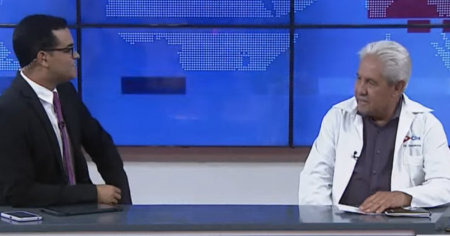
The national director of Epidemiology at the Ministry of Public Health (MINSAP), Dr. Francisco Durán García, reported the latest data on the epidemiological situation in Cuba.
In his remarks, he confirmed that reports of dengue cases are ongoing and the oropouche virus is circulating in eight Cuban provinces. He also issued a warning to the population.
Circulation of oropouche and dengue
“In Cuba, we are dealing with two circulating arboviruses: dengue and oropouche,” stated Durán during his appearance for Canal Caribe.
According to the explanation, dengue currently affects three provinces, spread across four municipalities and four health areas, while oropouche has a wider distribution, present in eight provinces, 12 municipalities, and 14 health areas.
Despite the high infestation of the vector mosquito, especially in Pinar del Río and Santiago de Cuba, the epidemiologist assured that no severe or critical cases have been reported: “We have really managed to keep it at that level.”
Other circulating viruses and respiratory diseases
In addition to arboviral diseases, the specialist confirmed the presence of respiratory viruses commonly seen at this time of year, such as influenza. “Many people say, ‘I had COVID and I've ended up with a cold,’ but what is circulating are also influenza viruses and other respiratory ones,” he indicated.
Durán warned about the seasonal increase in acute diarrheal diseases, attributed to heat, poor food preservation, and refrigeration issues.
"It's not that there is an outbreak as such, but rather that this is the time when these conditions lead to more cases," he emphasized, urging to intensify hygienic and sanitary measures.
Second phase of the polio vaccination
During his speech, the official also reminded that the second phase of the oral polio vaccination campaign is currently being developed. “The second dose is being administered to children from one month to nearly three years old, and a booster is being given to children who are nine years old,” he explained.
Finally, it was highlighted that "Mosquito Action Week" is being celebrated in Cuba, with educational activities promoted by health promotion centers.
“Although the environmental context is complex, efforts are being made to eliminate breeding sites with active participation from the community,” he concluded.
Frequently asked questions about the epidemiological situation in Cuba
What viruses are currently circulating in Cuba?
Currently, dengue and the Oropouche virus are circulating in Cuba, along with respiratory viruses such as influenza. Dengue affects three provinces and Oropouche affects eight, with presence in multiple municipalities and health areas. Although no severe cases have been reported, the population is urged to maintain preventive measures. There has also been an increase in acute diarrheal diseases due to the heat and food preservation issues.
What measures are the Cuban authorities taking to combat dengue and Oropouche?
The Cuban authorities have implemented various measures, such as the "Action Week Against Mosquitoes," to educate the population on eliminating mosquito breeding grounds. Efforts are actively underway to remove breeding sites with citizen participation. Furthermore, a polio vaccination campaign is being conducted to prevent other infectious diseases.
What recommendations have been given to the population to prevent respiratory and diarrheal diseases?
Recommendations include taking extreme hygiene and sanitation measures, such as properly washing food and ensuring the cleanliness of drinking water. It is advisable to wash food thoroughly, especially raw vegetables, and to treat water with bleach or boil it. Additionally, it is recommended to get vaccinated against influenza, particularly for children, and to see a doctor if any suspicious symptoms arise.
How is the epidemiological situation affecting health services in Cuba?
The epidemiological situation is placing pressure on health services in Cuba, with thousands of people hospitalized primarily due to dengue. The medical infrastructure is facing significant challenges, including a shortage of beds in intensive care units and a lack of medications. These issues are exacerbated by poor sanitary conditions and a lack of resources.
Filed under: