
Related videos:
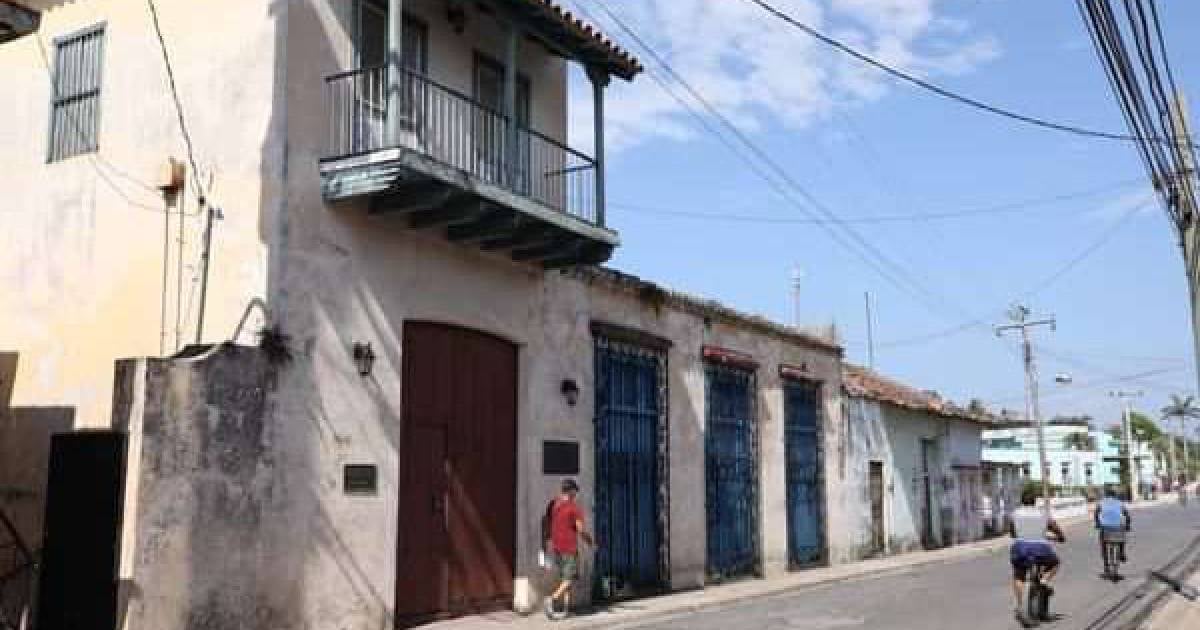
The museum honoring Carlos Baliño (1848-1926), one of the founders of the first Communist Party of Cuba (PCC), remains closed and in disrepair, with no clear date for reopening. Six years after its closure in 2019, the building located in the municipality of Guanajay, in the province of Artemisa, still lacks a complete roof, the collection is overcrowded, and the approved investment is moving at a snail's pace.
Baliño “does not have a bust in his hometown honoring his memory. Moreover, the museum named after him is undergoing an investment process that seems never-ending, and its status as a National Monument hangs by a thread,” acknowledged the official newspaper El Artemiseño.
Mercedes Záceta, the only one of the museum founders still working at the institution, stated that she never imagined such a decline. “We were like the convention center of Guanajay. Important meetings and the most significant political and cultural activities in the municipality took place here,” she recalled.
Today, the museum is closed to the public, and its collection is crammed together, exposed to heat and potential humidity outbreaks, which endangers its good condition, despite the ongoing conservation efforts carried out by the museum specialists.
But the most concerning aspect, according to the media outlet, "is to see how resources invested in some completed work have been wasted and the quality of their finishing".
In this regard, he mentioned the incomplete placement in 2019 of the roof structure on metal beams, without essential materials such as the waterproofing blanket. As a result, there are already damaged clay tiles and parts of the roof suffering irreversible damage from rain and sun. The integrity of the walls is also at risk, especially in areas without a cover, where moisture seriously compromises the cladding.
The historian and archaeologist Leonardo Camoeira, one of the institution's most experienced collaborators, also expressed his frustration. He mentioned serious structural damage and loss of functionality in the lime and stone walls. Even a window was dislodged due to the effects of Hurricane Rafael, worsening the risk to the collection.
The museum's management, led by Alina Pérez, continues to juggle efforts to preserve what can be saved. The priorities, she stated, are the conservation of objects and the maintenance of external monuments. However, she acknowledges that without completing the roof, further actions on walls, doors, windows, and floors cannot move forward. And with each delay, both the cost of the investment and the damage to the property continue to increase.
El Artemiseño emphasized that the mayor Diaberkis Lugo, and the director of Culture in the municipality, Yanara Sarría, “have pinned their hopes on the arrival of a blanket donation, as well as on the review of the one million pesos budget allocated this year to invest in the museum; an amount deemed insufficient considering the volumes of work, labor, and resources needed to continue the projects.”
Despite the commitment of the staff and some institutional support, the reality is that time is passing and deterioration is advancing. At this stage, it is almost impossible for the museum to open its doors on August 16 to commemorate the centenary of the PCC, a key date for honoring Carlos Baliño.
The centenary of the patriot's death will be in June of next year and in August, the centenary of Fidel Castro's birth (1926-2016). Other symbolic dates on the horizon. But if political will and resources do not emerge, Guanajay will remain without a bust, without a museum, and without tangible memory to pay tribute to one of its great figures.
The first Communist Party of Cuba was founded on August 16, 1925, in a location where the Hubert de Blanck theater now stands in Havana. It was the result of the initiative of several communist leaders, including José Miguel Pérez (1896-1936), Alfonso Bernal del Riesgo (1902-1975), Julio Antonio Mella (1903-1929), and Carlos Baliño.
This party, originally called the Cuban Communist Party, later became the Popular Socialist Party (PSP). Subsequently, in October 1965, it adopted the name Communist Party of Cuba under Castro's leadership.
In times when the government emphasizes identity and memory, it is alarming to see the number of heritage sites or iconic places in Cuba that are abandoned and doomed to disappear due to a system unable to preserve them, plunged into official indifference and civic resignation, already accustomed to deterioration amid the economic crisis.
An example is the El Arte printing house, in Manzanillo, one of the most important cultural symbols of eastern Cuba, which is languishing in neglect, while its historical and editorial legacy crumbles in the face of institutional indifference.
The Máximo Gómez Airport in Ciego de Ávila, built at a cost of over 100 million pesos, is now a derelict site with no flights or purpose. More than two decades of state abandonment have buried public investment under the weight of negligence and absurdity.
The once-renowned Casino Español de La Habana in the Playa municipality, the iconic Teatro Musical de La Habana, and the former Hotel Venus in Santiago de Cuba are just a few examples of cultural and architectural treasures that have fallen victim to abandonment and governmental neglect.
The Morón Railroad Terminal, a National Monument and the second largest in the country, is another example of how public budgets in Cuba soar without realistic planning or transparency. What began in 2022 as a "capital restoration" with a budget of 3.4 million pesos has transformed into a state megaproject that already exceeds 100 million pesos.
Frequently asked questions about the state of neglect of cultural heritage in Cuba
What is the current status of the Carlos Baliño Museum in Cuba?
The Carlos Baliño Museum has been closed and in a state of decline since 2019, with its collection overcrowded and exposed to deterioration. Despite an approved investment, restoration work is progressing slowly, and the museum does not have a clear reopening date.
Why is the Carlos Baliño Museum important for the history of Cuba?
The museum honors Carlos Baliño, one of the founders of the first Communist Party of Cuba, and is considered a National Monument. It is a symbol of the country's historical and political memory, whose preservation is crucial to keeping alive the cultural and historical roots of Cuba.
What other monuments in Cuba are at risk of abandonment and deterioration?
In addition to the Carlos Baliño Museum, other monuments and iconic places in Cuba are at risk, such as the Chinese Cemetery in Havana, the El Arte printing house in Manzanillo, the Morón Train Station, and the National Aquarium of Cuba. These sites are facing severe deterioration due to a lack of maintenance and institutional support.
What measures are being taken to restore the Carlos Baliño Museum?
The authorities have approved a budget of one million pesos for investment in the museum this year, and a waterproof tarp is expected to be received as a donation. However, these funds are insufficient to cover the required workload, and the progress of the works remains slow.
Filed under: