
Related videos:
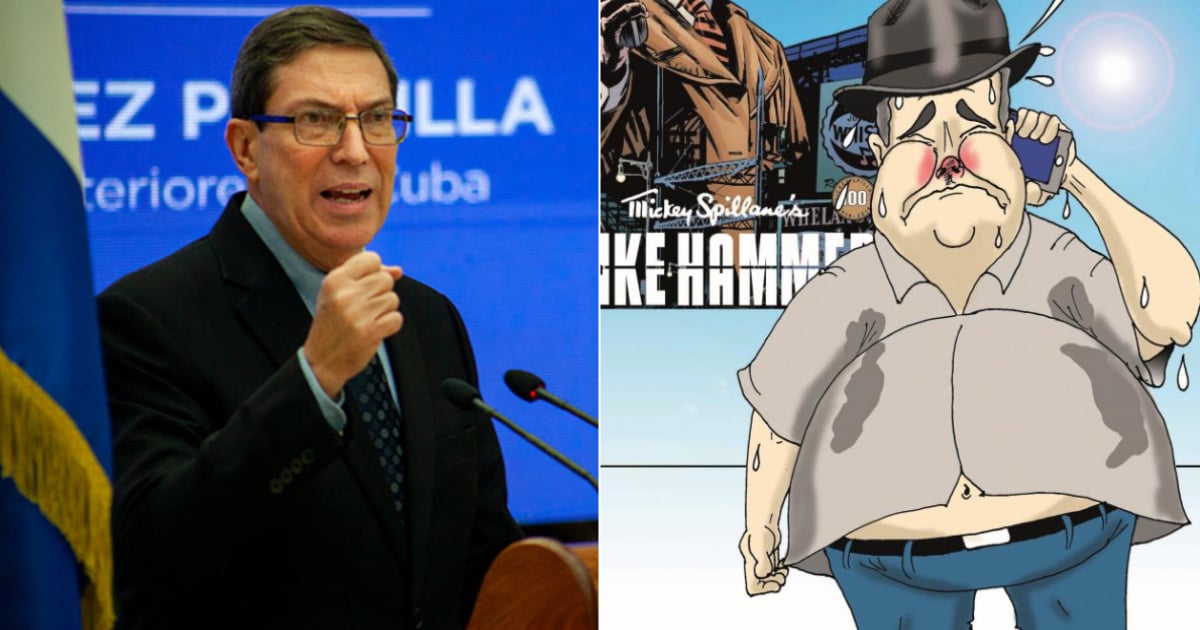
The Cuban regime once again expressed its discomfort with the presence of the Chargé d'Affaires of the United States in Havana, Mike Hammer, this time resorting to a political cartoon in the pages of Granma, the official organ of the Communist Party.
In an article titled "Hammer in the Wrong Novel," the government resorted to the old tactic of comparing the American diplomat to the fictional character of the same name—created by the novelist Mickey Spillane—in order to discredit him without any solid legal or diplomatic arguments.
The strategy reveals more than it intends to hide. Instead of responding with diplomatic language or appealing to formal mechanisms of International Law — such as the possibility of declaring "persona non grata" for a foreign official if they indeed violate the Vienna Convention — the Cuban authorities choose media discrediting, veiled threats, and an inquisitorial tone that seeks to intimidate both the diplomat and the sectors of civil society that have met with him.
Since his arrival in Havana, Hammer has held meetings with independent actors, religious figures, and human rights defenders. He has also visited iconic sites such as the Sanctuary of El Cobre.
These actions, which are normal within the practice of international diplomacy and consistent with the rights recognized in the Vienna Convention—which prohibits interference but not contact with civil society—have been interpreted by the regime as acts of provocation.
Instead of utilizing the appropriate diplomatic channel, the Cuban government has chosen a campaign of discredit. The article from Granma, rather than being a political critique, is a piece of propaganda that employs sarcasm to blur Hammer's image and depict him as an emissary of dark conspiracies.
But if the diplomat has committed, as they claim, any serious offense, why hasn’t he been expelled? The answer is simple: the Cuban regime does not want, nor can it afford, to bear the political cost of directly confronting Washington.
The regime's hostility has extended even to the graphic realm, with a cartoon published in Granma depicting Hammer as a grotesque and ridiculous version of the namesake detective from Spillane's novels.
Sweaty, clumsy, and with a bewildered expression, the caricatured character exclaims, "I don't think I can pull off the role!" This visual mockery, far from being humorous, is an attempt to dehumanize the diplomat and reinforce a infantilized narrative of the confrontation, which sidesteps the political substance of the matter: the growing international interest in the situation of human rights and fundamental freedoms in Cuba.
Meanwhile, Hammer continues his agenda, which includes meetings with opponents, members of the religious community, and activists, in an exercise of direct diplomacy that breaks with the usual opacity in relations between the United States and Cuba.
His style, transparent and focused on fundamental rights, contrasts with the closed narrative of the establishment, which views any external contact as an existential threat.
It is evident that Hammer has awakened not only the animosity of the regime, but also a palpable fear. A fear that his presence, instead of artificially destabilizing, makes visible a Cuba that the official narrative insists on hiding: plural, critical, and weary of old dogmas. That’s why they monitor him, harass him, and caricature him. But they do not confront him with actions or with justice.
In a repressive environment where independent voices are criminalized, Hammer takes on a symbolism that goes beyond his position. He represents a way of conducting foreign policy that listens, observes, and reports. And that, for a regime that fears scrutiny, is intolerable.
The paradox is that, in trying to ridicule him, they place him at the center of a narrative that they themselves have lost control over. The article from Granma fails to discredit Hammer. On the contrary, it reinforces his image as an uncomfortable but necessary interlocutor in a Cuba that demands dialogue, truth, and future.
What the Vienna Convention states and what the Cuban regime prefers not to say
The response of the Cuban regime to Hammer's public agenda has focused on a self-serving interpretation of Article 41 of the Vienna Convention on Diplomatic Relations (1961).
In that international treaty, signed by Cuba and governing the basic norms of diplomacy between states, it is indeed established that diplomats must "respect the laws and regulations of the host state" and are obligated "not to interfere in the internal affairs of that state."
Nevertheless, the use of this article as an argument against Hammer's activity is profoundly manipulative and deliberately ignores the context, the spirit, and the international practice of Diplomatic Law.
The Convention itself establishes in its Article 3 that one of the essential functions of a diplomatic mission is to "gather information, by all lawful means, about the conditions and developments occurring in the host State and to inform the Government of the accrediting State accordingly."
In other words, diplomats not only can but must maintain contacts with civil society actors, with religious leaders, with representatives of local communities, and even with critical sectors of the government, as long as they do not incite violence or directly interfere in governmental affairs.
In Hammer's case, there is no evidence — nor has the Cuban government provided any — that he has violated Cuban law, called for demonstrations, financed political activities, or promoted civil disobedience. His meetings with citizens, dissidents, human rights defenders, and members of the clergy are part of the normal exercise of his diplomatic duties.
If there were truly a violation of the Convention, the Cuban government would have the option to declare the diplomat "persona non grata", as outlined in Article 9 of the treaty. However, it has not done so. It prefers propaganda noise over legal confrontation.
The underlying question is why the Cuban regime fears this supposed "interference" so much. And the answer has to do with its own political nature.
Cuba is not a democratic state. The laws that it demands to be respected have not been discussed or approved by a freely elected parliament, and the structures of power adhere to a single-party system, where the citizen does not have a real option for alternation.
In that context, "non-interference in internal affairs" becomes a shield to protect systematic practices of repression, political persecution, censorship, ideological exclusion, and human rights violations.
Invoking legality to protect a regime that jails peaceful opponents, represses civic demonstrations, restricts free association, criminalizes independent journalism, and blocks the entry and exit of its own citizens from the country is a legal and moral paradox.
International standards were not designed to shield totalitarian systems from scrutiny. On the contrary, their very essence is to protect individuals and nations against abuses of power.
For this reason, Article 41 of the Vienna Convention cannot be read in isolation nor become a tool to silence diplomacy. Respect for the laws of the host country is valid to the extent that those laws align with international standards of legality, proportionality, and human rights.
By developing a public and transparent agenda, in contact with sectors that the regime seeks to render invisible, Hammer fulfills his diplomatic duty. The Cuban regime, by not tolerating these meetings, reveals that its fear is not of a supposed violation of sovereignty, but rather the visibility of its own illegitimacy.
It's not about interference, but rather about presence. And for a power that relies on isolation to sustain itself, any critical presence—even from an embassy—is perceived as a threat.
That's why the campaign of cartoons, inquisitorial speeches, and ad hominem attacks against Hammer. Because they cannot respond to him with reason, let alone legitimacy.
Filed under: