
Related videos:
Construction has begun on a new and controversial detention center for undocumented immigrants in the state of Florida.
Unofficially dubbed "Alligator Alcatraz", the project has been advocated by Attorney General James Uthmeier and Governor Ron DeSantis, who present it as a significant advancement in state immigration policy.
The center, located in a remote area of the Everglades, is being built over the Dade-Collier Training and Transition Airport, an almost abandoned airfield, and will have the capacity to accommodate up to 5,000 migrants with criminal backgrounds.
The name "Alligator Alcatraz" refers to the site's isolated location, surrounded by alligators and other wildlife that would serve as a natural security barrier.
“If someone escapes, they will find little more than alligators and pythons. There is nowhere to go and nowhere to hide,” declared Attorney General Uthmeier.
Temporary facilities and military surveillance
The design of the center includes reinforced tents capable of withstanding the extreme weather of South Florida in summer.
No concrete walls or permanent structures have been planned, thanks to the apparent advantage that the wild terrain offers in deterring any escape attempts.
The site, covering approximately 78 square kilometers, will have military support, particularly from the Florida National Guard.
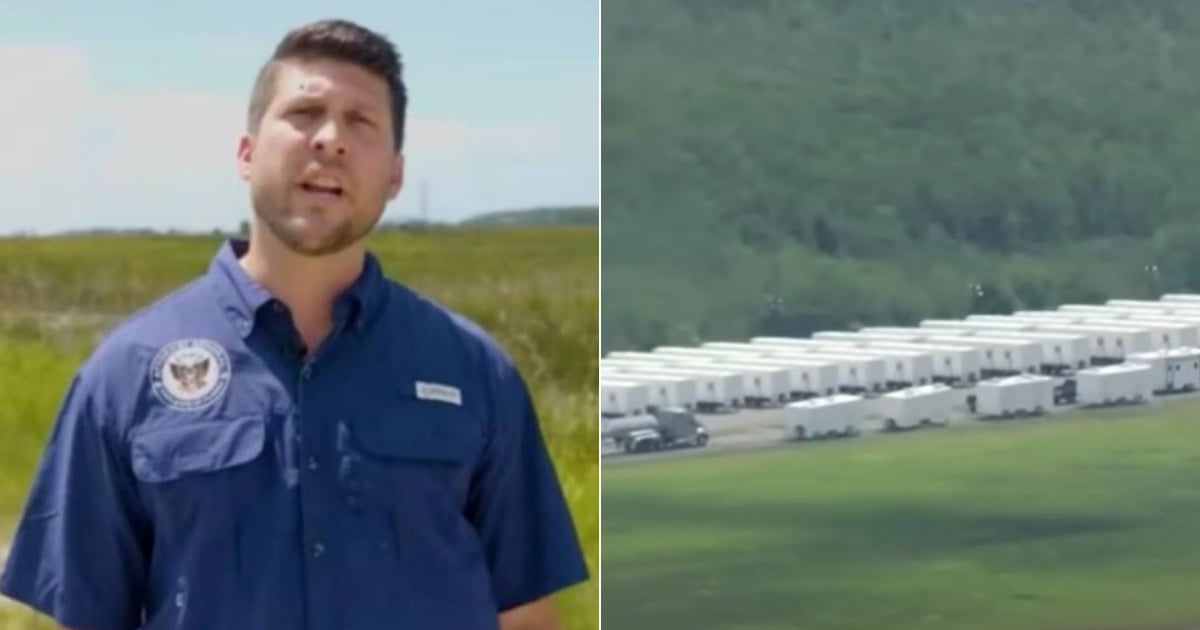
The first signs of construction were recorded by Telemundo 51, which reported movement of machinery and small mobile units in the area of the old airport.
State authorities project that the center will be operational at the beginning of July, with an initial capacity of at least 1,000 detainees and a gradual expansion thereafter.
A construction without consensus
The speed of the projects has raised alarms among local authorities, environmental leaders, and indigenous communities.
Daniella Levine Cava, the mayor of Miami-Dade, expressed her concern about the ecological impact of the project and the lack of transparency in the land acquisition process.
In an official letter, it was warned: “Due to the location of this land in a critical area, its transfer requires thorough review and due process before taking any action that may have significant long-term consequences for our community.”
Levine Cava also reported that the state of Florida offered only 20 million dollars for the property, while its most recent appraisal exceeds 190 million.
"We request a thorough review of the impact on our environment. We have not received a response," he commented after a recent event, indicating that the works began without formal approval from the county.
Use of emergency powers
Through a letter sent on Monday, Kevin Guthrie, director of the Florida Division of Emergency Management, invoked emergency powers established during the Biden administration to justify the occupation of the land.
"Time is of the essence. We must act quickly to ensure the preparedness and continuity of our state operations to assist the federal government with the enforcement of immigration law," he added, in statements reported by local media.
Although the state claims to be open to negotiating the purchase, the property has already been intervened by the DeSantis administration under executive orders.
This unilateral measure has created increasing tension between the state government and the authorities of Miami-Dade.
Federal support and national vision
The Department of Homeland Security (DHS) has approved the project and praised the cooperation with Florida.
On its official account, the DHS stated that it is working “on cost-effective and innovative ways to fulfill the mandate of the American people to carry out mass deportations,” highlighting the efficiency of the proposed center in the Everglades.
The spokesperson for DHS, Tricia McLaughlin, stated: "Alligator Alcatraz will expand the facilities and available space in just a few days thanks to the collaboration with Florida.”
For his part, Uthmeier reaffirmed his alignment with federal immigration policies, stating: "I am proud to support President Trump and Secretary Noem in their mission to finally solve our illegal immigration problem once and for all.”
A center funded by FEMA with controversial objectives
The estimated operating cost of the center will exceed 450 million dollars annually, an expense that, according to reports from the New York Times, may be partially reimbursed by the Federal Emergency Management Agency (FEMA).
The funds used come from programs established to support organizations that assist migrants, although some of this funding has been the subject of controversy and litigation, particularly due to its withdrawal in cities like New York.
Ecological and human rights concerns
Environmental leaders and Indigenous communities have reacted strongly.
The organization Friends of the Everglades publicly condemned: "This site is a multigenerational home for the Indigenous peoples of Florida, and it is not the home of a harmful and unnecessary prison."
Curtis Osceola, an advisor to the Miccosukee tribe, also expressed that the tribe was interested in conserving that land and participating in an environmental restoration project: "It will be vital for us to restore those lands and the flow of water."
In addition to the criticisms of the immigration plan itself, construction in this region -considered ecologically sensitive- could cause irreversible damage to the ecosystem of the Everglades, one of the most important natural reserves in the United States.
A state policy aligned with Trump
Florida has positioned itself as a leading state in the implementation of the immigration policy promoted by the Trump administration.
Governor DeSantis has promoted regulations that require all 67 counties to cooperate with ICE, and has proposed that the Highway Patrol participate in immigration raids.
The detention center "Alligator Alcatraz" is part of this broader offensive.
Despite Mayor Levine Cava's acknowledgment of the importance of border control and the necessity for immigrants with criminal records to face justice, she has emphasized that acting swiftly is not enough: a legal, environmental, and moral review of any measure of this magnitude is required.
While Florida authorities are moving swiftly to ensure that the first beds are occupied by July 1, opposition from local leaders and environmental advocates threatens to turn this project into a legal, political, and social battleground.
Frequently Asked Questions about the "Alligator Alcatraz" detention center in Florida
What is "Alligator Alcatraz" and why is it being built in Florida?
"Alligator Alcatraz" is a new detention center for undocumented immigrants in Florida, driven by Attorney General James Uthmeier and Governor Ron DeSantis. It is located in the Everglades and surrounded by wildlife, which serves as a natural security barrier. This project is part of a state immigration policy aligned with the Trump administration, aimed at detaining and deporting immigrants with criminal records.
Why is the construction of "Alligator Alcatraz" controversial?
The construction of "Alligator Alcatraz" has sparked controversy due to its ecological and humanitarian implications. Environmental leaders and indigenous communities have voiced concerns about the environmental impact on the Everglades, an ecologically sensitive area. Furthermore, human rights advocates criticize the dehumanization and criminalization of immigrants by using a wild setting as a deterrent tool.
How will the "Alligator Alcatraz" detention center be funded?
The operational cost of the detention center "Alligator Alcatraz" is estimated to exceed 450 million dollars annually. The Federal Emergency Management Agency (FEMA) will reimburse part of these costs. The funds come from programs aimed at supporting organizations that assist migrants, although this funding has been controversial.
What measures have the local authorities taken regarding "Alligator Alcatraz"?
Local authorities, particularly in Miami-Dade County, have expressed their concerns regarding the project. Mayor Daniella Levine Cava has requested a thorough review of the environmental and social impact before proceeding with the land use. The state of Florida has proposed paying 20 million dollars for the land, even though its assessed value exceeds 190 million, which has caused tensions between the state government and local authorities.
Filed under: