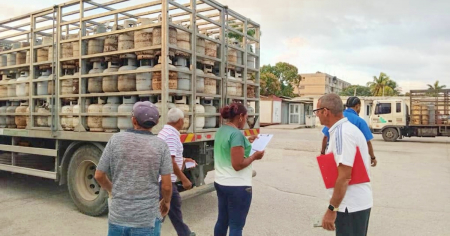
The testimony of a young Cuban mother living in Matanzas has gone viral on TikTok after she shared, with a mix of relief and pride, that she was able to buy liquefied gas for the first time in three months. “After 3 months, I finally managed to buy gas,” she wrote in the video posted by the user @briana_matancera, which has garnered thousands of views and reactions.
In the video, the woman shows how she had to carry her gas cylinder alone to the sales point, wait in a long line with ticket number 1046, and finally return home to dust off her old stove and use the gas to make a fresh pot of coffee. She also took the opportunity to visit her grandparents, who were eager to see her son. "Women are warriors, and we can handle anything," she stated.
The account has generated a wave of supportive and admiring comments. “God chose his best warriors to be Cuban,” wrote one user. Others, from countries like Mexico, Chile, and Venezuela, expressed their astonishment at the situation and shared comparisons about the ease of access to gas in their regions. “Here, we just call and they bring it to our doorstep,” said a follower from Guatemala.
This case is not isolated. In recent weeks, Santiago de Cuba suspended the distribution of liquefied gas, contradicting official promises of guaranteed coverage. The measure left thousands of people without options for cooking, amidst power outages, food shortages, and structural precariousness.
Furthermore, the use of digital applications like Transfermóvil has been introduced as a solution, although it excludes those who cannot access the internet or do not have compatible devices. The dollarization of digital access further exacerbates the social divide.
On the other hand, the Attorney General is investigating networks involved in the theft and illegal resale of gas cylinders in several provinces, where black market prices reach up to 30,000 Cuban pesos per full cylinder, highlighting the severity of the crisis.
Testimonies like Briana Matancera's have become a spontaneous channel to highlight the precarious conditions in which millions of Cubans live. As she herself said in another earlier video: “That’s why you’ll see many Cubans cooking with charcoal, because there’s never any electricity and getting gas is an odyssey.”
In places like Isla de la Juventud, gas has been rationed only for bedridden individuals or those undergoing hemodialysis, while in Villa Clara the distribution was halted due to a technical stoppage at the processing plant.
The liquefied gas crisis in Cuba, which has persisted since late 2024, still lacks a structural solution. Amid blackouts, inflation, and shortages, the population is forced to normalize what should be exceptional: surviving without the most basic necessities.
Frequently Asked Questions about the Gas Crisis in Cuba
Why is it so difficult to obtain liquefied gas in Cuba?
The shortage of liquefied gas in Cuba is due to failures in the distribution system and the country's financial problems. The lack of funding has prevented ships loaded with gas from unloading their supplies, causing a chronic shortage. Additionally, the complicated regulations for acquiring gas, such as the use of digital applications that are not accessible to everyone, worsen the situation.
What alternatives do Cubans have in the face of the gas shortage?
Despite the lack of gas, many Cubans turn to using charcoal or firewood for cooking, even though these methods are less efficient and more polluting. These alternatives have become common in homes that cannot access liquefied gas due to shortages and long lines to obtain it.
How does the gas crisis affect daily life in Cuba?
The gas crisis in Cuba significantly impacts daily life, making it difficult to cook food and forcing families to seek alternative methods such as using charcoal, which increases the time and effort required to prepare meals. This adds to other issues, such as power outages and food shortages, creating an environment of constant precariousness.
What measures is the Cuban government taking to address the gas shortage?
The Cuban government has promised to gather the necessary resources to pay for gas supplies, but international restrictions and a lack of financing complicate the resolution of the problem. No effective structural solutions have been implemented, and the situation remains critical, with promises not translating into constant and sufficient access to liquefied gas for the population.
Filed under: