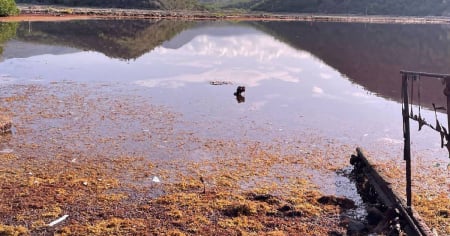
A historic record in the accumulation of sargassum in the Caribbean Sea, the western and eastern Atlantic, and the Gulf of Mexico has raised alarms in the region and is directly affecting several coastal areas, including regions in Cuba.
According to a report from the Optical Oceanography Laboratory at the University of South Florida, cited by the AP, in May 2025, 38 million metric tons of sargassum were recorded, the highest amount documented since studies on the Atlantic's Great Sargassum Belt began in 2011.
The previous record of 22 million tons was reached in June 2022, the news agency specified.
The current accumulation has already led to temporary closures of schools in the French Caribbean, citizen protests on islands like St. Maarten due to odors and pollution, and special operations with heavy machinery in tourist areas.
In the island Caribbean, hotels have had to bear the cleaning costs, while in places like the Dominican Republic, barriers have been installed to contain the spread of the algae.
The impact also extends to marine ecosystems: sargassum blocks sunlight, suffocates reefs and seagrass beds, and when it reaches the shore, it kills the organisms it carries. It also releases toxic gases like hydrogen sulfide and ammonia that affect human health.
In Cuba, the phenomenon has hit the eastern part of the country particularly hard, especially in the province of Guantánamo. According to the newspaper Venceremos, in the Baitiquirí Bay —one of the most affected areas— hundreds of decomposing macroalgae are generating foul odors and have caused discomforts such as headaches and nausea among the local population.
Local authorities have held public hearings and are conducting active investigations in the nearby communities.
Iroel Cantillo Cartaya, a specialist from the Ministry of Science, Technology, and Environment (CITMA) in San Antonio del Sur, explained that the phenomenon is linked to climate change, which has raised sea temperatures and altered ocean currents, facilitating the proliferation of sargassum.
Although it is expected that accumulations will decrease starting in July, the CITMA acknowledged that there are no technical resources available to remove the large concentrations in areas like Baitiquirí, where intervention is unfeasible due to its magnitude.
In other Guantanamo beaches such as Sabanalamar, El Guanal, Los Siguatos, and Yateritas, partial cleanups are indeed planned before summer. However, managing the sargassum remains a challenge at the municipal level due to a lack of technology for its proper disposal or utilization.
Authorities recommend not bathing or walking in areas with a high concentration of algae, avoiding direct contact, not consuming fish caught near these hotspots, and using a face mask as a protective measure against the gases.
In Cuba, the Civil Defense has already classified sargassum as a potential risk within its Directive 1 for disaster reduction, due to its complexity and its impact on public health, the local economy, and the coastal environment.
Filed under: