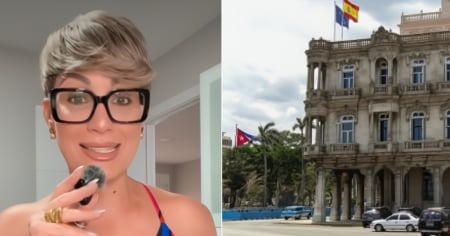
Mario Dueñas, an administrative manager and expert in immigration procedures in Spain, explained this Wednesday on CiberCuba that "half of the people who contact his office in Galicia (Equipo Dueñas) are from the United States."
This is due, in their opinion, to the intense migration pressure that many Cubans with I-220A and I-220B are currently experiencing, and in light of the uncertainty, they view emigrating to Spain positively.
"It is increasing significantly. Half of the people contacting us today are from the United States, and many are seeking Spanish nationality. Similarly, many also want to return to Spain or come to Spain for the first time," said Dueñas.
"The demand from people wanting to apply for citizenship at Spanish consulates in the United States is enormous, at least with us. We are contacted daily. It often happens that the young people are in the United States while the parents, who are older, are in Spain."
"Parents are also contacting us, telling us: 'I have my child who is in the United States, and things have gotten a bit difficult for him. I want him to obtain Spanish citizenship as soon as possible, before October,' she added."
In an interview given to this platform, the Camagüey manager clarified that the deadline to apply for the Law of Democratic Memory, commonly referred to among Cubans as the Law of Grandchildren, ends in October. However, anyone who obtains the relevant consular credential from Spain, in accordance with the address listed on their driver's license in the case of the United States, remains within the process to acquire their grandparent's nationality.
The problem lies in the fact that with three months left until the deadline, the Spanish Consulate in Havana has stopped sending the acknowledgment of receipt to applicants for Spanish nationality, certifying that their application has been registered. This creates uncertainty, as those affected do not know whether the Consulate received their email or not.
"Where is the concern today at the Consulate in Havana? For some time now, there has been no acknowledgment of receipt. Because until recently, one would send everything and receive an acknowledgment that stated, we have received your documents, and you will receive your credentials in due course. However, it has been several days since that acknowledgment has arrived. Why? We don’t know, but it hasn’t come," said the expert, who has his own office in Ourense (Galicia).
Among the questions that were most frequently asked during this Wednesday's program was the case of great-grandchildren, who inquire whether they can aspire to Spanish nationality. Mario Dueñas answered that they can, as long as the other family members from the preceding generations have passed away.
“At the Consulate of Havana, they are accepting individuals applying for nationality like great-granddaughters, provided that all direct ancestors are deceased. In other words, if you are the only one left and you are a great-granddaughter, they will accept it,” the expert noted.
"For example, I had a consultation with a client who is a great-grandson, and his mother is the granddaughter. She is alive. The issue is that the mother is not in the best physical health, and he wanted to bypass her. In other words, he wanted to be considered a grandson without his mother opting in as a granddaughter. I told him, no, you can't do that; your mother must necessarily opt in as a granddaughter. Then, you can opt in as the son of a granddaughter once your mother's application has been approved."
This means that the son of a grandson of Spaniards, who obtains Spanish nationality, can be naturalized as the child of a Spaniard of origin. Additionally, Mario Dueñas clarified that the new Immigration Regulation, which recently came into force in Spain, allows the children of naturalized Spaniards (that is, Spaniards by origin) to obtain a visa to travel to Spain and enter the country with a residence permit.
Regarding the cost of procedures in Cuba (legalization of documents), it was mentioned that it costs about 2,250 Cuban pesos and takes an average of four months. It should be noted that there are only three months left until the deadline to apply under the Grandchildren's Law closes.
Filed under: