As Cuba endures one of the worst crises in its recent history—marked by blackouts lasting over 24 hours, food shortages, lack of medications, a collapse of public transportation, and a widespread deterioration of the quality of life—the regime insists that the only possible way forward is the same system that has driven the country to the brink.
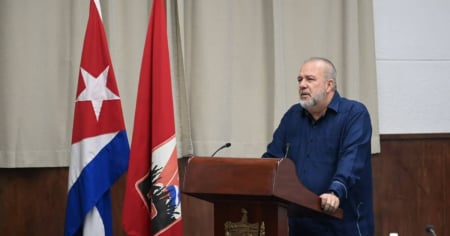
This Friday, the X Plenary of the Central Committee of the Communist Party of Cuba (PCC) began in Havana, led by Miguel Díaz-Canel.
On social media, the president affirmed that issues affecting the people were being debated "with critical sense," and that the party's task is to "analyze, define actions, and encourage the participation of all."
However, far from proposing a change in direction, the leaders of the regime reaffirmed their loyalty to socialism as the only possible path.
Roberto Morales Ojeda, a member of the Political Bureau of the PCC, acknowledged at the meeting that the country is going through "one of the most complex stages in its history" and described the current circumstances as "harsh," marked by "scarcity, limitations, and discouragement."
Still, he reaffirmed that "socialism is the way" and that the Communist Party is "the force and compass" towards collective well-being.
This speech contradicts the reality faced by millions of Cubans: endless power outages, hospitals lacking supplies, a collapsed public transport system, miserable wages, and an inflation that devours any income.
Each year, the regime is less capable of guaranteeing the basics: neither food, nor medicine, nor basic services. However, the political apparatus continues to bet on ideological inertia.
The plenary meeting was also marked by a strong symbolic weight. Historical figures such as Ramiro Valdés Menéndez and José Ramón Machado Ventura were present, representing the continuity of a model that has promised a socialist paradise for over six decades but has never arrived.
Meanwhile, the current Constitution states that this model is "irrevocable" and enshrines the Communist Party as the only possible political force, eliminating any alternatives.
Paradoxically, days earlier, an academic from the system itself acknowledged on state television that "Cuba is not a socialist country", but rather "in the process of building" that model.
Silvia Odriozola Guitart, Dean of the Faculty of Economics at the University of Havana, stated that it is necessary to "rescue" Lenin and that the Cuban socialist economy is "a science in construction."
These statements, far from providing solutions, reinforce the narrative that every failure is part of an eternal, unfinished experiment, used by the regime to justify its continued hold on power.
In a context of national emergency and growing social desperation, the regime continues to offer more Marxism as a response to the collapse.
And while the Party meets in air-conditioned halls to talk about "resistance" and "dignity," the people await light, bread, medicine, and transportation. Not slogans.
Frequently asked questions about the crisis in Cuba and the regime's stance
What is the current situation in Cuba and how does the regime describe it?
Cuba is facing one of the worst crises in its recent history, characterized by power outages lasting more than 24 hours, food shortages, lack of medications, and a widespread collapse of public transportation. However, the Cuban regime insists that socialism is the only possible path, despite the fact that these conditions have worsened under its management. During the X Plenary of the Central Committee of the Communist Party of Cuba, the seriousness of the situation was acknowledged, but loyalty to socialism as the only way forward was reaffirmed.
What measures is the Cuban government taking to address the energy crisis?
The Cuban government has announced a three-year energy recovery plan that includes investments in renewable energies and the repair of plants. However, the solutions are long-term and no clear details have been provided on how they will be implemented. Meanwhile, prolonged blackouts continue to affect millions of Cubans.
How does the Cuban regime justify the current economic problems?
The Cuban regime attributes a significant portion of the economic problems to the U.S. embargo, as well as to external factors like climate change and the pandemic. However, critics like economist Pedro Monreal point out that internal causes, such as poor management and the centralized economic model, are the main culprits behind the crisis. The government has avoided accepting specific responsibilities for these issues.
What is the response of the Cuban people to the crisis and the government's statements?
The Cuban population is facing the crisis with desperation and frustration, and the government's response, which insists on ideological immobility, has generated skepticism and discontent. The government's statements are perceived as empty and disconnected from the reality that Cubans live every day. On social media, citizens criticize unfulfilled promises and demand real solutions to their problems.
Filed under: