
Related videos:
The Cuban government has once again activated its anti-American rhetoric following the release of a new Presidential Memorandum on National Security by President Donald Trump, which strengthens the embargo policy and further restricts economic and travel relations with the Island.
In a statement from the Ministry of Foreign Affairs (MINREX), the Castro regime responded with a speech that aims to reaffirm the notion that "Cuba is a peaceful, stable, and supportive country," even as it plunges into one of the worst crises in its history.
But the claim of stability issued by Havana in its official statement contrasts sharply with the harsh reality faced by millions of Cubans daily: power outages lasting over 24 hours, chronic shortages of food and medicine, collapse of the water system, deterioration of public transport, rampant inflation, and an unprecedented mass emigration.
The MINREX statement: victimhood and propaganda
In the text, MINREX "categorically" rejects the new presidential memorandum signed by Trump on June 30, which it describes as a "re-edition" of the document issued in 2017 during his first term.
The Cuban government accuses Washington of attempting to "break the political will of the entire nation" and of promoting an economic blockade with the aim of "taking over the country and controlling its destiny."
The regime denounces that these measures are based on pretexts such as human rights, democracy, or religious freedom, and labels them as hypocritical.
"It is an abusive, transgressive, and illegal conduct," says the statement. Furthermore, it claims that the sanctions aim to destroy Cuban socialism and convert the economy to capitalism.
But while Havana presents itself to the world as a victim of "imperialist aggression," the truth is that the economic and social collapse of Cuba primarily stems from the ineptitude and paralysis of the government, not from the embargo.
Private enterprises can barely operate due to bureaucratic suffocation, remittances from abroad must go through state channels that keep a portion of the money, and productive sectors are controlled by military conglomerates like GAESA, which oversees everything from tourism to imports.
Nonetheless, the text insists on portraying Cuba as a "sovereign nation" that built its project "in full exercise of its rights," while ignoring the repressed protests, the hundreds of political prisoners, and the growing popular discontent that increasingly manifests online and in the constant exodus of young people.
The Trump memorandum: suffocating the repressive apparatus
The new National Security Presidential Memorandum (NSPM-5) issued by Trump restores and strengthens the harshest measures adopted during his first term.
Specifically, the document:
It prohibits all financial transactions with companies controlled by the Cuban Armed Forces, especially GAESA, the regime's economic arm.
It prohibits U.S. tourism to the Island and imposes audits and detailed records to ensure compliance.
Reaffirms the current economic embargo and commits to opposing any attempt to repeal it in international forums.
Eliminate incentives for illegal migration by maintaining the repeal of the "Wet foot, dry foot" policy.
He orders the preparation of reports on human rights, arbitrary detentions, and repression of civil society.
Promotes free access to the Internet, freedom of the press, and support for non-state private enterprise.
The narrative of the Cuban government tries to portray this memorandum as an attack against the entire population, but the focus of the document clearly aims to dismantle the repressive apparatus and the economic-military elite that supports it.
Trump's strategy is based on a fundamental principle: any economic relief that strengthens the military or the intelligence services of the regime - and not civil society - reinforces the dictatorship, rather than helping the people.
Official reactions: victimhood without self-criticism
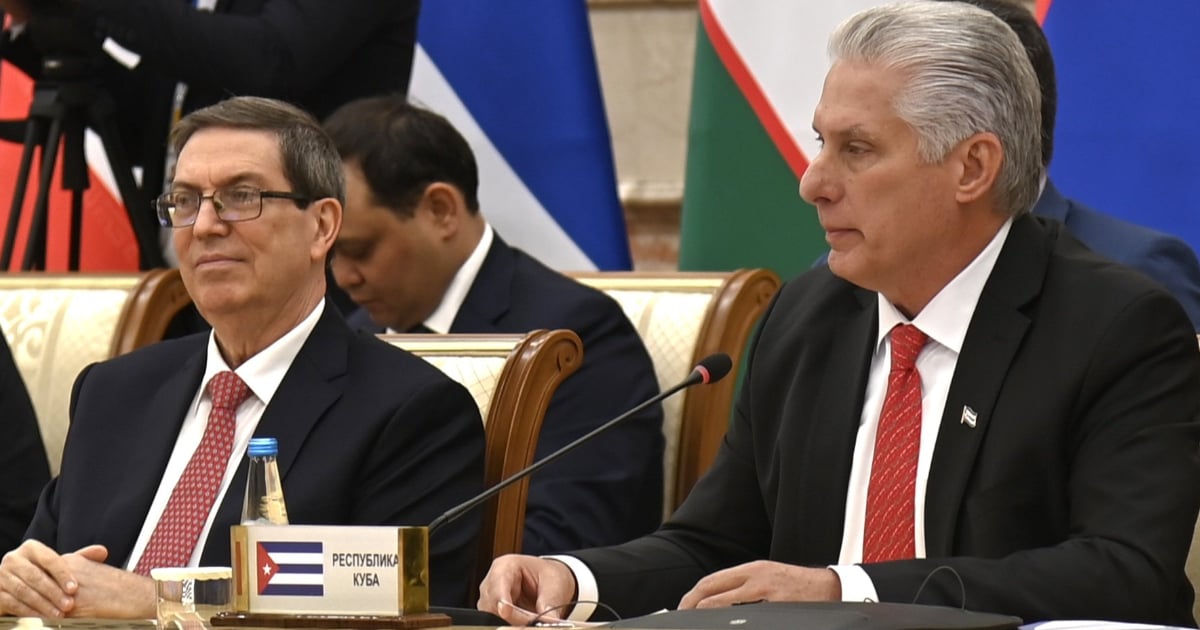
Before the official statement from MINREX was published, Chancellor Bruno Rodríguez Parrilla described the memorandum as "criminal behavior" and a "violation of human rights" that hinders the country's development.
On his X account, he blamed the embargo for "punishing the entire Cuban people."
For his part, Miguel Díaz-Canel stated that "the impact will be felt, but they will not bend us", in a tone that aimed for firmness but clearly reflected concern over what this new external pressure represents.
Díaz-Canel did not mention that while he talks about "resistance," the people can no longer endure: hospitals are out of basic medications, blackouts leave entire cities without electricity, and the average salary is not enough to buy a liter of oil.
It also does not acknowledge that the true "blockade" suffocating the Island is internal: that of a system that prohibits freedom of association, independent press, political parties, full private property, and alternation in power.
The message from MINREX attempts to project an image of cohesion and strength, but in reality, it is a smokescreen to conceal the deep internal decay of the regime.
The only businesses that continue to invest in Cuba are those willing to navigate an environment dominated by corruption, legal risk, and uncertainty, which seriously limits any possibility of sustainable development.
Meanwhile, the regime responds to the sanctions with the same script from decades ago, failing to offer a single concrete solution to improve the lives of Cubans. In the name of "sovereignty," they keep the country in ruins.
And so, amid blackouts, repression, and empty speeches, the government insists that "Cuba is a stable country."
Frequently Asked Questions about Trump's Presidential Memorandum and its Impact on Cuba
What does the new Presidential Memorandum on National Security signed by Trump establish?
The new National Security Presidential Memorandum (NSPM-5) signed by Trump strengthens embargo measures and prohibits financial transactions with companies controlled by the Cuban Armed Forces. Additionally, it prohibits American tourism to Cuba, reaffirms the economic embargo, and promotes free access to the Internet and freedom of the press on the island.
How has the Cuban government responded to these new sanctions?
The Cuban government has described Trump's measures as "abusive, transgressive, and illegal behavior," accusing the United States of attempting to undermine the political will of the Cuban nation. The Castro regime maintains its victimization rhetoric, blaming the U.S. embargo for its internal problems.
What is the real impact of these measures on the Cuban population?
The measures are designed to weaken the repressive apparatus of the Cuban regime, not to harm the general population. However, the restriction of remittances and the prohibition of transactions with military entities may have indirect effects on the Cuban economy, impacting those who rely on these remittances to meet their basic needs.
What does the United States seek with this policy towards Cuba?
The United States seeks to pressure the Cuban regime to implement political and economic reforms that promote freedom and human rights on the island. The goal is to support the Cuban people in their struggle against repression and to encourage a transition to a democratic and free system.
Filed under: