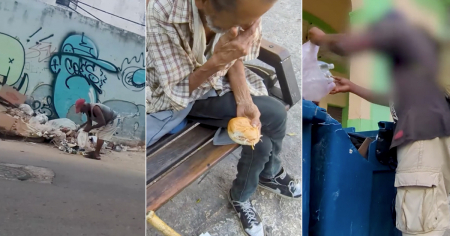
The scarcity in Santiago de Cuba strongly impacts the tables of thousands of families. In the first days of July, flour for regulated bread has only been distributed on two occasions, and officials admit that the supply depends on shipments from Havana that do not arrive regularly. The result is a “forced rotation” among municipalities, where bread is delivered only when there is something to bake.
“When flour arrives, we have to rush to cover one municipality, then another. And that’s how we are,” acknowledged Edelva Marín Medina, coordinator of programs and objectives for the provincial government, during a recent meeting with the local press.
The lack of bread is just one of the symptoms of a broader crisis. Children aged 0 to 13 years and pregnant women are being given one pound of "extended ground beef", a meat formula that often contains a high proportion of soy or other additives to "stretch" the product.
For the general population, the upcoming distribution of one pound of chicken per capita was announced, along with two pounds for pregnant women and individuals with medical diets, in an effort to cushion the impact of the shortage.
With this situation, the seven pounds of rice for the month of April are still being completed, of which only five have been delivered, and the remaining two started arriving this week. Next, the delivery of the three pounds of rice for the month of May is expected to begin, indicating a two-month backlog for an essential food item.
Regarding sugar, its distribution has been partial, and only a few municipalities, such as Santiago de Cuba, Palma Soriano, and Contramaestre, have received part of the product. The rest are waiting for the arrival of raw sugar to begin distribution.
Pregnant women and children with chronic illnesses are also receiving the so-called "games" from the Maternal and Child Care Program (PAMI), but access is uneven and depends on the intermittent availability of supplies.
Milk, another critical product for childhood, also presents a fragmented situation. 20 days of milk have been delivered to the zero-year age group and only 10 days to the two to six-year age group. Meanwhile, children aged one to two are still not receiving the product, although authorities assure that it is “in transit.”
The picture painted by the authorities in Santiago de Cuba reflects a food management system that delivers supplies sporadically, where basic products are distributed weeks late, in insufficient quantities, and often with substitutes of low nutritional value.
The reality is clear: in the midst of a country immersed in one of its worst economic crises, the people of Santiago, like those across Cuba, line up for bread that does not exist, wait weeks for a pound of rice, and receive “extended ground beef” as their only source of meat. Meanwhile, the promises are repeated: “when the ship arrives,” “when the sugar arrives,” “when the flour appears.”
But for many families, what runs out is not just bread or rice. It's patience.
Frequently Asked Questions about Food Shortages in Santiago de Cuba
Why is there a shortage of bread in Santiago de Cuba?
The shortage of bread in Santiago de Cuba is due to the lack of wheat flour, as the local mill is shut down due to a lack of raw material, and the supply relies on sporadic shipments from Havana. This situation has led to the implementation of a rotating distribution system that struggles to meet the demand.
What measures has the government taken to address the scarcity in Santiago de Cuba?
The government has implemented a rotating distribution system for bread and has announced the delivery of products such as extended ground beef and chicken for certain vulnerable groups. The measures have not been sufficient to resolve the food crisis, and the distribution of basic goods continues to face significant delays.
What is the "extended picadillo" that is being distributed in Santiago de Cuba?
"Extended picadillo" is a meat mixture that includes a high percentage of soy or other additives to stretch the product. This type of picadillo is being distributed to children and pregnant women as part of measures to address food shortages in the region.
How does the food shortage affect the population of Santiago de Cuba?
The food shortage in Santiago de Cuba is severely affecting the population. Families are facing long lines and weeks of waiting to obtain basic products such as bread and rice. Furthermore, the quality and quantity of the available food are insufficient, leading to a growing social unrest.
Filed under: