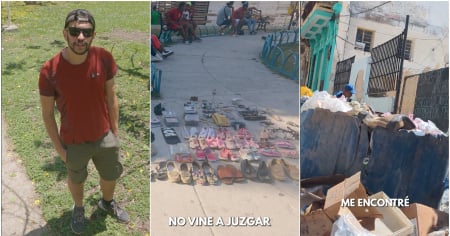
The Spanish youtuber José María Pastor, known as Topeados de viaje, has published new videos on TikTok from his trip to Cuba, where he continues to showcase scenes of hunger, blackouts, and despair in the daily lives of Cubans.
While sharing the first excerpt, @topeadosdeviaje wrote: “When I arrived in Cuba, I thought the most valuable thing would be the landscapes… But I discovered that what is truly valuable are the stories. Some ask for food. Others shout in silence. Some blame the system, others the 'blockade.' But all… are hungry. This is the voice of a people who survive amidst blackouts and hope.”
In the video, her voice accompanies images of dilapidated streets, elderly people, and children, as she states: "On every corner, someone has something to tell. Some ask for food, others cry out silently. Some blame the system, others the infamous blockade, but in the end, regardless of their opinions, they are hungry. This voice represents a people who survive amidst blackouts, restrictions, and the hope, although dwindling, that something will change."
In a second post, without accompanying text, the creator depicts scenes of transportation collapse and long hours without electricity. "And this reality is on the streets: food shortages, constant blackouts, collapsed transportation, and thousands of people surviving as best they can in a country where expressing too much opinion also has consequences. Still, many, tired of everything, are simply asking for help, hoping that perhaps a miracle from above will save them."
One of the hardest testimonies comes from a Cuban with a pixelated face, who says, "I hope this interview really reaches someone who can truly help me... because it really isn't easy."
The comments came quickly: users expressed pain, gratitude, and frustration. Many applaud the display of this reality and call for the video to "reach the world." Others explain that the regime's control prevents organization, that "the people are afraid," and that speaking openly can lead to imprisonment.
Before these testimonies, the youtuber had already shown other scenes of extreme poverty during his journey across the island: lines for basic food, empty markets, teachers earning the equivalent of ten dollars a month, and elderly people asking for milk or medications. In those clips, he stated that what had impacted him the most was the hunger, and that instead of money, they asked for rice, bread, or a little soda.
Frequently asked questions about the current reality in Cuba according to the YouTuber Topeados de viaje
What scenes has the Spanish YouTuber Topeados captured during his visit to Cuba?
The Spanish YouTuber José María Pastor, known as Topeados de viaje, has documented scenes of hunger, blackouts, and despair in Cuba. His videos showcase deteriorating streets, endless lines to obtain basic food items, empty markets, and testimonials from people suffering from the economic and social crisis on the island. Additionally, the difficulties in transportation and the lack of electricity are highlighted.
What is the reaction of Cubans to the current situation in Cuba according to the collected testimonies?
The testimonies collected by the YouTuber reflect a deep sense of hopelessness and hunger among Cubans. Many people blame the system and the blockade for the situation, while others are simply pleading for help in desperation. Furthermore, it is mentioned that speaking openly about reality can have consequences, such as imprisonment, which creates an atmosphere of fear and powerlessness.
What impact has the travel video series Topeados had on social media?
The videos of José María Pastor have generated a strong impact on social media, with users expressing pain, gratitude, and frustration. Many applaud the portrayal of the Cuban reality and hope that these testimonies reach the world to raise awareness about the situation on the island. However, there are also those who defend the Cuban government, attributing the crisis to the U.S. embargo.
How does the YouTuber describe the food situation in Cuba?
The food situation in Cuba is described as extremely precarious. José María Pastor emphasizes that many people ask for rice, bread, or soft drinks instead of money, and there are teachers earning the equivalent of ten dollars a month. The videos show that in Cuba, a meal can be a luxury of the day for many families, and that food improvisation is common due to scarcity.
Filed under: