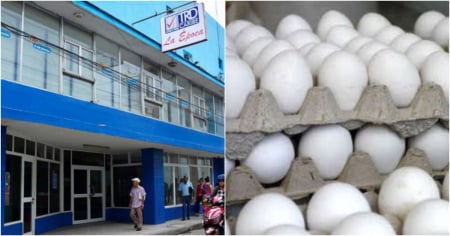
The production of eggs in Pinar del Río today barely reaches 24% of what was achieved in 2019, and even though recovery programs continue after years of accumulated crisis, hurricanes, blackouts, and feed shortages, the situation remains critical.
Pinar's poultry farming is one of the many sectors affected by the economic crisis on the island, along with several factors that "led it to hit rock bottom in 2024." In 2022, Hurricane Ian devastated part of the infrastructure, recalled the official newspaper Guerrillero.
The current figures do not allow for meeting basic demand, and only partially supply prioritized social programs and some medical diets. Of the poultry facilities in the province, only 46% have been restocked with animals.
According to Edel Triana Velázquez, director of the Poultry Company of Pinar del Río, the cooperative production strategy "with two major tobacco producers" allows for a partial bypass of the shortage of animal feed.
In this model, the company provides the birds and the logistics, while the private producer supplies the feed, which accounts for more than 65% of the production cost.
Although this program has allowed for the delivery of eggs to the maternal and child program, pregnant women, hospitals, the Family Care System (SAF), childcare centers, and children with chronic medical diets, it is not sufficient to reverse the general shortage or contain high prices.
"Through cooperative productions, including those with state-owned companies, there is a presence in the markets, and although it may not fully meet the demand, it is at least a way to combat the inflation that exists with the product," said Triana.
Part of the egg produced is sold in dollars as part of a financial scheme to support the purchase of feed, a logic that excludes the majority of consumers.
In the future, the company plans to automate a new poultry facility in the municipality of Consolación del Sur. However, as long as there are ongoing issues with cement production for construction, fuel, and energy, the sector's development will remain limited. The hens are ready, but the eggs are still far from the plate.
The state poultry company, unable to sustain the national egg production, has turned to an unprecedented cooperation scheme with private entities. Under the name "cooperative eggs", the experiment aims to alleviate the shortages that have left social programs -such as the basic food basket and hospitals- on the verge of collapse.
Behind the rhetoric of "cooperation" lies a much more precarious and unequal reality: the State can no longer sustain its supply network and is reimplementing emergency solutions by delegating production to the private sector. In this case, the feed is provided by the entrepreneur, the control is maintained by the state company, and the eggs are distributed, when they arrive.
In October 2024, the Minister of Agriculture, Ydael Pérez Brito, revealed that, from producing between four and five million eggs per day, only 1,200,000 are reached when they manage to feed the livestock.
The authorities of the regime attribute the collapse of the agricultural sector to the lack of supplies, the scarcity of fuel, and climatic conditions. However, these last factors do not seem to affect neighboring Dominican Republic, from which approximately 16.5 million monthly hatchlings are imported.
Cuba also imports eggs from countries such as Colombia and the United States. In fact, the latter are sold in state-owned foreign currency stores and by micro, small, and medium enterprises (mipymes).
Online stores also sell eggs from the U.S. on the island, although the regime claims that the U.S. embargo prevents it from purchasing basic food products.
The recent sale of eggs in dollars at the La Época store in Sancti Spíritus turned into "a sort of Roman coliseum" with pushing, shouting, chaos, and complete impunity, where resellers imposed their rules without the slightest disguise to acquire the product, acknowledged the official newspaper Escambray.
Due to the lack of a historically essential food in the Cuban diet, a carton of eggs has reached astronomical prices in the informal market that greatly exceed the minimum salary or pension.
In 2024, Cubans denounced the exorbitant cost of a "file" of chicken hatchlings: 5,000 pesos on the black market, a price that a low-wage worker or a retiree, with their meager pension, cannot afford.
Frequently asked questions about the egg production crisis in Cuba
Why has egg production in Pinar del Río dropped so dramatically?
Egg production in Pinar del Río has fallen to 24% of what it was in 2019 due to a series of factors such as the economic crisis, the impact of hurricanes, blackouts, and feed shortages. These issues have severely affected the poultry infrastructure of the province.
What is the "cooperative eggs" model and how does it affect production?
The "cooperated eggs" model is an initiative of cooperation between the state poultry company and private producers, where the latter supply the necessary feed for the birds. Although it has allowed for some supply to social programs, it has not been sufficient to meet overall demand or control high prices in the informal market.
How does the egg shortage affect the Cuban population?
The shortage of eggs has caused prices in the informal market to skyrocket to unattainable levels for most Cubans, with a carton of eggs costing thousands of pesos. This has left vulnerable groups such as children and pregnant women without regular access to this essential food.
What measures does the Cuban government anticipate to address the poultry crisis?
The Cuban government plans to automate new poultry facilities and increase cooperation with the private sector to enhance egg production. However, the shortage of cement, fuel, and energy remains a significant obstacle to the progress of these initiatives.
Filed under: