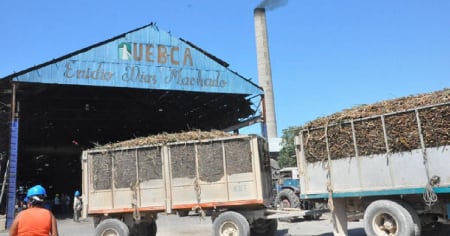
The province of Villa Clara has been failing to meet its sugar production plans for six years, and all indications suggest that this trend will continue in the upcoming harvest.
With seedless machines, unfinished repairs, and low planting levels, the December goals once again rely more on will than on the actual capacity of the agro-industrial system.
The harvest “cannot continue to fail in Villa Clara. The production plan has not been met since 2019,” admitted the first secretary of the Party in the province, Susely Morfa González, during a visit to the Héctor Rodríguez and Quintín Bandera sugar mills in Sagua la Grande and Corralillo, as reported by the official newspaper Vanguardia.
Likewise, Morfa confirmed a basic truth: "Without seeds, there will never be a promotion of plantations."
Beyond the obvious, he pointed out a pattern that hampers the harvest year after year: "when there is oil, agricultural machinery breaks down, or drought persists, or the soils are waterlogged, and a justifying spirit prevails that we must eradicate in order to achieve economic goals, record better wage income, and treat people as they deserve."
The Héctor Rodríguez mill produced this year about 11,000 metric tons of sugar, following a late start, wasted time, low yields, and both objective and subjective failures.
Repairs in this industry, which contributes 40% of the municipality's revenue, will not begin until August, reducing the window for regaining efficiency.
The outlook is not better at the Quintín Bandera sugar mill, whose goal is 12,000 tons of raw sugar, in addition to by-products such as syrup, vinegar, raspadura, and Lebame, the media outlet specified.
The production units from where the cane should come lack sufficient seed, and the planting volumes for the spring campaign were below what was planned. Despite the fact that the plant does not consume oil and generates electricity from biomass, industrial repairs are only at 65%, which raises doubts about its actual capacity to meet obligations.
Both mills must contribute 23,000 tons to the province's sugar plan next year, intended for the basic basket of the population.
Four other plants in the central region will produce sugar for the production of rum and animal feed, the source added.
For the provincial authorities, the problem is no longer just technical: there is a lack of qualified personnel, there is turnover in key positions, and strategic decisions are met with internal inertia that never quite gets resolved.
The sugar agroindustry, which should be an economic and food pillar, is caught between the hope for a resurgence and the inertia of its own collapse. Villa Clara is attempting again, but without breaking away from the same old mistakes, the results will continue to depend more on improvisation than on a structural strategy.
The province of Granma concluded the 2024-2025 sugar harvest with disastrous figures, as it barely achieved 27% of the planned target, amounting to a meager 5,277 metric tons of sugar, far below the scheduled 19,871 tons.
By the end of May, the Government Council of the eastern province had acknowledged the production disaster in the sugar sector, characterized by severe non-compliance, disorganization, idle fields, and debts to workers.
The news agency Reuters reported that this year annual sugar production in Cuba will fall below 200,000 metric tons.
Although the decline has been ongoing for several years, the figure marks a new historic low in an industry that was for decades the economic pillar of the country and a symbol of its national identity.
In recent weeks, several official media outlets have briefly reported alarming statistics: several key sugar mills have produced less than 15% of their sugar plan, while others barely survive amid blackouts, outdated machinery, and a shortage of cane.
For example, the province of Camagüey produced 4,512 tons of raw sugar out of a plan of 23,521 tons, which represents 19.2% compliance.
In the case of Guantánamo, instead of showing recovery, by early June it had only produced about 2,900 tons of sugar, which represents 38% of the initial plan of 7,632 tons.
Frequently Asked Questions about the Sugar Industry Crisis in Cuba
Why has Villa Clara not met its sugar production plan since 2019?
Villa Clara has not met its sugar production plan since 2019 due to issues such as a lack of seeds, incomplete industrial repairs, and low planting levels. Furthermore, they face challenges like faulty agricultural machinery, adverse weather conditions, and a pattern of justifications that hinders the achievement of economic goals.
How has the crisis in the sugar industry affected the Cuban economy as a whole?
The crisis in the sugar industry has dealt a significant blow to the Cuban economy, which has traditionally relied on sugar as one of its main economic pillars. Production has fallen to historically low levels, forcing the country to import sugar, further exacerbating the already critical economic situation. This reflects a structural collapse that affects self-sufficiency and results in millions of dollars in economic losses.
What is the current situation of the sugar mills in Cuba?
The sugar mills in Cuba are facing a critical situation, with many producing only a small percentage of their plans. Obsolete machinery, lack of resources, and scarcity of sugarcane are common problems. In 2025, national sugar production will fall below 200,000 metric tons, marking a new historic low for the industry.
What measures are being taken to address the sugar crisis in Cuba?
The authorities have tried to implement measures such as restructuring management and calling for an extraordinary effort to save the sugar harvest. However, the lack of material and human resources, along with ineffective strategic decisions, have limited the effectiveness of these initiatives. The situation requires a profound structural change that has yet to be implemented.
Filed under: