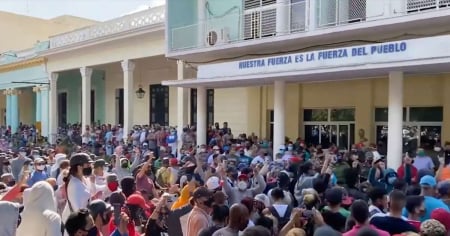
Cuban residents in Spain demonstrated in Madrid to commemorate the fourth anniversary of 11J, the historic day when thousands of citizens inside the island took to the streets in 2021 to demand freedom and were brutally repressed by the Cuban regime.
During the protest, the demonstrators chanted slogans such as "Homeland and Life!", "Down with communism!" and "Down with the Castro-Canel dictatorship!", in a display of rejection of the system that has governed the island for more than six decades.
They sang the National Anthem of Cuba as a symbol of dignity and freedom, far from the constraints imposed by the apparatus of power.
In addition to demanding freedom and democracy, the participants called for the immediate release of all political prisoners and reminded everyone that this July 11 marks the fourth anniversary of the largest civic protest recorded in Cuba in the 21st century, led by a people weary of repression, hunger, and the lack of rights.
Throughout the event, several activists took the floor to denounce the regime's crimes and call for unity.
One of the most emotional interventions was by the activist Avana De La Torre, who sent a direct message to the Cuban people: “To the Cuban people, I say that this is a brave people; keep going, we must persist in the idea, because we are going to be free. We will stand with them at all times.”
Avana showed those present a flag more than 15 meters long, on which were written the names of some of the over a thousand political prisoners who remain imprisoned in Cuba, many simply for the act of expressing themselves or peacefully protesting.
"We need to empower that people, because we have a cloud that prevents us from seeing the reality. But there is light at the end of the tunnel. From exile, we must help, denounce, and teach what Cuba is really like inside," he expressed.
In addition, he showcased another altered flag, in which he condemned what he considers the true legacy of more than six decades of revolution.
"Without hospitals, without roads, without food, without medicines, without doctors because they are used as slaves. The leadership squanders everything and misuses the people's money."
The activist also demanded justice for the victims of the tugboat 13 de marzo, sunk in 1994 by orders of the regime while they were trying to flee the country.
“For over 66 years, Cuba's history has been one of hunger and repression,” he stated.
The protesters agreed that "now more than ever, Cuba deserves freedom," and they committed to continue denouncing the abuses of power from exile until the island is truly free.
Similar demonstrations also took place in Miami and Washington, where participants commemorated the 11J and denounced the repression in Cuba, as well as demanding freedom and bringing attention to the political prisoners on the island.
Recently, the U.S. State Department announced sanctions against Miguel Díaz-Canel and his family members, suspending their visas, and added 11 properties linked to the Cuban regime to its list of prohibited assets.
The Cuban-American voices in the United States Congress celebrated the sanctions imposed by the State Department, deeming them a long-awaited act of justice, coinciding with the four-year anniversary of the historic protests on July 11.
Likewise, the U.S. Government assured that the Cuban regime will be held accountable for human rights violations on the fourth anniversary of the repression following the social uprising of July 11th.
In this regard, the U.S. Secretary of State, Marco Rubio, sent an emotional message to the Cuban people on the occasion of the fourth anniversary of the mass protests.
Frequently Asked Questions about the Fourth Anniversary of 11J in Cuba
What happened on July 11, 2021, in Cuba?
On July 11, 2021, thousands of Cubans took to the streets in over 40 cities to demand freedom and an end to the dictatorship. It was an unprecedented day of civic protest on the island, marked by demands for human rights and a call for democracy, which was violently suppressed by the Cuban regime under the leadership of Miguel Díaz-Canel.
What was the Cuban government's response to the protests on July 11th?
The Cuban government, led by Miguel Díaz-Canel, responded with violent repression to the protests on July 11, 2021. A "combat order" was issued, resulting in the imprisonment of thousands of protesters, many of whom remain incarcerated. The repression included the use of police violence and arbitrary detentions to quell demands for freedom and human rights.
What demands did the Cuban protesters express during the 11J?
The protesters demanded freedom, democracy, and the end of the dictatorship in Cuba. Furthermore, they called for the release of all political prisoners and denounced the living conditions on the island, marked by repression, lack of food, medicine, and fundamental rights. The most notable slogans included "Homeland and Life!" and "Down with the dictatorship!".
How has the anniversary of 11J been commemorated in the Cuban exile community?
The anniversary of 11J has been commemorated by Cuban exiles with demonstrations and activities in various countries, especially in Spain and the United States. These commemorations have included peaceful protests, informational events, and symbolic acts to remember political prisoners and continue denouncing human rights violations in Cuba. Activists and exile organizations have reaffirmed their commitment to the fight for a free and democratic Cuba.
What has been the role of the Cuban diaspora in the fight for Cuba's freedom?
The Cuban diaspora has played a crucial role in the fight for Cuba's freedom, organizing demonstrations, highlighting the regime's repression, and supporting political prisoners. From exile, Cubans have used their voices to internationally denounce human rights violations on the island and to push for political change. They have been a fundamental pillar in keeping the spirit of July 11 alive and in demanding justice and democracy for their homeland.
Filed under: