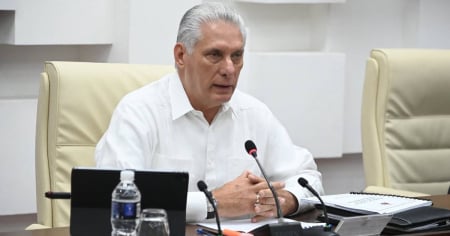
Cuban-American voices in the United States Congress celebrated this Friday the sanctions imposed by the State Department on Cuban leader Miguel Díaz-Canel, his family, and high-ranking military officials, labeling them as a long-awaited act of justice, coinciding with the fourth anniversary of the historic protests on July 11.
"Finally, the pathetic puppet of a dictator is being sanctioned for his violations against the Cuban people,” wrote representative Carlos Giménez on X, while his colleague María Elvira Salazar stated that "it was about time we had leadership with zero tolerance for tyrants.”
The sanctions, announced by Secretary of State Marco Rubio, prohibit entry to the U.S. for Díaz-Canel, Defense Minister Álvaro López Miera, Interior Minister Lázaro Álvarez Casas, and their immediate family members. Restrictions were also imposed on judicial and penitentiary officials accused of repressing and torturing protesters from the 11J, although their names were not disclosed.
Also, Congressman Mario Díaz-Balart directly thanked President Donald Trump and Rubio for "using the legal tools" necessary to punish those who "continue to brutally terrorize those who only demand freedom". Díaz-Balart criticized the previous administration for supposedly prioritizing appeasement of the regime over national security.
For his part, Senator Rick Scott warned that “violence against peaceful protesters will have consequences” and expressed his support for the students who recently demonstrated at the University of Havana, citing an article from the Wall Street Journal.
The question that many Cubans are asking themselves
From Havana, Miguel Díaz-Canel described the sanction as an attack on Cuba's "true independence" and stated that what bothers the U.S. is “that we have free healthcare and education.”
But on social media, many Cubans questioned the contradiction of a regime that has always demonized the U.S., yet feels uncomfortable when its ruling class is banned from entering.
Chancellor Bruno Rodríguez spoke of a “ruthless economic war” and the Deputy Chancellor Carlos Fernández de Cossío stated that it was a “so-called sanction” that they accept “with pride.”
The sanctions imposed this Friday revive the echoes of July 11, 2021, when thousands of Cubans took to the streets demanding freedom and were met with violent repression. More than a hundred people are still imprisoned for participating in those protests.
Although they arrive four years late, for many in exile and within the island, these measures are a sign that repression will not go unpunished. “The United States will never forget the tenacity of the Cuban people,” a high-ranking official stated to the Miami Herald.
The message is also clear: there will be consequences for those who raise their hand against their own people.
Filed under: