Cuban exile organizations gathered last Friday in the United States to commemorate the fourth anniversary of July 11, when thousands protested on the island demanding freedom and faced violent repression.
Sylvia Iriondo, from Mar por Cuba, stated to Univisión: “I have extraordinary faith that Cuba will be free, and it will be free soon because of their efforts over there and ours over here.”
The television station reported that during the Stations of the Cross and the mass at the Shrine of Our Lady of Charity of El Cobre in Miami, prayers were offered to the Virgin for the freedom of the Cuban people.
Earlier, at the Museum of the Cuban Diaspora, an exhibition was inaugurated that commemorates the protests of July 2021 and strengthens the bond between the exile community and political prisoners on the island.
Ramón Saúl Sánchez, from the Movimiento Democracia, emphasized: “It is important for the Cuban exiles and the friends of our struggle to show solidarity with those who are behind bars and with those who continue fighting in the streets.”
Ángel de Fana, also an exile, expressed feeling "moved to share this moment with so many brothers in struggle, where so many Cubans of this generation took to the streets calling for freedom."
Exile organizations agree that there are more than 1,000 political prisoners in Cuba, including opposition leader José Daniel Ferrer, artist Luis Manuel Otero Alcántara, and rapper Maikel Osorbo.
Luis Enrique Ferrer, brother of José Daniel Ferrer, stated: “The dictatorship is afraid, and that is why they are killing Félix Navarro, José Daniel Ferrer, Luis Manuel, Michael, Mara, Sisi, Sailí, and many other prisoners. They just assassinated Yan Carlos González González a few days ago.”
In Washington D.C., protesters gathered in front of the Cuban embassy reiterating that many compatriots are imprisoned for "simply demanding freedom."
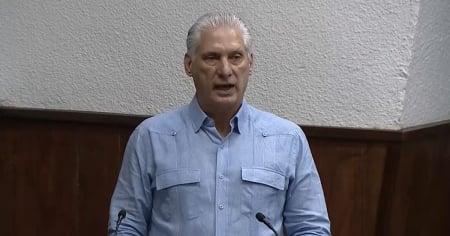
Recently, the U.S. State Department announced sanctions against Miguel Díaz-Canel and his family members, blocking their visas and adding 11 properties linked to the Cuban regime to its list of restricted assets.
Cuban-American voices in the United States Congress celebrated the sanctions imposed by the State Department, describing them as a long-awaited act of justice, just as we reach the four-year mark of the historic protests on July 11.
Similarly, the U.S. Government affirmed that the Cuban regime will be held accountable for the violations of human rights on the fourth anniversary of the crackdown on the social uprising of July 11.
In this regard, the United States Secretary of State, Marco Rubio, sent an emotional message to the Cuban people on the occasion of the fourth anniversary of the massive protests.
Rubio reaffirmed the U.S. government's commitment to the cause of freedom and firmly condemned the Cuban regime, as seen in a video shared by journalist Mario J. Pentón on his social media.
Frequently Asked Questions about 11J and the Cuban Exile
What do Cuban exiles commemorate on the anniversary of 11J?
Cuban exiles commemorate 11J as a symbol of resistance and the fight for freedom. On this day, they remembered the mass protests in Cuba on July 11, 2021, when thousands of Cubans demanded freedom and democracy on the island, confronting severe repression from the regime. During the anniversary, demonstrations and events took place in the United States to honor political prisoners and strengthen the bond between the exile community and the cause for Cuba's freedom.
Who are some of the most prominent political prisoners in Cuba mentioned in the news?
Some of the most notable political prisoners mentioned are José Daniel Ferrer, Luis Manuel Otero Alcántara, and Maikel Osorbo. José Daniel Ferrer, leader of UNPACU, has been imprisoned multiple times for his political activism. Luis Manuel Otero Alcántara is an artist who has been a central figure in the fight for freedom of expression in Cuba. Maikel Osorbo is a rapper known for his participation in the song "Patria y Vida," which became an anthem for the protests on July 11th.
What actions has the U.S. government taken in support of the Cuban people?
The United States government has imposed sanctions against figures of the Cuban regime, including Miguel Díaz-Canel, and has expressed its support for human rights in Cuba. Additionally, the U.S. Embassy in Havana has maintained a constant dialogue with activists and family members of political prisoners, reaffirming its commitment to freedom and democracy on the island. They have also condemned arbitrary detentions and the treatment of Cuban dissidents.
What is Miguel Díaz-Canel's position regarding the 11J and the protests in Cuba?
Miguel Díaz-Canel has stated that Cuba "is strong" and downplays the protests of July 11. According to his statements, the regime believes that the protests were orchestrated from abroad and do not represent a genuine challenge to the government. Díaz-Canel has highlighted that the Cuban people are strong and resilient, although the numerous demonstrations and the repression faced by the protesters suggest a different reality concerning public discontent.
Filed under: