
Related videos:
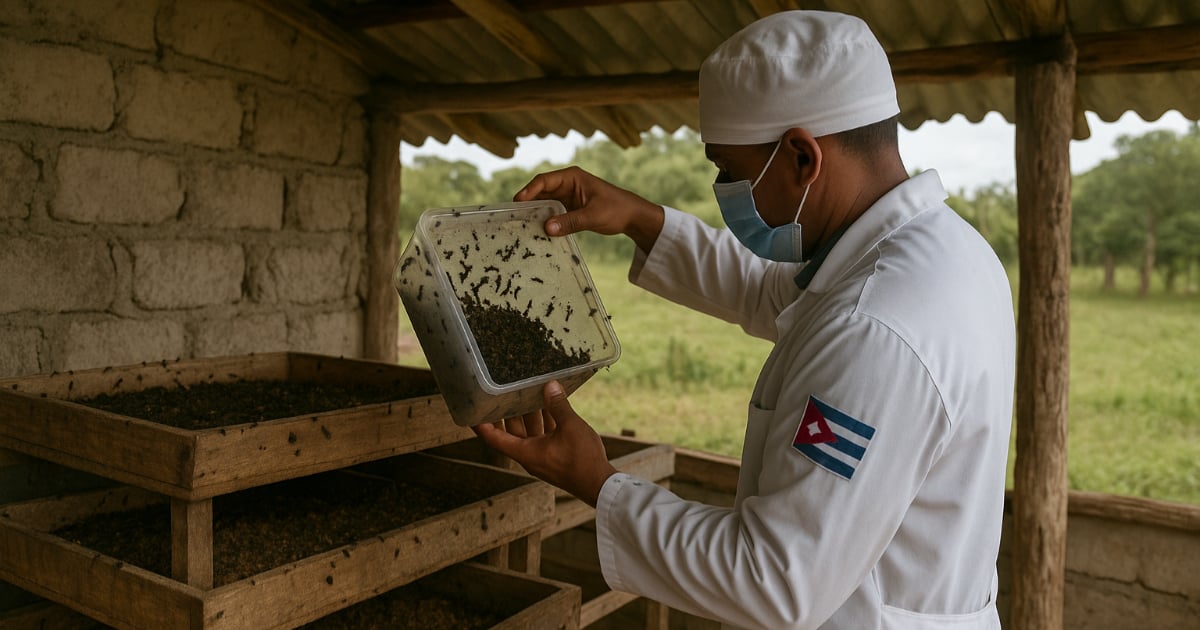
The former Cuban doctor Yodermis Díaz Hernández has found in the breeding of black soldier flies a more profitable business than decades of practicing medicine.
In an improvised workshop on the outskirts of Havana, this health professional turned insect breeder produces hundreds of kilograms of larvae intended for animal feed, especially for fish, using tools made from recycled materials.
Díaz, who practiced internal medicine for over 20 years, decided in 2019 to trade his stethoscope for incubator trays following a friend's suggestion. Since then, he has witnessed how this activity, virtually unknown on the island until recently, has become an alternative source of income.
In the past year, he sold 300 kilograms of larvae to freshwater fish farms at 450 pesos per kilo, and he expects to triple that figure this year.
The production has a very low cost and represents an ecological solution. "We turn waste into protein, into gold for animals, and the scraps into fertilizer. We also help the environment," says Díaz. Beyond financial gain, he claims to be motivated by sustainability.
However, the rise of these types of initiatives cannot be understood without the context of the economic collapse that Cuba is experiencing. The decline in tourism, the centralized economic model, and government inefficiency have left the island without the liquidity to import essential supplies, including animal feed.
Faced with scarcity, the regime has begun to explore desperate solutions. In 2023, state-run media such as Juventud Rebelde promoted the black soldier fly as a "promising source of protein", in a propaganda piece reminiscent of the times when they tried to convince Cubans of the nutritional value of "roach milk."
While millions of Cubans struggle to feed their families, the government celebrates the virtues of an insect, conveniently omitting the lack of effective policies, agricultural inputs, and basic food supplies. This is not the first time such practices have been hailed as a national salvation in a country without the infrastructure or resources to sustain them.
The official glorification of such initiatives only confirms the structural failure of a system that has not been able to provide the most basic necessity: food on the table for its people.
Frequently asked questions about the economy and the food crisis in Cuba
Why does a former Cuban doctor decide to raise flies instead of practicing medicine?
Yodermis Díaz Hernández, a former Cuban doctor, found in breeding black soldier fly larvae a more profitable venture than medicine, due to the economic crisis in Cuba and the inefficiency of the state healthcare system. Breeding these larvae provides an ecological and economical solution, turning waste into protein for animal feed, in a context where the government is desperately seeking alternatives due to the lack of basic supplies.
How is Cuba's economic crisis related to the promotion of alternative solutions such as insect farming?
The promotion of alternative solutions such as insect farming in Cuba arises from the economic crisis and the lack of resources to import basic foods. The regime has begun to explore these solutions in response to shortages, promoting the black soldier fly as a source of protein. However, this reflects the structural failure of the Cuban economic system, unable to ensure the most basic needs for its population.
What is the impact of the food crisis on the daily life of Cubans?
The food crisis in Cuba has led to extreme situations, such as collecting spilled yogurt from the street and reliance on the black market to obtain food. The shortage of basic products and inflation have made it so that most Cubans cannot access essential food items, increasing inequality and precariousness on the island.
What role does the Cuban government play in the current economic crisis of the country?
The Cuban government has been unable to implement effective policies to overcome the economic crisis, instead opting to promote alternative solutions such as insect farming and domestic self-sufficiency. The lack of liquidity, the decline in tourism, and the inefficiency of the centralized economic model have exacerbated the situation, leaving the population with few options to meet their basic needs.
Filed under: