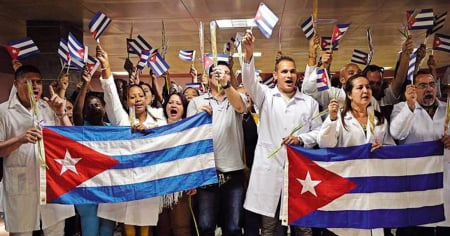
“Cuban doctors want to stay, but we depend on what the United States says,” stated to the local newspaper The Tribune, the Minister of Health of the Bahamas, Dr. Michael Darville, confirming that the healthcare professionals sent by Havana are interested in remaining in the Caribbean nation under direct contracts with the Bahamian government.
The situation of Cuban doctors in the Bahamas has undergone a significant change following the local government's decision to cut ties with the Cuban Medical Services Commercializer (CSMC), the state agency that manages these missions. Instead, the authorities are looking to offer direct contracts to the Cuban healthcare workers, but this measure is contingent upon approval from Washington.
On his part, U.S. Secretary of State Marco Rubio has described the Cuban medical brigades as a form of modern slavery. Furthermore, threats of immigration sanctions, including the revocation of visas for officials and their families, led Nassau to reconsider the agreement it had with Havana.
Dr. Darville ensured that the country is already taking steps to reduce its dependence on Cuban medical cooperation, intensifying the recruitment of healthcare personnel from India, the Philippines, and Ghana.
But in the midst of the political and diplomatic debate, the future of these Cuban professionals remains uncertain, caught between the humanitarian interest of a government that needs them, the political pressure from Washington, and the shadow of state control in Havana.
A leaked contract from 2022 revealed that the Bahamas was paying up to $12,000 monthly for each Cuban doctor, but these professionals received between $990 and $1,200, with the remainder going to the Cuban government. Additionally, there are reports of passport confiscation, surveillance, movement restrictions, and repercussions against defecting or critical doctors.
Despite this context, the 35 Cuban doctors currently working in the Bahamas, including ophthalmologists, an optometrist, nurses, X-ray technicians, physiotherapists, and biomedical specialists, have expressed their desire to stay and work freely in the country.
After the threats of immigration sanctions imposed by the U.S., the Bahamian Prime Minister, Philip Brave Davis, announced that his government will directly pay all contracted foreign workers, including Cubans, to ensure that they are not victims of forced labor.
“Sharing an employee's salary with a government could be perceived that way”, Davis admitted, although he said he had no evidence of abuses in his country. “If we discover that, we will correct it”.
The case of the Bahamas reveals the cracks in a model that has been a key source of income for Havana, but also a source of suffering and restrictions for thousands of Cuban professionals who only want to pursue their vocation freely.
Frequently Asked Questions about the Situation of Cuban Doctors in Bahamas
Why do Cuban doctors in the Bahamas want to stay?
Cuban doctors wish to stay in the Bahamas because they seek to work under direct contracts with the Bahamian government, which would provide them with greater freedom and better working conditions compared to the restrictions imposed by the Cuban regime.
What is the role of the United States in the situation of Cuban doctors in the Bahamas?
The United States plays a crucial role in pressuring the Bahamas to reconsider its medical cooperation agreements with Cuba, labeling these missions as a form of modern slavery and threatening with immigration sanctions if the labor exploitation conditions are not remedied.
How are Cuban doctors affected by the agreements with the Cuban regime?
Cuban doctors receive only a small portion of their salary because the Cuban regime retains between 83.9% and 91.6% of payments made by the Bahamas, in addition to facing restrictions such as passport confiscation and constant surveillance.
What measures has the Bahamian government taken to improve the situation for Cuban doctors?
The government of Bahamas has decided to pay Cuban doctors directly to avoid forced labor, although it still depends on the approval of the United States to formalize direct contracts with these healthcare professionals.
What impact do Cuban medical missions have on international relations?
Cuban medical missions are a source of diplomatic tensions between Cuba, the United States, and other countries that rely on these services, as Washington believes that these practices violate human rights and constitute labor exploitation.
Filed under: