The Minister of Energy and Mines of Cuba, Vicente de la O Levy, assured this Monday before deputies of the National Assembly that there is a “viable strategy” to recover the National Electric System (SEN), although he acknowledged that blackouts will continue to affect the daily lives of Cubans.
“We are on the path to independence from imported fossil fuels”, declared De la O Levy during his speech at the Commission of Industry, Construction, and Energy of Parliament, where he also announced that there will be no immediate solution for the power outages, although an “improvement” is expected.
In his remarks, De la O Levy presented data on the installation of solar parks, about five per month, along with planned improvements in thermal and distributed generation, although he clarified that the strategy will not resolve blackouts immediately. “We started July with an average of 18 hours of blackout and last Friday, 11,” he noted. The goal: rotations of blackouts of around four hours per day.
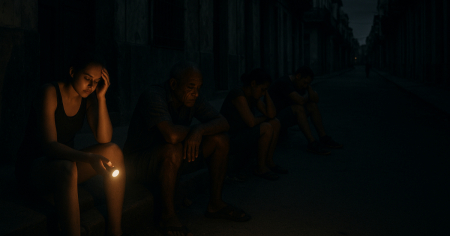
But the reality on the streets and in neighborhoods is far from that goal. Cubans face entire days without electricity, without water, unable to preserve food, nor use a fan in the sweltering summer.
According to the official media Cubadebate, De la O Levy explained that there is a decrease in mobile generation. “In the country, we used to have up to eight units, and five have been retired. With the scarce financial resources, only minimal payments have been made to keep the units generating during July and August.”
The electricity generation crisis is compounded by the sustained decline in national crude oil production, which dropped from 3.6 million to just 2.1 million tons. Although, according to the minister, the negative trend has recently stopped, the country has only managed to accumulate 51,000 tons above the plan. Imports of diesel and fuel oil have also decreased, which continues to directly impact the electricity generation capacity.
Regarding generation with natural gas, there are currently 8.3 GWh in Energas, which do not offset the widespread deterioration of the system.
One of the most visible examples is the Felton 2 thermoelectric power plant, which remains out of service. The minister assured that it is in the process of recovery, although the work is being carried out exclusively with resources from the national industry, which could lead to longer delays due to the lack of parts and technology.
The situation with the generators is not any more encouraging. De la O Levy admitted that no progress has been made due to the inability to access the necessary financing, which leaves many of these key pieces of equipment in distributed generation inactive.
However, in a rhetoric that has become recurrent in recent months, the official explained that the peak consumption has increased by 524 MW, due to the rise in the importation of household appliances, the shortage of liquefied gas, and electricity rates that, instead of encouraging savings, promote excessive consumption.
Although progress is being reported in the installation of renewable energies, such as the 481.3 MW already available in solar parks, this still does not compensate for the generation deficit nor guarantee stability for the system.
Additionally, the country lacks sufficient transformers, 12,000 are required each year, and the theft of electrical components, oil, and fuel exacerbates the situation.
The contrast: between the "viable strategy" and the admission of collapse
The minister's statements contrast with what he himself and other government figures said just a few days earlier, during the X Plenary of the Central Committee of the Communist Party, when they acknowledged that the lack of oil is the main cause of the electrical collapse.
“if we had fuel and lubricant today, the situation would be completely different,” said the Secretary of Organization, Roberto Morales Ojeda, supporting De la O Levy, who confirmed that more than half of the blackouts, up to 1,000 MW of impact in a single day, are due to the lack of fuel and not to technical failures.
Even the ruler Miguel Díaz-Canel was more emphatic: “Here, when we have this energy situation, almost everything comes to a halt. (...) In recent weeks, there have been provinces that have been without power for almost the entire day.”
Furthermore, for this summer, the government has imposed a series of restrictive measures to ration electricity, having profound impacts on the country’s work and social life:
- State offices closed from Friday to Monday.
- Mandatory reduction of consumption in public and private centers.
- Cuts directed at private businesses that exceed their consumption plan.
- Time restrictions for the use of electrical equipment in carpentry shops and food centers.
In localities such as Manicaragua and Calixto García, these selective cuts are already being implemented, posing a direct threat to the non-state sector that is struggling to sustain itself.
The contradiction between the minister's optimistic and technical message to the Assembly and the prior warnings about the impending collapse and the inability to pay for fuel confirms the confusion and lack of planning with which the crisis is being managed.
The promise of "improvement" no longer comforts a population that hears different versions week after week, as the fan shuts off and the little food stored in the refrigerator spoils.
Filed under: