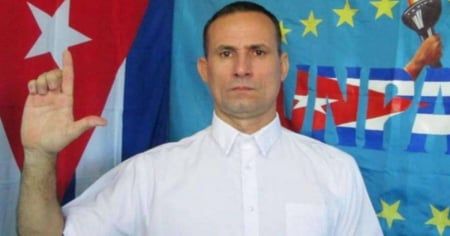
The Cuban regime finally agreed to show proof of life of opposition leader José Daniel Ferrer, after days of reports and international pressure led by the United States.
The only person authorized to see him was his wife, Nelva Ismarays Ortega-Tamayo, during a highly monitored visit and in the presence of the G2 enforcer known as Julio Fonseca, reported Ana Belkis Ferrer, sister of the political prisoner.
The visit, which took place this Monday at the Mar Verde prison in Santiago de Cuba, lasted approximately one hour and revealed an alarming reality: Ferrer is surviving in cruel, inhumane, and degrading conditions, according to the testimony shared by his family member.
During the meeting, Ferrer confirmed that the brutality has slightly diminished in recent days; he is no longer subjected to savage beatings or extreme torture, but his ordeal continues.
He continues to be confined in a cell infested with bedbugs, mosquitoes, and flies, crammed in with common criminals allegedly serving the regime, forced to drink dirty and contaminated water, and without receiving medical attention, despite suffering from severe headaches, a ruptured eardrum, persistent cough, and muscle and joint discomfort.
Days of anguish and uncertainty
The proof of life arrives after several days of complete silence regarding the whereabouts and condition of the opposition figure, a situation that sparked fears among his family and human rights organizations, who warned of a possible death in custody.
“Six days without news of my brave brother. Is he still alive? Is he recovering or is he still being tortured?”, wrote Ana Belkis Ferrer in desperation.
The alarms were also raised in Washington. The U.S. Secretary of State, Marco Rubio, demanded that the regime provide an immediate proof of life and the release of Ferrer, publicly denouncing the torture he has been subjected to.
Since his arrest on April 29, Ferrer has been a victim of an escalating repression. He was transferred without any clear legal justification to the Mar Verde prison to serve a sentence imposed in 2020 during a process widely regarded as arbitrary.
There, according to reports, he was brutally beaten by at least five officials, whose names are already listed in the List of Repressors by the Foundation for Human Rights in Cuba (FDHC).
The documented tortures include beatings all over the body, finger twisting, attempts at asphyxiation, forced feeding during his hunger strike, and threats of reprisals against his family, including the potential internment of his youngest son in a state facility.
Hunger strike as a last resort
The leader of the Patriotic Union of Cuba (UNPACU) declared a hunger strike on June 29, in protest against his unjust imprisonment and the inhumane conditions he is facing. His family had warned that Ferrer was so weakened and affected that he feared he had contracted tuberculosis, and he didn't even dare to kiss his loved ones during the most recent visit.
Despite the physical wear, Ferrer made it clear that he will continue to resist. "Even though he is like this now, he will keep fighting for freedom, democracy, and human rights," he said in his message. But he also warned of the risk of death: if that happens, he fears devastating reprisals against his family. "They have been told that they will be disappeared," he denounced.
The case of José Daniel Ferrer is a chilling example of the human cost of dissent in Cuba. It is a story that cannot remain silent and demands urgent attention from the international community.
Filed under: