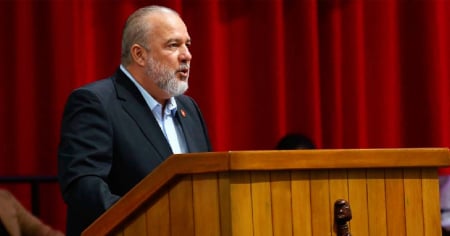
The Cuban Prime Minister, Manuel Marrero Cruz, acknowledged this Wednesday before the National Assembly of People's Power a new contradiction generated by the increase in pensions for retirees: the minimum wage for some workers has fallen below the pensions.
In that context, he promised that the Government would "study" the issue to determine how to act, although he also assured that this would only happen "as long as we continue to boost the economy," a statement that is shaky, as it was reported the day before that the Cuban economy continues to contract, according to official data presented to the National Assembly itself.
"We have improved the situation for pensioners and the most disadvantaged, but there are now people who are working and earning a minimum wage that is currently lower than the pensions. We have identified this issue, and we will study it and see what we can do," said Marrero during the parliamentary session.
The prime minister's statements come immediately after the announcement that more than 1.3 million retirees will receive an increase starting in September, which will, in some cases, double the current minimum amount.
However, Marrero warned that the review of the minimum wage will be "complex," as it would require allocating new resources that the state does not have readily available.
"Complex!", because it requires money, but we have to keep working and studying this. We committed to studying it and seeing how we can…," he stated, without providing deadlines or specific measures.
The contrast between the new pensions and the lower salaries highlights a structural distortion in the income system in Cuba, where formal employment no longer ensures minimum living conditions.
In Marrero's own words, “it is necessary to continue seeking sources of employment” and only “to the extent that the economy is revitalized and new sources of income are generated” will it be possible to implement structural changes.
The government has tried to justify the increase in pensions as a partial measure amid a prolonged crisis. Without mentioning that, in the midst of cash shortages at ATMs and a distorted banking process, withdrawing more money will lead to more problems for pensioners.
Nevertheless, in the same National Assembly, the regime acknowledged that the economy continues to not recover, despite the official narrative that insists on signs of stabilization.
The Minister of Economy admitted that the country is experiencing a severe fuel shortage, poor performance of the electrical system, and ongoing fiscal imbalances, while real income continues to deteriorate and prices are skyrocketing.
The potential review of the minimum wage occurs in a context where, according to the Government itself, there is not enough financial capacity to implement a comprehensive reform of the wage system or the pension system.
For millions of Cubans who survive on stagnant incomes amidst rampant inflation and an increasingly dollarized market, the promise to “study” a wage increase may sound more like a delay than a solution.
Frequently asked questions about the increase in the minimum wage and pensions in Cuba
Why is the minimum wage in Cuba lower than pensions?
The increase in pensions has surpassed the minimum wage, creating a contradiction in the income system in Cuba. While more than 1.3 million retirees will receive an increase, some workers continue with a minimum wage that is lower than pensions, highlighting a structural distortion in the country.
What measures does the Cuban government promise to address the minimum wage issue?
The Prime Minister Manuel Marrero has promised that the government "will study" the minimum wage issue to identify solutions, although its implementation will depend on the ability to revive the economy. However, no deadlines or concrete measures have been defined, which generates skepticism among the population.
How does the economic crisis in Cuba affect the pension and salary system?
The economic crisis in Cuba has led to a shortage of resources, making it difficult to implement comprehensive reforms in the pension and wage systems. The economy continues to contract, facing issues such as fuel shortages and an underperforming electrical system, which affect real incomes and drive up prices.
What does the Cuban population think about the promises of salary increases?
For many Cubans, the promise of "studying" a salary increase sounds more like a delay than a solution. Persistent inflation and an increasingly dollarized market have left millions of people with stagnant incomes, generating distrust towards official statements that do not translate into effective actions.
Filed under: