
Related videos:
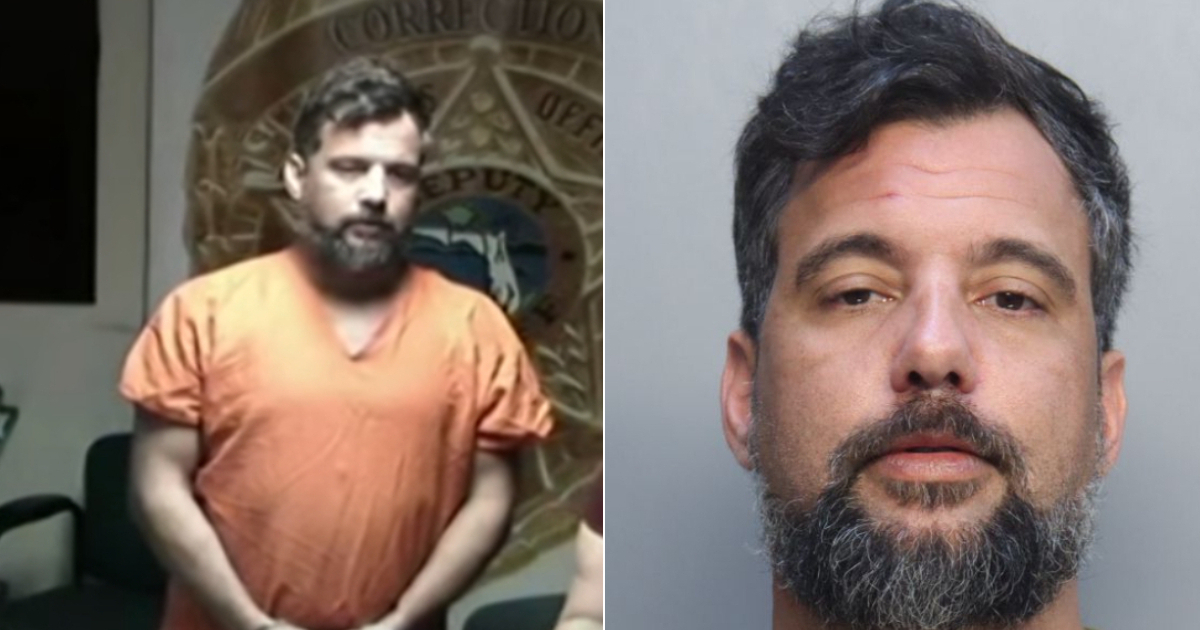
The Miami-Dade County State Attorney's Office released disturbing images this week from a case that has sparked public outrage: the alleged physical and psychological abuse of a six-year-old boy by his stepfather, identified as Zachary Pérez, 42 years old.
The events took place in May of this year in a residence in southwest Miami-Dade, where the accused lived with his wife, daughter, and two stepchildren. In the video captured by a security camera inside the home, Pérez is seen walking with the minor to whom he has put a dog collar around the neck and is holding a pink leash. At another moment, he drags the child across the floor, kicks him several times, and chases him with what appears to be a stick.
According to court records, another video shows the child running with a backpack full of stones, while other clips reveal blows inside the living room and a bedroom. The minor ended up with swollen eyes, multiple scratches, a rash on the neck, and marks consistent with branches, according to the forensic report cited in the case.
Pérez's arrest occurred on May 10 and he was taken to the Turner Guilford Knight Correctional Center (TGKCC). During his first court appearance, the judge presiding over the case denied him bail, classifying the actions as "aggravated child abuse with torture." “It is truly horrific that at this point in humanity we continue to commit such distressing acts, I have a knot in my throat,” she stated during that hearing.
The minor's mother was the one who alerted the authorities and reported the assaults, after which Pérez was formally charged with aggravated child abuse resulting in serious bodily harm. Since then, several people have contacted the Prosecutor's Office claiming to have been victims of mistreatment by the same accused in the past, including his 14-year-old daughter. According to the prosecutors, at least five protective measures have been issued against him for domestic violence.
Pérez's legal defense has argued that the accused suffers from post-traumatic stress disorder (PTSD), hearing problems, and has undergone surgeries after serving as a Marine in Iraq. His mother testified that he suffers from a traumatic brain injury. Nevertheless, the prosecution maintains that he poses a risk to those around him.
Despite the seriousness of the case, on June 10, Pérez was released under house arrest with a restraining order of at least 500 feet from the victims and without direct or indirect contact. He is expected to return to court on August 28 to continue the judicial process.
Amanda Altman, executive director of Kristi House, a child advocacy center in Miami, stated: "The child likely has emotional, psychological, and even physical traumas and injuries that may have resulted from this horrible abuse." She also noted that Pérez's untreated past could have influenced his behavior: "What trauma might he have suffered for which he never received the appropriate intervention?"
Frequently Asked Questions about the Child Abuse Case in Miami
What happened in the case of Zachary Pérez in Miami?
Zachary Pérez has been charged with aggravated child abuse after being caught on video physically mistreating his six-year-old stepson, including the use of a dog collar and a leash to harm him.
What was the authorities' response to the case of Zachary Pérez?
The judge overseeing the case denied bail to Pérez, deeming the facts as "aggravated child abuse with torture." Despite this, he was released under house arrest with a restraining order of at least 500 feet from the victims.
What does Zachary Pérez's defense argue?
The legal defense for Pérez claims that their client suffers from post-traumatic stress disorder and hearing problems, in addition to having undergone surgeries after serving as a Marine in Iraq. They also mentioned that he has a traumatic brain injury.
How has this case impacted the community?
The case has generated a great public outrage and has highlighted the seriousness of child abuse in society. It has also sparked a debate about the necessity of identifying and addressing unresolved traumas that can lead to such behaviors.
Filed under: