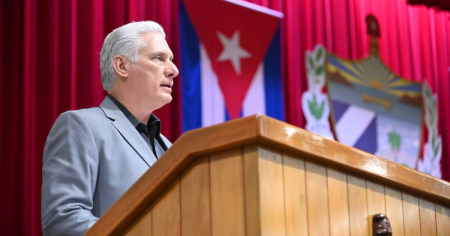
The Cuban leader, Miguel Díaz-Canel, stated this Friday before the National Assembly of People's Power that "this is not the first time, nor will it be the last, that the Cuban revolution faces its most difficult moment," in a speech where he justified the country's complex current situation by appealing to a historical context of "resistance."
During the Fifth Ordinary Session of the National Assembly, Díaz-Canel contextualized the current economic and social adversities of the island, asserting that the situation is "comparable" to other critical moments in Cuban history, such as the "Sanjón Pact," the fall of independence leaders, or the U.S. intervention.
Therefore, she asserted that the Cuban people would be prepared for the current and future crises.
"This is not the first time, nor will it be the last, that the Cuban revolution faces its most difficult moment, in quotes," he said.
The ruler defended the "authenticity" of the Cuban regime and criticized those who compare the current times with the period before Fidel Castro came to power, noting that they "conceal the misery" that existed at that time.
Díaz-Canel, as in so many other moments of his mandate, attributed most of the problems to external factors, mentioning the "suffocating economic blockade" imposed by the United States and Cuba's inclusion on the list of state sponsors of terrorism. He asserted that these measures "intensify the blockade policy to unprecedented levels" and have a "multiplied impact" on the economy and the standard of living of the population.
Despite acknowledging various moments of the economic crisis, such as the increase in the fiscal deficit and the instability of the electrical system, he made a appeal for "discipline, organization, awareness, and persistence" to overcome the situation.
He emphasized the need to increase national production, reduce dependence on imports, and strengthen local production systems as strategies to address the crisis.
He called once again for "resistance" and referred to the Cuban people's ability to endure the crisis, as the hours of blackouts are prolonged and food shortages impact families.
"There is an impressive willingness of this people to fight when things get tougher. Neither pessimism, nor defeatism, nor discouragement," argued the representative of the dictatorship.
In his speech before the deputies of the ANPP, he also acknowledged that there is social inequality in Cuba, exacerbated by the partial dollarization of the economy, which benefits those who receive remittances from abroad.
However, he justified the measure by citing the need to gather foreign currency and to address "the limited availability of medications, the reduction of transportation services, solid waste collection, and water supply."
Frequently Asked Questions About the Economic and Political Situation in Cuba Under Díaz-Canel
What is Díaz-Canel's main justification for the current crisis in Cuba?
Díaz-Canel attributes the crisis mainly to the economic embargo by the United States, which he considers the primary obstacle to the country's development. However, he has also acknowledged the existence of internal errors in the regime's management, although he has not delved into specific measures to address them.
What measures does Díaz-Canel propose to confront the crisis in Cuba?
The Cuban leader proposes to increase national production and reduce dependence on imports as strategies to tackle the crisis. Additionally, he has highlighted the need for discipline, organization, and consistency, although he has not presented a specific and detailed plan to address the country's structural issues.
How does the partial dollarization of the economy affect the Cuban population?
The partial dollarization of the economy benefits those who receive remittances from abroad, increasing social inequality in Cuba. This measure has favored a minority with access to foreign currency, while the majority of Cubans without this access face growing economic vulnerability.
What does Díaz-Canel acknowledge about the state of the electric system in Cuba?
Díaz-Canel admits that Cuba's electrical system is in a critical situation, with outdated infrastructure and a lack of proper maintenance. Despite acknowledging the severity of the electrical collapse, he continues to blame the U.S. embargo without addressing the internal management errors that have also contributed to the crisis.
Filed under: