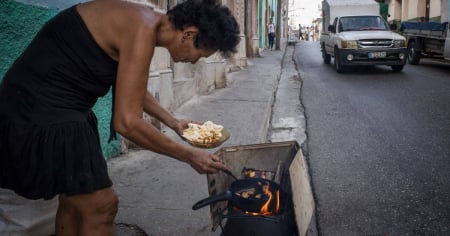
The Cuban electrical system remains in a critical situation. The Unión Eléctrica (UNE) reported that this Saturday the service was affected for 24 hours and has remained interrupted during the early hours of Sunday.
There are electricity outages throughout the country. On July 19, the highest impact due to a generation capacity deficit occurred at 10:50 p.m., with a shortfall of 1,897 megawatts (MW), despite the forecast for the peak energy demand being 1,500 MW.
Insufficient solar production
Despite the fact that the 22 new photovoltaic solar parks generated 2,557 megawatt-hours (MWh) with a maximum capacity of 482 MW, this renewable source was not enough to meet the needs of a collapsed system.
At 7:00 a.m. today, the availability of the National Electric System (SEN) was only 1,746 MW, compared to a demand of 3,273 MW, resulting in a deficit of 1,590 MW. By noon, this deficit is expected to be around 1,400 MW.
Thermal power plants paralyzed and lack of fuel
The main causes of the crisis include breakdowns in several generating units:
- Unit of the CTE Guiteras
- Unit 1 of the CTE Santa Cruz
- Unit 2 of the CTE Felton
- Unit 6 of the CTE Renté
In addition, others are undergoing scheduled maintenance:
- Unit 2 of Santa Cruz
- Unit 4 of Cienfuegos
- Unit 5 of Renté
In addition, there are 285 MW out of service due to thermal limitations, as well as issues caused by a lack of fuel in 81 distributed generation plants (affecting 712 MW) and in the Regla plant, where 7 engines are out of service (53 MW).
The forecast for peak hours this Sunday is not encouraging. A partial capacity recovery is expected with 100 MW from distributed generation engines, 70 MW from the entry of unit 1 in Santa Cruz, and 20 MW from the reactivation of three engines in the Regla area
Nonetheless, the UNE estimates a total availability of 1,936 MW against a maximum demand of 3,700 MW, which indicates a deficit of 1,764 MW and an impact of up to 1,834 MW during peak hours if current conditions do not change.
Frequently Asked Questions about the Electric Crisis in Cuba
What is the current electricity deficit in Cuba?
The current electricity deficit in Cuba exceeds 1,800 MW during peak hours, resulting in widespread blackouts across the country. This situation is due to the National Electric System's (SEN) inability to meet the high demand for energy.
What are the main causes of the energy crisis in Cuba?
The main causes of the energy crisis in Cuba include breakdowns in several thermoelectric units, lack of maintenance, thermal limitations, and fuel shortages. Many distributed generation centers and barges are out of service due to these issues, exacerbating the energy deficit.
What role does solar energy play in Cuba's electrical crisis?
Although Cuba has installed new photovoltaic solar parks, solar energy is not sufficient to cover the energy deficit. The solar parks have contributed a limited amount of energy, which fails to offset the significant shortcomings of the Cuban electric system.
How do blackouts affect the Cuban population?
Extended blackouts severely affect the quality of life for Cubans, impacting essential activities such as cooking, using appliances, and preserving food. Furthermore, they interrupt vital services like healthcare and transportation, exacerbating social discontent in a context of economic and social crisis.
Filed under: