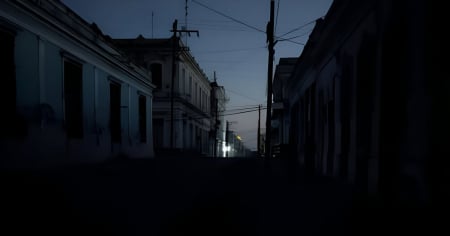
The Cuban government confirmed this Thursday that the country will return to the "levels" of blackouts that existed before the maintenance shutdown of the Antonio Guiteras thermoelectric power plant, thus acknowledging that the projections for a reduction during the months of July and August were not met.
The cause, as explained by the Minister of Energy and Mines, Vicente de la O Levy, is still the fuel deficit, a problem that the government has not managed to solve.
During his speech before the deputies at the first plenary session of the fifth ordinary period of sessions of the National Assembly of People's Power (ANPP), De la O assured that there has been intense work from "the highest leadership of the country," although he admitted that solutions have yet to arrive.
He reiterated that the supply of fuel continues to be the "most difficult problem to solve" due to high costs and external pressures. No concrete plan or dates were presented for a stable recovery.
A recent breakdown in a 110 KV transmission line caused the shutdown of the power plants in Havana and affected the Energás units, temporarily worsening the generation deficit.
According to the minister, the units are already in recovery, but power outages will remain at levels prior to the departure of Guiteras, meaning far from an acceptable normality.
De la O Levy also acknowledged that it has not been possible to progress at the same pace in the rehabilitation of the electrical networks, "given a situation as tense as that of generation, with significant financing needs," stated a report from the official portal Cubadebate.
Despite isolated efforts in the construction of solar parks (22 to date, with a generation capacity of 481 MW) and the recovery of some plants, the system remains vulnerable to unforeseen failures and lacks stability guarantees.
Despite insisting that there is a "viable strategy" for energy sovereignty, the minister acknowledged that much of the effort depends on projects still underway, such as the installation of photovoltaic parks and the recovery of thermal units using national fuels.
According to the sector head, among the actions being implemented "is the recovery of 850 MW in distributed generation. Efforts are being made to reach 1,400 MW available in thermal generation, maintain mobile generation, and restore emergency generators."
He assured that the country "has prioritized the limited financial resources available to support this program, both in dollars and in pesos" and that "only in national currency, more than 30 billion pesos have been allocated to back the executed actions".
The Cuban government's investment budget for 2025 reflected a partial shift in spending priorities, with a significant increase in renewable energy and debt repayment, although sectors such as tourism continue to receive a considerable portion of resources, significantly surpassing investments in health and social assistance.
The logic of “tourism first” has led to the systematic deterioration of the rest of the productive apparatus, in parallel with the collapse of the SEN, yet the government, despite warnings from economists about the need to settle debts, decentralize payment schemes, and adjust supply to real demand, remains anchored to a strategy that yields no results.
Meanwhile, Cubans continue to face no tangible relief from the constant blackouts.
The official reiterated that the measures include a combination of savings, regulation of state consumption, and control over non-state economic actors, without explaining how this will be enforced in practice or what the real impact on the population will be.
He also spoke about "advancing a communication strategy that facilitates understanding and popular support for these measures and the designed actions," in order to encourage rational energy use among consumers, but he did not mention accountability mechanisms or openness to public scrutiny.
Previously, before the members of the Committee on Industry, Construction, and Energy of the parliament, O Levy explained that in June, over 20 hours of blackouts were reported on average. “We started July with 18 and last Friday, 11,” he added.
For the summer, he announced, the units from CTE Carlos Manuel de Céspedes (Cienfuegos), Santiago de Cuba, and Santa Cruz del Norte (Mayabeque) should come online, although he explained that this does not mean that blackouts will end, but rather that "there will be an improvement."
The official strategy is built on a discourse of resistance and perseverance, but the concrete result is that the blackouts continue. And for now, there is no end date in sight.
The CTE Antonio Guiteras, located in Matanzas, finally managed to synchronize last Friday night with the National Electric System (SEN), after completing a maintenance shutdown that had raised hopes for relief amid the prolonged blackouts experienced by the Cuban population.
Despite being the main thermoelectric plant in the country, its commissioning does not guarantee a significant improvement in power outages. The problem, as acknowledged by Prime Minister Manuel Marrero before the National Assembly this week, lies in a system overwhelmed by a lack of fuel, technological obsolescence, and logistical failures.
In recent weeks, images of entire Cuban families sleeping on the street, on makeshift mattresses and under the sweltering summer heat on the island, have emerged due to the blackouts and the oppressive heat.
Frequently Asked Questions about the Electrical System in Cuba
Why do blackouts continue in Cuba despite the government's promises?
Blackouts in Cuba continue due to a fuel deficit and structural problems in the electrical system. The government has attempted to implement solutions such as the construction of solar parks and the recovery of thermoelectric units, but these efforts have not been sufficient to eliminate power outages. Financial constraints, the high cost of fuels, and technological obsolescence are factors that exacerbate the situation.
What measures is the Cuban government taking to improve the electricity supply?
The Cuban government is working on the installation of solar parks and the rehabilitation of thermoelectric units. Several solar parks have been synchronized, and there are plans to increase generation capacity through renewable energy. In addition, efforts are being made to rehabilitate the electrical grids and improve distributed generation, although the impact of these measures remains limited due to a lack of resources.
What is the role of the Antonio Guiteras Thermal Power Plant in the energy crisis in Cuba?
The Antonio Guiteras Thermoelectric Power Plant is one of the main generating plants in Cuba, and its operation is crucial for the national electrical system. However, it suffers from recurring technical issues and maintenance shutdowns that affect the stability of the electricity supply. The lack of technological updates and financial limitations complicate its efficient operation.
What impact do blackouts have on the daily lives of Cubans?
Power outages in Cuba seriously affect the quality of life of citizens, interrupting daily activities such as food preservation, access to water, and the use of appliances. Additionally, they create an atmosphere of frustration and social discontent, also impacting the national economy and causing productive interruptions.
Filed under: