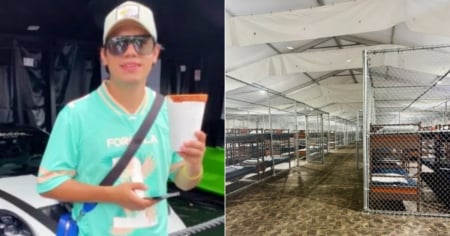
The legal situation of the migrant detention center known as Alligator Alcatraz has become even more complex following the first court hearing held this Monday, which was presided over by federal judge Kathleen Williams.
In the center of the process are the serious allegations of inhumane conditions, violations of due legal process, and an intense jurisdictional battle, the latter of which could hinder the lawsuit against the controversial center located in the Big Cypress reserve, within Florida's Everglades.
A key audience for the future of the center
The judicial process, which began on July 21 with an initial hearing of approximately one hour, aimed to establish the timeline of the litigation and, as a first step, determine whether the lawsuit is under the appropriate jurisdiction.
Judge Williams will need to decide whether the case should be held in the Southern District of Florida, as the plaintiffs maintain, or if it should be moved to the Central District, as argued by state authorities.
The Executive Director of the Florida Division of Emergency Management, Kevin Guthrie, stated that "all the detention centers, all the buildings, and all the pavement in question are located in Collier County, not in Miami-Dade," therefore the case should change jurisdiction.
However, Paul Schwiep, attorney for the environmental groups that have also filed legal actions, refuted that position and stated that “a substantial part of the events” related to the center took place in Miami-Dade County.
The next key date in the process will be July 30, when both parties must return to court.
Later, on August 6, Judge Williams will evaluate the request to temporarily suspend the operations of the center while the litigation progresses.
Accusations of inhuman conditions
The complaints presented in the class action lawsuit cite a series of irregularities ranging from lack of access to legal advice to alleged medical negligence.
One of the cases is that of Michell Borrego, who was arrested following a probation interview related to a prior criminal case.
His mother, Yaneisy Fernández, recounted that her son underwent emergency surgery and was returned to the center without time for recovery or appropriate medical care.
“The only thing that worries me is that my son gets an infection and dies,” Fernández declared, visibly distressed, in statements reported by Telemundo 51.
The woman recently received a call informing her that her son was transferred again in a wheelchair to the infirmary of the center.
Another striking testimony is that of Juan Palma Martínez, who was detained after an interview with immigration officials.
From inside the center, he described: “32 people trapped in a fence... too many mosquitoes... you can't stand... you can't walk... it's terrible.”
His wife, Yanet López, reported that her husband is "practically missing," with no official confirmation from ICE regarding his custody.
"She's like invisible, like a person who is not in anyone's custody," he lamented in statements to the mentioned outlet, where López added that "thousands of families are reporting serious problems in this place."
Protests and community support
The community has also started to mobilize in response to what they consider a serious violation of human rights.
The Archbishop of Miami, Thomas Wenski, publicly expressed his concern and stated that he is awaiting authorization to visit the center.
Meanwhile, in recent days he led a rosary in front of the facilities, accompanied by parishioners and a group of Catholic motorcyclists.
The environmentalist and political angle
Alongside the class action lawsuit regarding the conditions of the detainees, environmental groups filed another lawsuit claiming that the construction and operation of the center violate state and federal environmental laws.
These organizations aim to completely halt the construction and the transfer of more detainees to the site, which is expected to receive up to 900 people in just three weeks, according to estimates presented in court.
Critics believe that the center represents "a cruel and inhumane threat to ecologically sensitive wetlands."
On his part, Governor Ron DeSantis and other Republican officials defend it as part of the state strategy to support federal tough-on-immigration policies.
Even the Secretary of Homeland Security, Kristi Noem, praised the model promoted by Florida as an example for expanding detention capacity at the national level.
The legal battle surrounding Alligator Alcatraz has only just begun, and it ultimately shapes up to be a multifaceted conflict: a clash of jurisdictions, a debate over human rights, and a high-impact environmental dispute.
As the lawyers present their arguments and the families await answers, Judge Williams will be responsible for deciding the legal direction of one of the most controversial detention centers in Florida's recent history.
Filed under: