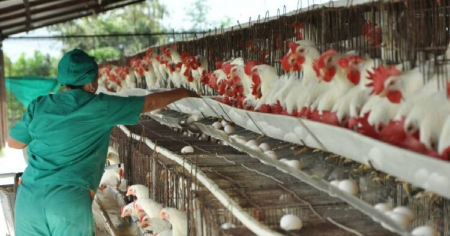
Amid an unprecedented food crisis, the official newspaper Granma has acknowledged on its social media the dramatic shortage of eggs in Cuba, a staple food that has now become a luxury for most households.
“Will it ever be possible to buy eggs at affordable prices? The prevailing reality demands a single solution: there must be hens on the farm so that there can be eggs on the family table,” the outlet published on X, triggering a wave of criticism and disbelief.
A luxury on the Cuban table
In various areas of the island, an egg can cost up to 120 Cuban pesos, which amounts to 3,600 pesos for a carton of 30 units, a figure that exceeds the monthly pension of a retiree. According to Granma itself, the average price ranges between 90 and 110 pesos per egg, a price unimaginable just a few years ago.
Small and Medium Enterprises (Mipymes) and the regime itself import eggs from the Dominican Republic, Brazil, and even the United States, paying for them in dollars. This practice, combined with rampant inflation and the unofficial exchange rate close to 400 pesos, has driven prices up in the domestic market.
National production in ruins
The Business Group for Food and Poultry (Gealav), which is part of the Ministry of Agriculture, acknowledges that the poultry production is at its worst. The lack of funding and feed led to the loss of over 1.3 million laying hens in 2024, drastically reducing the supply.
In statements to the aforementioned communist media, Jorge Luis Parapar López, president of Gealav, admitted that the situation is “very complex and unfavorable,” adding that “the hen is a very demanding animal; if it does not receive the proper feed, it will not lay eggs”.
It is worth noting that more than 90% of the inputs for the poultry sector are imported, including corn, soy, and vitamin premixes.
Solutions?
The government has established new "cooperated" management models with mixed and non-state companies, such as TabaCuba, which contribute foreign currency to import bird feed. However, these measures barely manage to sustain a minimal production aimed at tourism and priority social programs, such as the Maternal and Child Program, which has received just over 3.7 million eggs so far this year.
Meanwhile, the rest of the population can only buy eggs in the private market at exorbitant prices or in stores that accept freely convertible currency (MLC) or foreign currencies, where a carton is sold for $5.95, making it inaccessible for many families.
The uncertain future of eggs in Cuba
Granma admits that state poultry farming "is destined to fail" since producing an egg costs 8.65 pesos, while its regulated price is 2 pesos. The goal, according to Parapar López, is to rebuild the poultry stock in order to increase production in the future, although a short-term solution does not appear to be on the horizon.
Meanwhile, the question raised by Granma remains unanswered: Will eggs ever be an affordable food for Cubans again?
Frequently asked questions about the egg shortage in Cuba
Why is there a shortage of eggs in Cuba?
The shortage of eggs in Cuba is primarily due to a lack of financing and feed, which has led to a significant reduction in the number of laying hens. The dependence on imported inputs, such as corn and soy, has exacerbated the situation, severely impacting national production.
What is the price of eggs in Cuba?
In Cuba, the price of an egg can range between 90 and 120 Cuban pesos, which amounts to more than 3,000 pesos for a carton of 30 eggs. This price exceeds the minimum salary and pension in the country, making eggs unaffordable for many Cuban families.
What measures is the Cuban government taking to resolve the egg crisis?
The Cuban government has implemented cooperative management models with mixed and non-state enterprises to import feed for poultry. However, these measures only manage to sustain minimal production aimed primarily at tourism and priority social programs, leaving the rest of the population with limited access and high prices in the private market.
How does the importation of eggs affect the current situation in Cuba?
Cuba imports an average of 16.5 million eggs per month from countries such as the Dominican Republic, Brazil, and the United States. These imports, while helping to alleviate some of the scarcity, are not sufficient to meet domestic demand and have contributed to rising prices due to inflation and the devaluation of the Cuban peso.
Filed under: