The Cuban regime insists in its discourse that "a prosperous tourism will generate income, employment, and development," but a recent analysis by Cuban economist Pedro Monreal shows that the strategy is not working but rather sinking the sector and the people further into misery.
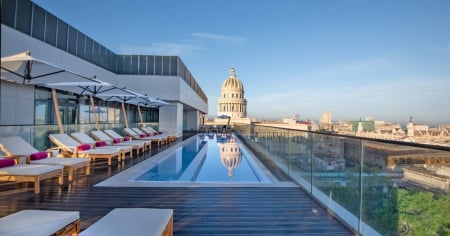
Despite the debacle of international tourism in Cuba, the regime continues to invest in the construction of new hotels. These multimillion-dollar investments, rather than responding to demand or sustainable development criteria, seem designed to benefit state-owned corporations.
Through a series of posts on social media platform X, Monreal denounced the "explosive expansion of the Ciego de Ávila tourist hub," which has quadrupled its capacity in just two years. He asserts that this is an example of a business model that prioritizes corporate logic over social well-being.
The real estate ‘business model’ views hotels primarily as an investment vehicle that generates profits for investor entities, mainly Cuban corporations, by renting out ‘their’ assets that are operated by others, Monreal explained.
This approach, far from focusing on tourism development as a true economic engine, seeks to maximize asset performance through "strategic positioning (exclusive location, brand), monopoly, state 'aid,' among other mechanisms."
Moreover, he pointed out that constructions are often contracted on a "turnkey" basis to foreign entities, and the tourism operations are delegated to international chains, which demonstrates that "it is not a priority to manage tourism activities" from within the country.
An investment that does not translate into results
The official data from the Cuban regime confirms the stagnation and decline of international tourism. According to the National Office of Statistics and Information (ONEI), by June 2025, 1,306,650 travelers arrived in Cuba, which is 319,654 fewer than during the same period in 2024.
The decline is even more dramatic when looking at international visitors: 981,856 as of June, a decrease of 25% (327,799 fewer tourists). Notable drops are seen in key markets such as Russia, which had 48,999 fewer visitors than the previous year, and Canada, which went from 577,624 to just 428,125 tourists.
“The investment primarily associated with tourism in Cuba has exceeded the value of the income generated by tourism. This roughly indicates that the tourism investment utilizes resources generated by other sectors,” Monreal warned.
The situation causes, in the words of the economist, that “national state corporations reliably benefit from ‘extra’ investment funds (through the state budget) and from tax and customs advantages.”
"Such types of corporations would have the ability to create and profit from financial assets thanks to the 'allocation' of state investment funds, monopolistic practices, and other 'assistance,' even when there is a substandard operation in tourism activities," he added.
Who are the hotels built for?
The statistics from ONEI itself reinforce this criticism. Hotel occupancy in the first quarter of the year was only 24.1%, indicating that more than 75% of the infrastructure remains idle, even during peak season.
Overnight stays dropped from more than 5 million to only 3.6 million, and tourism revenue fell by 21.5%. The Meliá chain, one of the most established on the island, reported a 20.8% decrease in revenue per available room and an average occupancy rate of just 40.5%.
“International tourism did not occupy even a quarter of the hotel capacity in the first quarter. This is a worse result than in 2024 and contradicts the official narrative of recovery,” Monreal stated.
Despite this outlook, the regime continues to promote new tourist developments. For what purpose? According to the economist, “the advancement of a ‘business model’ in tourist real estate in Cuba seems to be related to a disadvantageous investment pattern for development, but it is unlikely that the situation will change due to the ‘protection’ provided by its political connections and corporate opacity.”
Tourism no longer believes in the "Cuban socialist paradise."
The decline in tourism cannot only be explained by cold numbers. On social media, Cubans are responding emphatically to the official discourse. In a recent article published by Cubadebate, which questioned whether “the engine of the economy has stalled,” many internet users shared the real reasons why tourists are no longer choosing Cuba.
"But don't you realize that the tourist is human and who wants to go to a country without electricity, where people are bitter?" questioned a user.
"Our joy is fading... The tourist seeks human warmth, the empathy of the Cuban people, the joy in the streets, and that is no longer here. They are confronted with a scene of disgust; there is a stench, trash on every corner, and sewage water..." another added.
Some testimonies reflect personal experiences in hotels where basic products, such as eggs for breakfast, are scarce, and where workers are exhausted from the precarious living conditions.
A broken tourism and a model that persists
The contrast between the million-dollar investment in empty hotels and the deep crisis the country is experiencing has led many to ask: Who truly benefits from building hotels in a country without tourists?
The answer, according to Pedro Monreal, lies not in the real economy, but in a corporate logic that prioritizes real estate capital, state monopoly, and opacity over any criteria of sustainability, efficiency, or collective benefit.
Impact and Strategies of Tourism in Cuba in 2025
Why does the Cuban government continue to build hotels despite low occupancy?
The Cuban government continues to build hotels as part of a real estate business model that prioritizes real estate capital and state monopoly. This model primarily benefits state corporations that lease the assets to foreign entities for operation, without considering the actual demand for tourism. The construction of hotels is used as an investment vehicle to maximize asset returns, rather than focusing on the sustainable development of tourism.
What has been the decline in international tourism in Cuba in 2025?
In 2025, international tourism in Cuba has experienced a significant decline of 25% compared to the previous year. By June, 981,856 international visitors arrived, which is 327,799 tourists fewer than in the same period of 2024. This decline has severely impacted key markets such as Russia and Canada, contributing to a structural crisis in the tourism sector.
How does low hotel occupancy affect the Cuban economy?
The low hotel occupancy rate, which was only 24.1% in the first quarter of 2025, negatively impacts the revenues of the Cuban tourism sector. Tourism revenues have fallen by 21.5%, affecting the sector's ability to generate foreign currency and employment. The lack of demand has resulted in more than 75% of hotel capacity remaining idle, worsening the country's economic crisis.
What factors contribute to the decline of tourism in Cuba?
The decline of tourism in Cuba is influenced by multiple internal factors, such as the energy crisis, the lack of basic supplies, the perception of insecurity, and the limited air connectivity. These structural issues have undermined Cuba's competitiveness compared to other Caribbean destinations, leading to a significant decrease in international visitors and affecting the country's image as an appealing tourist destination.
Filed under: