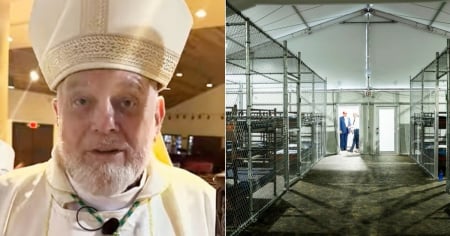
The United States Secretary of Homeland Security, Kristi Noem, announced that the detention center for migrants known as “Alligator Alcatraz,” located in the Florida Everglades, will be the model for a new network of state detention centers of the Immigration and Customs Enforcement (ICE).
In statements to CBS News, Noem explained that the goal is to replicate this type of facility in several states, including Arizona, Nebraska, and Louisiana, utilizing spaces close to airports to enhance operational efficiency.
"The locations we are considering are next to the airport runways, which will help us achieve unprecedented efficiency," he stated.
The "Alligator Alcatraz" center, built in just eight days at the Dade-Collier airport, accommodates up to 3,000 migrants and has become a symbol of the tightening of immigration policies under the Trump administration.
According to the Department of Homeland Security (DHS), the model represents a "more cost-effective" alternative to contracts with private prisons, with a cost per bed of $245 per night.
Noem highlighted that her strategy prioritizes shorter contracts, with a maximum duration of five years, and ensures a "more direct control" over detention conditions.
However, human rights organizations and legal experts have expressed their concern. Lawyers are denouncing prolonged detentions without access to immigration courts or legal resources, while some detainees have reported unsanitary conditions, including food with worms and limited access to drinking water and legal counsel.
Additionally, the legality of the state model has been called into question, as states do not have direct jurisdiction to enforce immigration laws without agreements with ICE.
A deterrence strategy
Noem defended the policy as an effective deterrent measure, supported by federal intelligence and testimonies from foreign leaders.
He pointed out that the visibility of these measures has encouraged thousands of migrants to voluntarily return to their home countries, fearing they may not be able to re-enter legally in the future.
The United States government will distribute 608 million dollars among state and local governments to build new detention centers for immigrants or to expand existing ones, as part of a growing immigration crackdown under the administration of Donald Trump.
The measure aims to alleviate overcrowding in current centers and reinforce the immigration policy of the Department of Homeland Security. The program is open for applications until August 8.
Frequently Asked Questions about the new detention center "Alligator Alcatraz"
What is "Alligator Alcatraz" and where is it located?
"Alligator Alcatraz" is a detention center for migrants located in the Everglades of Florida. It was built on an old airport and has the capacity to house up to 3,000 migrants. The center has been designed as part of a strategy to tighten immigration policies in the United States.
What is the objective of "Alligator Alcatraz" according to the U.S. government?
The goal of "Alligator Alcatraz" is to serve as a model for a network of state detention centers for ICE. Kristi Noem, Secretary of Homeland Security, explained that they aim to replicate this type of facility in several states to enhance operational efficiency and improve immigration control in the country.
What criticisms has "Alligator Alcatraz" received?
"Alligator Alcatraz" has been heavily criticized by human rights organizations, environmentalists, and political leaders. The criticisms focus on reported inhumane conditions, such as spoiled food and limited access to drinking water and legal resources. Additionally, its environmental impact and the legality of state jurisdiction without agreements with ICE have been called into question.
How is "Alligator Alcatraz" financed?
The funding for "Alligator Alcatraz" largely comes from FEMA's Shelters and Services Program. Kristi Noem indicated that FEMA funds will be used to cover the costs of the center, which total 450 million dollars annually. Florida is also expected to manage the initial costs and seek federal reimbursements.
Filed under: