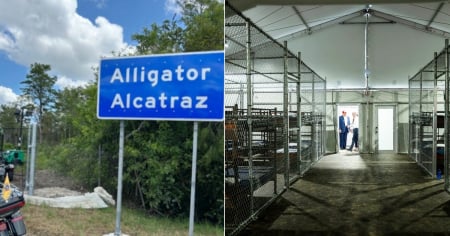
The U.S. government has firmly denied that there are detainees on a hunger strike at the immigration detention center Alligator Alcatraz in Florida.
"Fake news. There is no hunger strike at Alligator Alcatraz,” wrote the Department of Homeland Security (DHS) on its official account on X this Monday.
This is how the DHS responded to the complaints from activists who claim that several migrants, especially Cubans, have gone days without food in protest of the conditions at the center.
According to the government, the reports circulating are false, and they claim that those spreading them are damaging the image of the "brave agents" of the Immigration and Customs Enforcement (ICE) who are facing a significant increase in attacks.
"These false accusations against detention centers demean our brave ICE agents who are already facing an 830% increase in attacks against them,” the official statement added.
Despite the denial from the DHS, family members, human rights organizations, and media outlets have documented testimonies, forced transfers, and even hospitalizations that indicate the existence of an active protest in the center, where more than 1,500 people are currently detained.
Activists claim that there is more than one hunger striker
According to the Florida Immigrant Coalition (FLIC) and other pro-immigrant groups, at least a dozen detainees are participating in the hunger strike, as reported by local media.
These organizations have reported a decline in the health of several detainees, the arrival of ambulances over the weekend, and the transfer of some detainees to other facilities, which they interpret as a maneuver to disperse and disrupt the protest.
“They have transferred several individuals this weekend to other detention centers. I know of at least three people who were transferred to the Krome detention center,” said Thomas Kennedy, spokesperson for FLIC.
Videos shared by activists show ambulances leaving the center.
However, none of these strikers have been publicly identified, except for one: Cuban Pedro Lorenzo Concepción.
The case of Pedro Lorenzo Concepción
Pedro Lorenzo Concepción, 44 years old, has become the most visible face of this complaint.
However, Concepción has been moved from Alligator Alcatraz to the Krome detention center, from where he claims that he has been without food for 14 days in protest against his indefinite detention and the conditions of the Alligator Alcatraz center, where he was held until last weekend.
“I am still on hunger strike today, I still haven’t eaten,” he said in new statements published by El País this Tuesday.
"I refuse any assistance. Check the security cameras if you want," he added.
He was transferred on Saturday from Alligator Alcatraz to Krome, where he remains isolated and very weak, according to his wife Daimarys Hernández.
Her voice sounds weak, she can barely walk, and she needs a wheelchair.
Despite being on strike for nearly two weeks, Krome authorities informed Pedro Lorenzo Concepción that they will not officially recognize him as a striker until he rejects nine consecutive meals inside the new facility.
"They start counting from the day he arrived at Krome, not the other days he has gone without eating; that doesn't matter to them," explained his wife.
Lorenzo was arrested on July 8 during an annual appointment at the ICE offices.
Although years ago he served time for drug-related charges and possession of a weapon, his family says he has already paid for those mistakes and is now being punished again, despite having built a new life in the United States
Questioned conditions and official defense
The complaints against Alligator Alcatraz go beyond the strikes. Activists and family members have reported medical negligence, poor nutrition, lack of hygiene, insufficient legal representation, and confinement in inhuman conditions.
"They have had to clean toilets with their own hands due to a lack of water," Thomas Kennedy reported.
The DHS, however, asserts that the center is a model for future similar facilities.
The Secretary of Homeland Security, Kristi Noem, described it this week as a benchmark for similar centers that are planned to open in Arizona, Nebraska, and Louisiana.
Meanwhile, two legal actions are progressing against Alligator Alcatraz: one initiated by the ACLU for violations of migrants' rights, and another by environmental groups questioning the location of the center in the heart of a protected area of the Everglades.
Filed under: