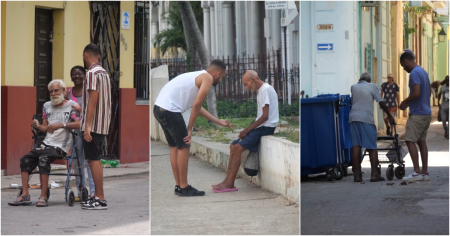
An 83-year-old man residing in Ciego de Ávila reported that he has gone days without eating and is surviving "on air," in a video testimony shared on social media by the user @DiazVismar38292.
The man, identified as Orlando Regueiro Castellano and originally from the municipality of Baraguá, explained that he has no money for food and walks the streets asking for "a little piece of bread," with most people unable to help him. “I’m dying of hunger… just a little piece of bread to eat,” he stated.
Orlando recounted that he had informed the police about his situation, but received a response stating that “they couldn’t do anything.” He also requested to enter a shelter, but was told that it was “very full” and that he would have to wait. “So how do you survive then?” they asked him in the recording. “On air... dying,” he replied.
The elderly man was in the city accompanying a sister who was hospitalized due to health issues, and she would be discharged in the coming days. During the conversation, his companion handed him 50 pesos so he could buy something, a gesture for which Orlando expressed his gratitude, insisting that all he asked for was a "little piece of bread."
The case has gone viral on X (formerly Twitter), where the user who shared the video stated that “you work your entire life only to end up abandoned and adrift,” blaming the Cuban political system for the lack of attention to the elderly.
A growing problem across the country
The story of Orlando adds to numerous cases of Cuban elderly living in extreme precarious conditions.
On the island, minimum pensions are around 1,500 Cuban pesos (a little over three dollars in the informal market), an amount that is insufficient to cover the basic basket, in a context of inflation, shortages of food and medicine, and high prices in the non-state market. Despite the recent approval of new increases for pensioners, non-governmental organizations report that it is clearly an inadequate measure.
In Matanzas, elderly individuals have been documented surviving by collecting cans or rummaging through garbage. In Santiago de Cuba, an elderly woman catches crabs to feed her grandchildren, while in Holguín, there have been reports of elderly people living in makeshift homes without access to water or electricity. In Havana, a 94-year-old woman reported that the current crisis is “worse than the Special Period” due to the lack of food, medicine, and electricity.
The massive migration of young people has left thousands of elderly individuals without family support. Many depend on neighbors or remittances sent from abroad, which do not always arrive or quickly lose value due to inflation.
State social assistance is nearly nonexistent, the capacity of shelters is very limited and their conditions are appalling, which, combined with the deterioration of the public health system, makes it even more difficult to care for this vulnerable group.
The testimony of Orlando reflects a structural crisis that particularly impacts the elderly population in Cuba. Authorities acknowledge demographic aging and the existence of communities in extreme poverty, but the cases that come to light show that the institutional response remains insufficient to meet the urgent needs of tens of thousands of elderly individuals.
Filed under: