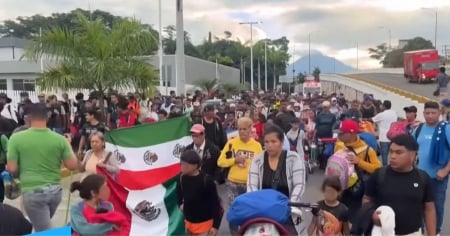
Part of the migrant caravan known as "Exodus of Justice", which has been advancing since last week through southern Mexico towards the capital, has begun to fracture after some, including several Cubans, accepted an agreement with the National Institute of Migration (INM) to obtain temporary stay permits.
The understanding has resulted in the voluntary surrender of migrants to the Mexican authorities, in exchange for temporary stay permits that would allow them to continue their journey to Mexico City.
The Mexican newspaper El Universal reports that initially at least 30 people from various nationalities -including Cuba, Nicaragua, Venezuela, Honduras, and El Salvador- have already received humanitarian visas and 30-day permits.
It is not clear how many Cubans exactly benefited from the agreement, nor whether there are others who are awaiting a similar pact.
It is expected that the documents they have provided will allow them to proceed legally by bus to the center of the country, where they hope to manage their immigration status.
Physical wear, fatigue, and distrust: The caravan fragments
One of the migrants who benefited from this program was Juan Pablo Urrutia Ríos, originally from Nicaragua, who explained to the mentioned outlet how the process unfolded after the approach from INM agents.
“They took us to the immigration regulation office in Tapachula, we waited a little over two hours and then they gave us the documents without any issue”, he stated to the Mexican newspaper.
Although part of the group chose to trust the institutional proposal, the majority of the caravan decided to continue their journey on foot, despite the harsh weather and physical conditions.
Women with children in their arms, the elderly, and people with injured feet walked over 30 kilometers during the night in the rain, until they reached an improvised shelter in a basketball court.
There, personnel from Immigration, officials from the Child Protection group Beta Sur, and representatives from the Ministry of the Interior were trying to persuade mothers with minors to accept official assistance.
The distrust towards the Mexican government, however, creates divisions among migrants.
The cited source revealed that an Ecuadorian family with a baby born in Mexico rejected the assistance from the INM, despite being promised a waiver of fines and assistance with immigration document processing.
On the afternoon of this Wednesday, the group decided to continue towards the community of Galeana, although several expressed their concerns about physical injuries, exhaustion, and the fear of more dropouts.
Census of Migrants
Last week, it was reported that the National Migration Institute (INM) of Mexico had begun to register the members of the migrant caravan in order to understand the type of process they have completed to regularize their status and to determine the options that will be offered to them.
According to a previous report by the same newspaper El Universal, last Friday, President Claudia Sheinbaum explained that the options for those who left Tapachula in a caravan include repatriation to their home countries as well as the possibility of accessing employment in Mexican territory.
Some participants expressed fear of being deceived, but they agreed to respond to the interviews and wait for the authorities' resolution.
The caravan consisting of hundreds of migrants, including many Cubans, departed on August 6 from Tapachula, in the Mexican state of Chiapas, heading north in search of relocation or legal means to migrate.
According to a report by CNN, the initial group, consisting of around 300 people, was made up of migrants from at least 12 nationalities, including Cuba, Venezuela, Nicaragua, and Honduras.
Many of these individuals spent months stranded at the southern Mexican border, trying to regularize their status unsuccessfully, after giving up on the American dream.
The return of Donald Trump to the White House and the have forced many to change their plans.
Now, migrants are targeting cities like Monterrey or the Mexican capital, where they hope to present themselves to diplomatic representations from countries such as Canada, Germany, Australia, or Switzerland that offer work visas.
Activist Luis Villagrán released after controversial detention
In parallel to these events, Luis García Villagrán, director of the Center for Human Dignification and one of the most prominent advocates for migrant rights in the region, was released.
Villagrán had been arrested last Tuesday on charges of organized crime related to human trafficking, charges that were ultimately dismissed by a judge due to insufficient evidence presented by the Attorney General's Office (FGR).
Upon leaving the prison, Villagrán stated that the arrest was part of a political persecution due to his reports against the INM and the Mexican Commission for Refugee Assistance (COMAR).
The activist has reported that these institutions charge up to 25,000 Mexican pesos to provide immigration documents or refugee status, a practice he has been denouncing for years.
"Let's hope there is no more government retaliation and no more fabrications of investigation files," he expressed after his release, adding that he is still assessing whether he will continue with his activist work following the events.
Filed under: