
Related videos:
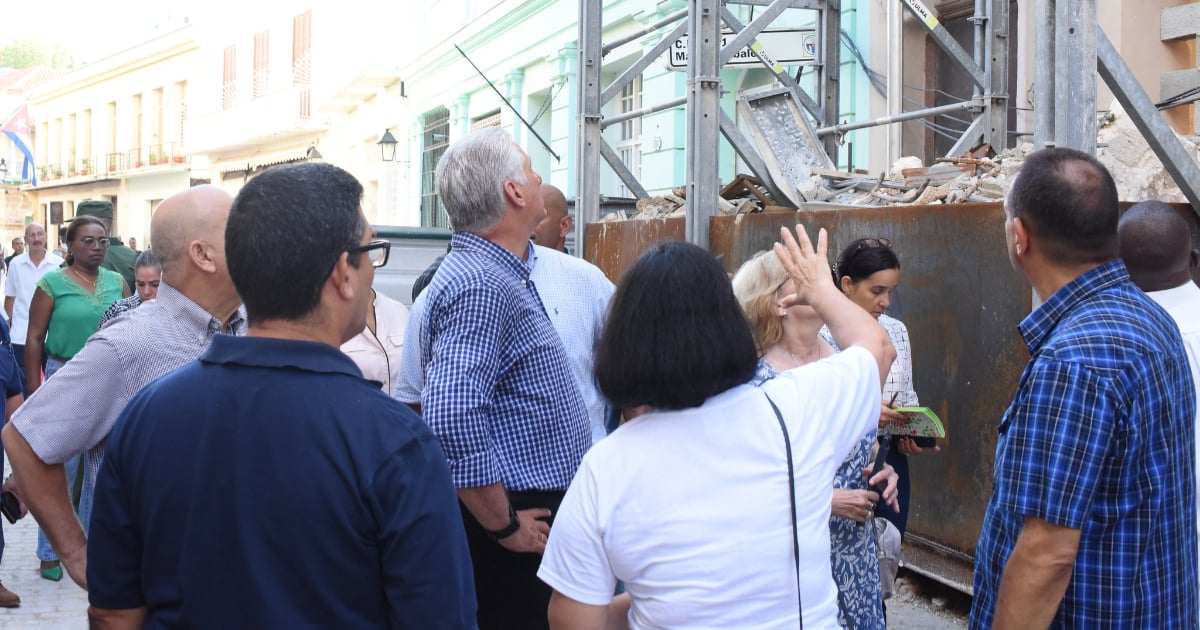
While Havana is still mourning the death of a baby and tallying the injured and affected after several recent collapses, Cuban leader Miguel Díaz-Canel toured heritage areas of the Historic Center on Thursday, accompanied by the leadership of the Communist Party, in what authorities described as a "working visit."
According to the official media outlet Tribuna de La Habana, the tour included recreational institutions and ongoing projects such as the redesign of the Antimperialist Tribune and the restoration of the “Ernesto Che Guevara” Pioneers Palace, founded by Fidel Castro in 1979.
The Presidency of Cuba shared on social media that Díaz-Canel "learned about significant investments" in housing construction and that "the dream of Fidel and Eusebio for Old Havana" remains alive, all this "amid the complex economic moment the country is experiencing."
But the contrast with reality has been, for many Cubans, as brutal as it is disturbing, because while the cameras follow the leader, stories of suffering are multiplying in the city's most vulnerable neighborhoods.
Recently, a five-month-old baby drowned in El Cerro after a wall collapsed due to heavy rains, and water violently flooded their home.
His mother, who was trying to collect some things in the middle of the storm, could not prevent the current from snatching the child from her arms. He was found still with signs of life, but did not survive. He was celebrating his fifth month of life that very day.
“Who pays for this death?” asked the activist Lara Crofs after the death of the baby. “We cannot continue to allow indifference and neglect to take innocent lives in our Cuba”.
In Regla, another girl was trapped under rubble after the collapse of a dilapidated house. Her mother sustained serious injuries. Entire families continue to wait for decent solutions, while reporting that they have only been offered uninhabitable spaces, lacking electricity, windows, or any minimal living conditions.
In Centro Habana, another collapse trapped an elderly man and his 10-year-old son, leaving them unable to go out for food. Local authorities told them that they had to demolish the walls at risk of collapsing themselves, despite the evident danger.
"The deterioration has been halted," said Díaz-Canel
During his visit, Díaz-Canel praised the partial restoration of the Palace of Pioneers and noted that "the deterioration has been halted," although he acknowledged that work must continue. However, in his remarks, there was no mention of the recent victims or the critical state of urban infrastructure that affects thousands of residents in Havana.
The leader also emphasized that the Antimperialist Tribunal should be a “frequent venue for denunciation against the blockade”, while calling for incentives for the workers involved in its restoration. The governor of Havana, Yanet Hernández, stated that the venue will host cultural activities and political events.
However, the images circulated on social media show a city battered not only by the weather but also by decades of institutional neglect. Each rainy season claims new victims. And while the government insists on talking about dreams and anti-imperialist plazas, Cubans live in fear of being buried alive in their own homes, amid official indifference.
Presidential visits and reports from the official press once again seem to overlook the question the people are asking: when will the government stop masking ruins while the country crumbles?
Frequently Asked Questions about the Recent Collapses in Havana and Díaz-Canel's Visit
What motivated Díaz-Canel's recent visit to Old Havana?
Díaz-Canel's visit to Old Havana was presented as a "working visit" focused on historical heritage, including restoration projects and housing construction. However, this visit has been criticized for its disconnection from the reality of building collapses and the difficulties faced by local residents.
How have the recent rains and floods affected Havana?
The recent rains and floods have caused serious problems in Havana, resulting in landslides in several areas of the city, leaving victims and those affected. The deficient infrastructure, with blocked drainage systems and deteriorated buildings, has worsened the impact of the rains.
What has been the government's response to the collapses in Havana?
The government response has been criticized for focusing on official visits and symbolic projects, without effectively addressing the urgent needs of the population affected by the collapses. Authorities have been accused of ignoring structural deterioration and the critical living conditions of many residents in Havana.
What impact have the collapses had on the lives of residents in Havana?
The collapses have had a devastating impact on the lives of residents in Havana, leaving many families homeless and in extremely precarious living conditions. Despite promises of rehabilitation, the lack of concrete actions keeps citizens in constant risk and vulnerability.
Filed under: