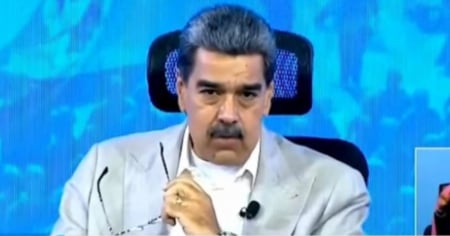
Nicolás Maduro took advantage of the commemoration of the birth of the Cuban dictator Fidel Castro, who would have turned 99 on Wednesday, to reaffirm the alliance between his government and the Cuban dictatorship.
According to the Venezuelan leader, both countries must be "more united than ever" in the fight against what he described as the "supremacists of the Gringo empire."
The speech, delivered at the Palacio de Miraflores during the reception of a Cuban delegation, included references to the resistance against the "immoral mafias that strike against the peoples of the world," in a clear attempt to justify the alliance with Havana and portray the close bilateral relationship as a heroic struggle against the United States.
Among the visitors was Elián González, the raft child who returned to Cuba after surviving a shipwreck while en route to the United States, a symbol of Cuban propaganda.
Maduro, ideologically aligned with the Cuban regime, emphasized the supposed historical connection and shared values between both countries and honored Fidel Castro and Hugo Chávez as the guiding figures of an "indestructible historical project."
"If something were missing, the light of Fidel and Chávez is shining brighter today than ever," he added.
However, their statements contrast sharply with the harsh reality: Venezuela and Cuba maintain authoritarian systems that restrict political freedoms, suppress dissent, and rely on clientelist and economic relationships to sustain their regimes.
The tribute to Castro, who was responsible for decades of absolute control in Cuba through a rigid and repressive model of communism, reinforces Maduro's narrative of presenting the Cuban regime as a symbol of humanity and resilience, while ignoring the economic collapse and humanitarian crisis affecting both countries.
The alliance between Caracas and Havana, established since Hugo Chávez came to power in 1999, involves the sending of Venezuelan resources to the Island in exchange for political and military support, keeping both governments in a cycle of mutual dependence and international isolation.
Maduro's emphasis on unity with Cuba does not stem from national needs, but rather from the preservation of a shared power between dictatorships that have eroded democracy and plunged their citizens into poverty and repression.
Last Monday, he issued a harsh warning against the United States and, in particular, against President Donald Trump, after Washington doubled the reward to $50 million for information leading to his arrest.
Flanked by his main military and police leaders during the broadcast of his television program Con Maduro +, the leader of the Venezuelan regime asserted that an attempt to capture him could trigger "the end of the American empire".
"I say to the imperialists, and to my people: do not dare, because the response could mark the beginning of the end of the American empire. Leave those who are at peace alone. I am a man of peace, but I am a warrior," he declared defiantly.
The threat from Maduro comes just days after the U.S. Department of Justice and the Department of State announced the increase to 50 million dollars in the reward for his capture, accusing him of leading the Cartel de los Soles and coordinating massive shipments of cocaine to U.S. territory.
For its part, Havana also criticized the announcement made by U.S. Attorney General Pam Bondi, who stated that her government would not relent in its goal of bringing Maduro to justice.
In X, the leader Miguel Díaz-Canel accused Washington of acting as a "global judge" to justify "illegal and unilateral measures against Venezuela and its legitimate president."
In the same vein, Foreign Minister Bruno Rodríguez Parrilla described the reward as "fraudulent" and characterized it as "a new act of aggression against that sister nation," asserting that the United States "lacks the legal and moral authority" for such a measure.
Frequently Asked Questions about the Alliance between Cuba and Venezuela
Why does Maduro claim that Cuba and Venezuela need to be more united than ever?
Maduro asserts that both countries must unite more than ever to confront what he calls the "white supremacists of the gringo empire." This statement is part of a reaffirmation of the alliance between his government and the Cuban regime, using a rhetoric of resistance against the United States as justification for this union.
How is the alliance between Cuba and Venezuela manifested?
The alliance between Cuba and Venezuela is reflected in the transfer of Venezuelan resources to the Island in exchange for political and military support. This relationship has remained steady since Hugo Chávez came to power in 1999, and it persists through an exchange of political and economic benefits that keep both governments in a cycle of mutual dependence and international isolation.
What criticisms are made of Maduro's government regarding its relationship with Cuba?
Criticism of Maduro's government regarding its relationship with Cuba focuses on the erosion of democracy and the impoverishment of its citizens. Critics argue that this alliance does not address the national needs of Venezuela, but rather serves to preserve shared power between dictatorships that restrict political freedoms and rely on patronage and economic relationships for their survival.
What role does Fidel Castro play in the narratives of Maduro and Díaz-Canel?
Fidel Castro is presented as a guide and historical reference by both Maduro and Díaz-Canel. In their speeches, both leaders exalt Castro's figure as a symbol of resistance and humanity, ignoring the economic and humanitarian crises affecting their countries. The exaltation of Castro reinforces the official narrative of both governments, which seek to legitimize their regimes through a tale of heroic struggle and resistance against the United States.
Filed under: