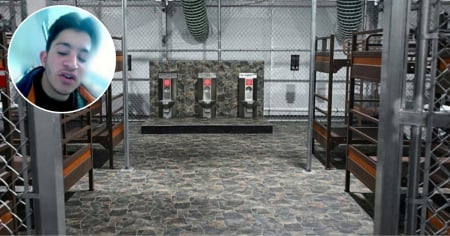
A Cuban who decided to participate in the self-deportation program through the CBP Home app reported that, after returning to the island, he has not received the promised payment from the United States government and described the experience as “a deception.”
The testimony was shared by journalist Mario J. Pentón on his social media, where the migrant, whose name was not disclosed, detailed how the voluntary departure process through the application went.
The man explained that he entered the U.S. in August 2024 through the family reunification parole, but in June of this year he lost his work permit. Two weeks later, he registered on the CBP Home app and, by mid-July, he received an email with instructions to arrange his return.
He was contacted at least three times from different numbers, until they finally assigned him an officer in Virginia, to whom he was required to report every step of his departure.
“They asked me to send a photo of my valid passport, to notify them when I entered the airport, when I checked in, when I went through immigration, and even when I was seated on the plane. I had to report everything via WhatsApp and email,” he recounted.
The migrant specifically asked how the payment of the promised stipend would be made since, due to the embargo, there are no banking agreements between the U.S. and Cuba. The response he received was that a "financial team" would handle the disbursement and that he would receive it in cash upon arriving on the island.
“Finally, I arrived in Havana and the only thing I found was silence,” she reported, asserting that to this day, she has not received the money or any response from the authorities.
Precisely, at the airport of the Cuban capital, the migrant was separated at immigration control and questioned about his status in the U.S., his work permit, and his previous jobs. "I felt a very uncomfortable moment; I even thought that they didn't want me there," he recalled.
"A deception for the Cubans"
The Cuban noted that, while migrants from other countries like El Salvador received credit cards as part of the self-deportation program, in his case and that of other compatriots, there is no clarity regarding the payment mechanism.
I wanted to tell everyone who is thinking of applying to reconsider if they have no other option. It really is a deception they are creating, at least for Cubans," he stated.
The CBP Home application was launched in March 2025 as a replacement for CBP One. Among its main features is the ability for undocumented immigrants to notify their "intention to leave" and coordinate a voluntary return.
In April, it was revealed that at least 2,500 migrants had already registered for self-deportation, and in May, the administration of Donald Trump announced that those who participated in the program would receive 1,000 dollars and a plane ticket as an incentive.
The government defended the measure as a way to provide migrants with a "dignified exit" and reduce deportation costs, while human rights organizations warned that it is a mechanism that could leave those returning to contexts of poverty or persecution in greater vulnerability.
The experience recounted by this Cuban adds a new layer of uncertainty that widens the gap between what the application promises and what those who choose to return actually receive.
Frequently asked questions about the use of CBP Home and the self-deportation of Cubans
What is CBP Home and how does it work for self-deportation?
CBP Home is an application launched by the U.S. Customs and Border Protection Office in March 2025 to facilitate the self-deportation of undocumented immigrants. It allows users to notify their intention to leave the country and coordinate a voluntary return. Users must follow a detailed process, including reporting each step of their departure through the app.
What incentives does the self-deportation program offer for Cubans?
The program offers a $1,000 incentive and a plane ticket to those who voluntarily self-deport. However, there are testimonies from Cubans who have returned to the island and have not received the promised payment, which has generated distrust and reports of non-compliance.
What are the legal risks of opting for self-deportation with CBP Home?
Opting for self-deportation can have serious consequences for the future immigration prospects of Cubans. They could face sanctions of up to 20 years without being able to legally return to the United States. It is crucial for migrants to assess their situation with an immigration lawyer before making a decision.
Why do some Cubans consider self-deportation a "deception"?
Some Cubans consider self-deportation a "deception" because, upon returning to Cuba, they have not received the financial stipend promised by the U.S. government. Moreover, the legal and banking complexities between the two countries hinder the transfer of these funds, leaving migrants in a vulnerable situation.
Filed under: