
Related videos:
Always explosive, remembered by many for that home run in Baltimore in 1999 and for his performance with the "mules" from Havana, Andy Morales is a happy man who knew how to choose his path wisely. He didn't succeed in the best baseball in the world, but he walks successfully in a country that welcomed him with open arms.
You could have stayed in the United States after that game between the national team and the Baltimore Orioles, why didn't you?
In '99, it didn't cross my mind to stay since at that time my wife was expecting my first child with her (I had another one in San Nicolás). And it seems returning was bothersome; honestly, I don’t know what to tell you. The undeniable fact is that, later on, everyone knows that they made my life uncomfortable.
I had returned from the "monster," I had hit a home run, it had been a celebration, and the members of the National Commission were adamant that I was "a potential defector."
It was all because my father-in-law, who was a U.S. citizen, visited Cuba at that time, and they associated that with a defection. Incredible but true! So they forced me, yes, they forced me to choose a path I never thought I would take.
It was in this way that I experienced two attempts to leave by raft; the second, fortunately, was successful, and here I am, with my home, with my family well settled and happy, with a professional baseball player son. Grateful for life and for second chances.
In the end, those who wanted to destroy me did me a favor!
In June 2000, Morales attempted to leave Cuba illegally on a boat, but he was captured and repatriated. Shortly thereafter, he managed to leave the country again, this time successfully.
He first settled in Peru and, after obtaining residency in that country, signed a free agent contract with the New York Yankees in February 2001. However, his time in the U.S. minor leagues did not meet expectations.
With the Norwich Navigators (Double-A), he participated in 48 games and batted just .231. This poor offensive performance did not allow him to advance. After his departure from the Yankees, he played briefly in the independent league with the Sonoma County Crushers.
In 2002, he signed with the Boston Red Sox and played with their Double-A affiliate, the Trenton Thunder, although his performance was also modest: in 16 games, he batted .231, with an on-base percentage of .348 and a slugging of .282.
After that season, Morales did not sign with any professional organization in the United States. His career ended without having made his debut in the Major Leagues.
However, not everyone can make it, and this is well understood by an Andy Morales who carved his path in the land of opportunities.
Regarding "those" who made your life impossible in Cuba, what do you think of the current state of Cuban baseball?
The reality of Cuban baseball today is a result of the system's inefficiency. Everything has been destroyed, everything has come to an end. There are no facilities in any province, no equipment to play with, and no places to play. What food do children and young people in the EIDES receive, and what events are held?
Now from a very young age, baseball players emigrate. Santo Domingo is filled with the best of Cuban baseball, many with no experience in the National Series because they leave as children.
So, the ones they stigmatized are the very same people they are now begging to represent them in international competitions. Do they have any shame?! Listen, Julita, regarding the issue of calling on players who were once labeled traitors to represent Cuba, I must say that my generation faced the most degrading part: they called us all sorts of names, stigmatizing us with whatever they could think of to belittle us as individuals. They targeted our families who stayed behind in the country.
And now those who are leaving are called to represent the "four letters" after the humiliations they've endured? Incredible! That's why many like me have NEVER returned. I don't criticize those who do; everyone has their own perspective, and everyone is free to think in their own way.
Now, if I were fit, young, and active, it would never cross my mind to play with them. That suit does not represent a free country, it doesn't represent me or my people. I repeat, those who do it, congratulations, they must have their reasons.
Pulling back a bit on the course of this interview: how did you find yourself on a baseball field?
I was born in Ciego de Ávila. However, my early experiences were in the baseball fields of the municipality of San Nicolás in Havana. The first time I entered a stadium, I was six years old. My first coaches were my own father, Adelso Morales, and Demetrio Miranda, known as "Puchito," in that area.
Time passed, and I studied at the EIDE and provincial ESPA with Esteban Lombillo, Rubén Prieto, “El Capi,” and Carlos Viera, depending on the level, as coaches.
In 1991, I joined my first team Habana under the guidance of José Miguel Pineda. I have a story from those early days that I would rather not remember. In my second SNB, I was the only player who batted once and hit a home run with three RBIs, none other than against Pedro Luis Lazo.
Imagine my excitement, but upon arriving in Havana, Jorgito Hernández, who was the director at the time, sent me to the Development League.
And why?
I still wonder about it. The truth is that due to my performance in that Development Series, I joined the Cuba team, with which we went to a tournament in El Salvador, and coincidentally, José Ariel Contreras was also on that team.
Later on, Juan Antonio Torriente, who was the third baseman, suffered an injury to his arm, and Barroso, who was the manager of that team, gave me the opportunity to be the starter. From that point on, I performed excellently, which led me to join the very competitive Selective Series, as well as the Cuba B selections, until the great year of 1999 when we faced the Orioles.
After 40 years, Cuba faced a professional MLB team, a truly historical event, and I had the honor of being the only one to hit a home run.
After all this time, could you tell me who your favorite manager has been, the one you got along with best, the one you learned the most from?
I played with many directors, but the one I felt most comfortable with was Dario Cid from Ciego de Ávila, once in a Cuba B in Italy and another time in Havana at a Universitario, achieving tremendous results.
What are you currently doing?
I work in a family business owned by my father-in-law. It's about air conditioning. I'm content; I have my family here, my four children are with me—what more could I ask for?
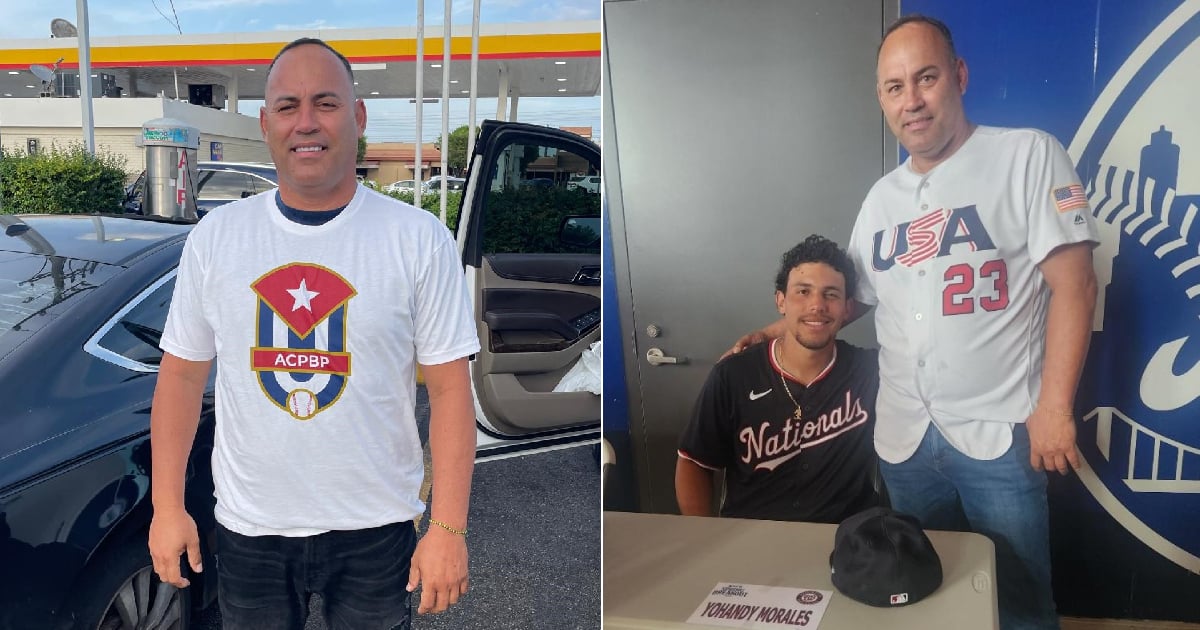
One of them, Yohandy plays first and third base in Triple-A for the Washington Nationals, and of course, his dream is to make it to the Major Leagues. I am very happy with his performance and eager for him to achieve his dreams.
This is a great country, one that welcomed me like a son. I live happily. I didn't make it to the MLB, but I am confident that my son will, and a Morales from my generation will take a place in the Big Leagues.
Filed under: