
Related videos:
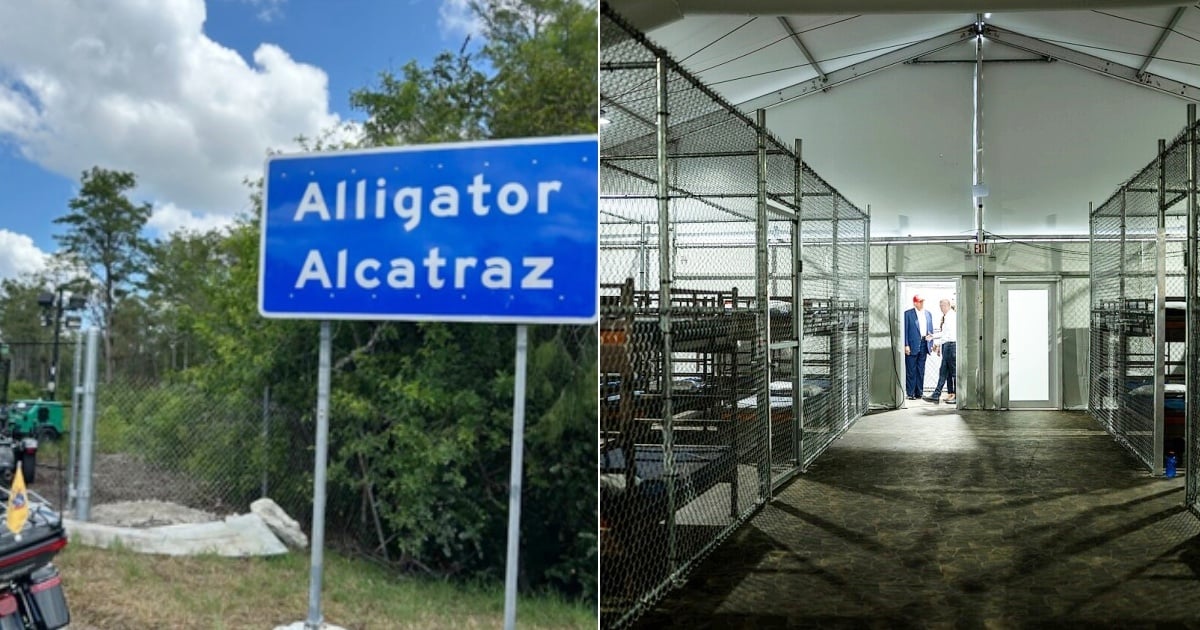
A federal judge in the United States has issued one of the most significant rulings of the year: the permanent closure of the immigration detention center known as "Alligator Alcatraz," built by the Trump administration in the protected wetlands of the Everglades, west of Miami.
Judge Kathleen Williams, from the Southern District of Florida, ordered the complete dismantling of the camp within a maximum of 60 days and prohibited the entry of new detainees, citing "irreparable" damage to the ecosystem, according to news agencies.
The judicial resolution - spanning 82 pages - responds to a lawsuit filed by environmental organizations Friends of the Everglades, the Center for Biological Diversity, and the indigenous Miccosukee tribe, who warned that the installation violated basic environmental regulations and endangered more than 30 protected species.
"Each governor of Florida, every senator from Florida, and countless local and national political figures, including presidents, have publicly pledged their unwavering support for the restoration, conservation, and protection of the Everglades," wrote Judge Williams.
"This order merely enforces the basic requirements of the legislation designed to fulfill those promises," he added.
The order: No new arrests, no expansion, no exceptions
The court ruling explicitly prohibits the admission of more detained individuals to the location, except for those who were already present at the time the order was issued.
Also prohibits any type of expansion or intervention on the land: new tents, buildings, offices, or fences may not be installed, nor will paving, excavation, or modifications to the existing infrastructure be allowed.
After the 60-day grace period, the state government of Florida, which operates the center in coordination with federal agencies, must:
-Remove all perimeter fences and allow free access for the Miccosukee tribe.
-Uninstall the generators, gas systems, waste, and drainage.
-Remove industrial lighting and other non-natural components added to the environment.
The judge also made it clear that this is a permanent suspension of the expansion, which replaces a preliminary order issued two weeks earlier, when the expansion of the camp had already been temporarily prohibited.
A direct and quantifiable environmental damage
The Everglades are one of the most sensitive and iconic ecosystems in the United States, home to unique species such as the Florida panther, the American stork, the Mississippi alligator, and the American crocodile, all classified as endangered or vulnerable.
According to the forensic reports and expert testimonies presented during the hearing, the construction of the center involved:
-The paving of at least 20 additional acres, which altered the soil's capacity to absorb water.
-Increase in the runoff of chemicals and nutrients into protected areas.
-Damage to the habitat of endangered fauna and forced migration of species.
-Amy Castaneda, director of water resources for the Miccosukee tribe, testified that the center disrupts the water balance in the area:
"The runoff of nutrients from the detention center could flow into tribal lands, altering vegetation growth, affecting wildlife, and hindering human and animal movement," he stated.
Inhumane conditions for migrants
Although the ruling is based on ecological reasons, the conditions inside the facility have also raised public concern.
Various organizations, journalists, and members of Congress reported serious human rights violations within the center.
At its peak occupancy, Alligator Alcatraz housed 1,400 migrants, many of them in tents without ventilation or adequate services. The accounts from detainees and lawyers agreed on:
-Food infested with worms and collapsed bathrooms.
-Massive presence of mosquitoes and insects.
-Constant electrical failures in an environment of extreme temperatures.
-Detainees spending days without access to showers, medication, or legal assistance.
"The toilets were not functioning, there was sewage on the floor, and the food was rotten," stated one of the testimonies gathered during the hearing.
The judge recalled that back in the 1960s, a megaproject for a tourist airport on that same land was rejected due to its potential impact on the Everglades.
"What was unfeasible more than 50 years ago due to its environmental impact cannot be considered suitable now as a site for such an installation," Williams concluded.
Political context: Trump, DeSantis, and the judicial resistance
The detention center was directly championed by President Donald Trump, who visited the site weeks before its opening and presented it as a national model.
Florida Governor Ron DeSantis publicly supported him as part of a policy for stricter immigration control, and has already announced the opening of a second center in an abandoned prison near Gainesville.
The operation of the center is managed by the Florida Department of Emergency Management, in coordination with the Immigration and Customs Enforcement (ICE).
Despite this, the state attorneys argued during the trial that federal environmental laws did not apply because "the facility was a state project to house federal detainees."
Judge Williams dismissed this argument and reaffirmed federal jurisdiction over the case. This has sparked a political reaction.
The state attorney general, James Uthmeier, and DeSantis himself have questioned the impartiality of the judge, arguing that she was appointed by former President Barack Obama.
"It seems that the state itself understands that they could be ordered to close this, whether this week, next week, or in the future," said Democratic Congressman Maxwell Frost after visiting the center and confirming that the number of detainees had decreased to just 336.
An environmental victory with lasting legal impact
The ruling represents an unprecedented victory for environmental organizations and Indigenous communities that have been fighting for the protection of the Everglades for decades.
“This is a historic victory for the Everglades and for countless Americans who believe that this endangered ecosystem must be protected, not exploited,” said Eve Samples, executive director of Friends of the Everglades.
"Send a clear message that environmental laws must be respected by leaders at the highest levels of our government, and that there are consequences for ignoring them," he added.
The plaintiffs also recalled that the center was built without environmental impact studies, risk assessments, or public consultation processes, in clear violation of federal law.
What's next?
Although Judge Williams has set a two-month deadline, authorities have already begun transferring migrants to other facilities. However, Florida is expected to appeal the decision, prolonging the battle in federal courts.
Meanwhile, the pressure on federal agencies like ICE and DHS is increasing.
Despite operating the center indirectly, they have not issued any official statements regarding the closure so far. The silence suggests caution in light of the judicial setback and the political tension it has generated.
Filed under: