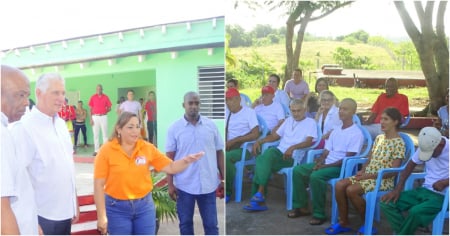
The Cuban leader Miguel Díaz-Canel openly questioned the agricultural producers of the country during a visit to the CPA Amistad Cuba-Cambodia, in the municipality of Jaruco, where he praised the results achieved by that cooperative under adverse conditions but issued a direct criticism of the rest of the national agricultural sector.
"You, in the hardest years, with less fuel and resources, achieve good results and have increased yields. Now, you have applied science and innovation. Why haven't other Cuban producers done it this way? What is needed to make it happen?" Díaz-Canel questioned.
The leader did not stop at the rhetorical question; he increased the inquisitive tone. "Good results are based on will, they are not due to resources; they come from will and understanding the moment we are in, because from difficult moments solutions arise. Fidel Castro taught us that," he stated.
The phrase, rather than highlighting the "successful" experience of this sugar CPA, hinted at a critique of the widespread inefficiency of the rest of the agricultural production apparatus in the country, which is experiencing a sustained crisis of low yields, shortages, and loss of labor force.
What are the results of the CPA that Díaz-Canel praised?
The CPA Amistad Cuba-Cambodia specializes in sugarcane cultivation. Díaz-Canel expressed that “these are the examples that do not allow us to give up” upon learning that the cooperative has consistently increased its yields.
Luis Pérez Gil, president of the CPA, assured that in the 2023/2024 campaign, 22.44 tons per hectare were achieved, and it is expected that by the 2025/2026 harvest, 44 tons per hectare will be reached, thanks to the use of agroecological techniques and the Cuban biostimulant Lebame, made with efficient microorganisms.
Initially, the use of the product faced resistance, but its application has now spread due to the results achieved. "Seeing the results we are getting, now everyone wants it," stated Pérez Gil.
The cooperative has 2,437 hectares, of which more than 850 are dedicated to sugarcane, although only 52% of that area is planted. They dedicate more than 700 hectares to livestock, including cattle, sheep, goats, and soon buffalo. There are 314 hectares for forestry plantations and more than 40 hectares for fruit trees and various crops.
Diversification allows them to be self-sufficient for their cafeterias and sell some products to the community and prioritized centers. They also trade in charcoal, round timber, milk, and meat from various species, and even provide technical and transportation services to other production units, including cutting and hauling sugarcane during the harvest season.
The income allows for an average monthly advance of 12,200 pesos (30 US dollars at the current exchange rate in the informal market) for cooperative members, 10,350 (25 dollars) for contracted workers, and up to 45,000 pesos (111 dollars) in the case of the sugarcane brigade, figures that, according to the president of the CPA, ensure job stability.
Frequently asked questions about agriculture and production in Cuba under the Díaz-Canel regime
Why does Miguel Díaz-Canel criticize Cuban agricultural producers?
The Cuban leader Miguel Díaz-Canel criticizes agricultural producers for not achieving the same results as the CPA Amistad Cuba-Cambodia, which has increased its yields under adverse conditions. Díaz-Canel argues that the key to success is "will" and not resources, suggesting that the agricultural sector is inefficient due to a lack of determination.
What achievements of the CPA Amistad Cuba-Cambodia did Díaz-Canel highlight?
The CPA Amistad Cuba-Cambodia has achieved an increase in its sugarcane yields to 22.44 tons per hectare in the 2023/2024 campaign, with an expectation of reaching 44 tons by 2025/2026. It has excelled in the use of agroecological techniques and the Cuban bio-stimulant Lebame, which has generated interest and adoption among other producers.
What is the current situation of sugar production in Cuba?
The production of sugar in Cuba has fallen to less than 150,000 tons in the 2024-2025 harvest, marking a historic low. The sugar crisis is due to the shortage of cane, frequent blackouts, lack of fuel, and deteriorating infrastructure, which forces the country to rely on imports to meet domestic demand.
What measures has Díaz-Canel proposed to address the agricultural crisis in Cuba?
Díaz-Canel insists on "working hard" and appeals for voluntary work to overcome the agricultural crisis. However, he has not proposed deep structural reforms, limiting himself to exhortations about "will" and "creativity" as solutions, despite the restrictions and lack of supplies that producers face.
Filed under: