
Related videos:
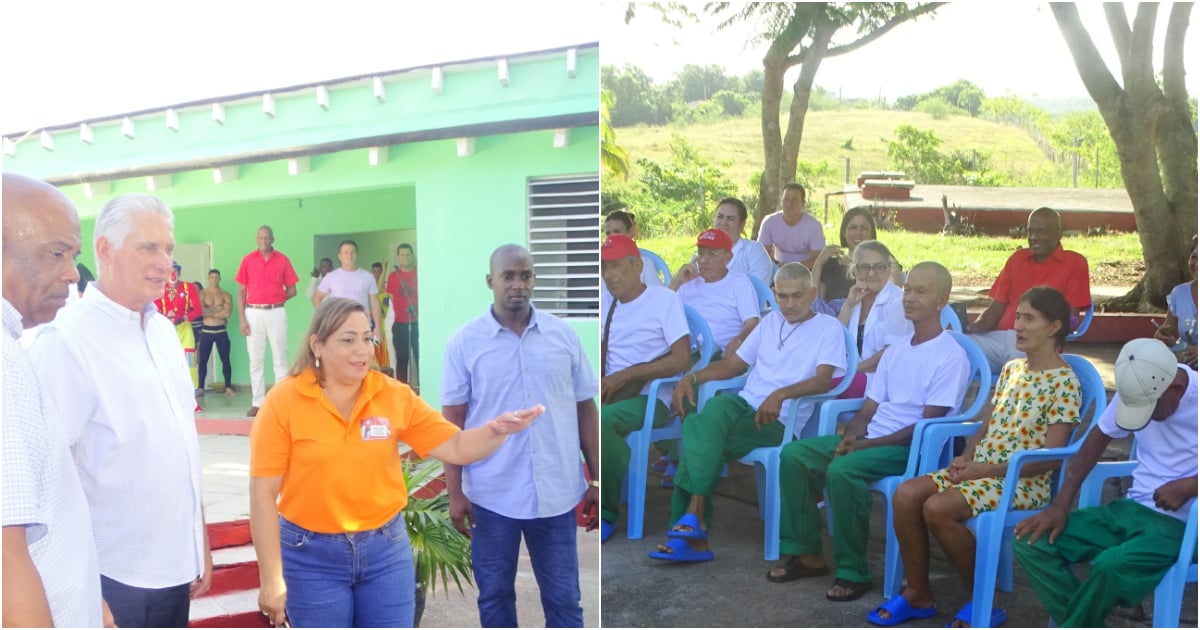
The president Miguel Díaz-Canel visited the William Darias Social Protection Center in the municipality of Santa Clara, presented as an example of care for homeless individuals, amid the controversy over the state’s abandonment of thousands of beggars who continue to live on the streets of Cuba without real solutions.
Since July, 43 individuals have passed through the facility that accommodates homeless people, of which only 30 currently remain there, despite the institution having the capacity for 60, reported the official journalist Henry Omar Pérez through his profile on Facebook.
Accompanied by the first secretary of the Communist Party in Villa Clara Susely Morfa and the provincial governor Milaxy Yanet Sánchez, the leader toured dining halls, dormitories, and medical consultations, greeting elderly individuals as they participated in a cultural event, during a visit aimed at highlighting the image of a state that provides solutions to marginalization.
Maraiky León Iglesias, head of the Provincial Department of Prevention, Assistance, and Social Security of the Provincial Directorate of Labor in Villa Clara, explained that the procedure for those individuals focuses on interviews, bathing, medical diagnoses, provision of clothing and food, followed by transfer to dormitories, complemented with cultural and sports activities that serve as a reintegration formula.
He also pointed out that among the solutions being implemented there are "the return of individuals to their provinces of residence, reunification with their families, or admission to nursing homes or psychiatric hospitals, depending on the specifics of each case."
According to the report, Díaz-Canel stated that this was not just about addressing a social issue, but about transforming lives and leveraging the knowledge of those who pass through the center, words that contrast with the absence of a real plan for the thousands of Cubans wandering the streets and terminals of the country without any kind of assistance.
The opening of the Provincial Center for Social Protection in Villa Clara took place just days after the former Minister of Labor and Social Security, Marta Elena Feitó Cabrera, denied the existence of homeless individuals in the country.
On July 14, the then Minister of Labor and Social Security, Marta Elena Feitó Cabrera, stated in one of the parliamentary committees that in Cuba “there are no beggars,” but rather people who are “disguised”, whom she also described as “drunks” and “simulators.”
His statements denying the existence of hunger on the island and blaming citizens for their poverty situation sparked an outburst of outrage on social media, independent media outlets, and among various sectors of the public.
Hours later, the Political Bureau of the Communist Party of Cuba and the Council of State accepted her resignation, which was submitted, according to official sources, after a “joint analysis” with the government leadership.
Two days later, the government acknowledged that more than 310,000 residents on the island are currently living in poverty or social vulnerability, amidst a deep economic crisis.
At the end of the month, Prime Minister Manuel Marrero Cruz visited the center for assisting homeless individuals in Ciego de Ávila, in an effort to address the criticism arising from the statements made by the former minister.
While the Cuban state glosses over poverty with euphemisms like "the homeless" and "vulnerable," a growing population of elderly, sick, and marginalized individuals survives outdoors in Matanzas and the rest of the Cuban provinces, without effective policies to support them or a genuine willingness to acknowledge what the country hides under the rug.
Even the state-run press has acknowledged this, which in recent reports has showcased that other city beneath the city, the forgotten layer where those who have lost almost everything -home, family, mental health, job- search through debris to survive.
The provincial newspaper Girón published on August 1 an investigative piece that revealed the serious situation faced by dozens of “homeless” individuals in the Social Protection Center of Jagüey Grande.
The report "Inhabitants of Dust (II): The Land That Was Never Promised" documents the living conditions in this place that, according to the gathered testimonies, seems less like a shelter and more like "a cemetery of living men."
The Agreement 10056/2025 of the Council of Ministers defines “wanderers” as “a multicausal disorder of human behavior” that involves “instability and insecurity at home, lack of self-care and economic autonomy, absence of family support or protection, as well as a favorable life project.”
The measure does not clearly address how to reverse begging, but rather how to manage its visibility. Although the government seems to offer solutions, in reality the conditions that create begging in Cuba are not being addressed.
Frequently Asked Questions about the Situation of Begging in Cuba and Díaz-Canel's Visit to the Care Center in Villa Clara
What was the reason for Miguel Díaz-Canel's visit to the William Darias Social Protection Center?
The visit of Díaz-Canel aimed to highlight the image of a State that provides solutions to marginalization amidst the controversy surrounding the state's neglect of thousands of homeless people in Cuba. The visit was conducted to showcase the facilities of the center as an example of care for roaming individuals.
What has been the government's response in Cuba to the homelessness crisis?
The government has attempted to downplay the crisis through statements that deny the existence of beggars and has promoted the creation of care centers like the one in Villa Clara. However, these efforts do not address the structural causes of begging, such as economic collapse and social disintegration.
What did the former minister Marta Elena Feitó declare about homeless individuals?
Former Minister Marta Elena Feitó denied the existence of beggars in Cuba, stating that they are "disguised" individuals looking for an "easy way of life." Her statements generated outrage and criticism both inside and outside of Cuba, which led to her resignation.
What has been the international reaction to the situation of begging in Cuba?
The situation has generated international attention and criticism, with media outlets from around the world highlighting the lack of empathy and disconnection of the Cuban government regarding poverty in the country. The resignation of Minister Feitó and the statements made by President Díaz-Canel have been widely covered by the international press.
Filed under: