
Related videos:
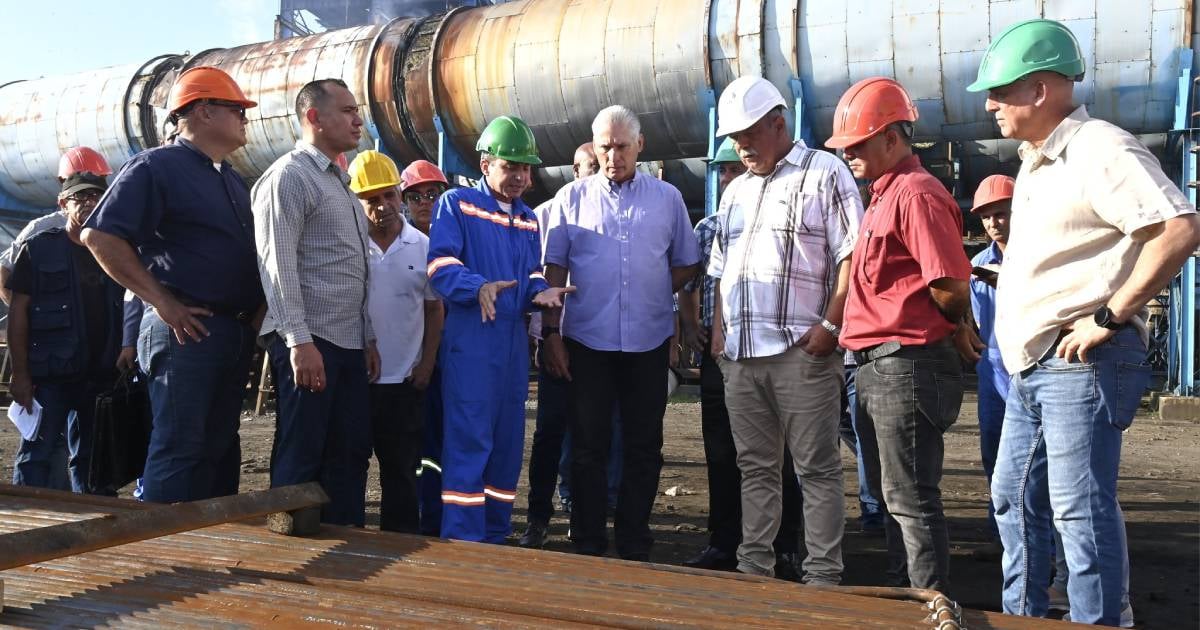
The Cuban leader Miguel Díaz-Canel visited the Ernesto Guevara Thermoelectric Power Plant in Santa Cruz del Norte this Thursday and demanded that the plant's management supervise "even the welds" in the repairs, in an effort to demonstrate control over an energy crisis that offers no respite to millions of Cubans.
In a thread published by Presidencia Cuba on X, the president called for prioritized attention to the workers involved in maintenance, stating that “the recovery of the electrical system is today's priority for the country.”
However, while Díaz-Canel was strolling among engineers and welders, the Electric Union (UNE) confirmed that blackouts would once again exceed 1,800 MW of impact, leaving almost the entire island under prolonged power outages, insomnia, and unbearable heat.
This is not the first time Díaz-Canel has appeared at the thermoelectric plant. He did so in 2022 and 2024, and always with the same promise that “this time for sure” the capacities will be recovered.
This time, he even emphasized that the work would be monitored "down to the welds," a phrase that highlights the obsession with cosmetic details while the population awaits electricity.
However, while the president spoke about energy recovery, the Electric Union (UNE) reported that power outages would extend throughout the day, with an estimated impact of 1,420 MW at noon and an even greater collapse during peak hours, with 2,240 MW of deficit against a demand of 3,800 MW, which will result in 1,630 MW of outages across much of the country.
On Wednesday, the island also experienced widespread outages throughout the 24 hours, with a maximum impact of 1,869 MW at 8:50 p.m., a figure higher than expected due to the shutdown of unit 6 of the Nuevitas Thermal Power Plant.
Official data confirms what millions of Cubans are experiencing firsthand, turning "normality" into darkness.
Díaz-Canel's visit to Ernesto Guevara is part of the official propaganda strategy to demonstrate concern for the crisis, but the results remain the same, anchored in promises of modernization, solemn phrases, and increasingly long power outages.
A plant with a history of failures
The Ernesto Guevara Thermoelectric Power Plant was built in the early 1990s with three generator blocks of around 100 MW each, operating on crude oil and fuel oil. For more than a decade, it has been functioning under severe technical limitations, having exceeded its capital maintenance cycles.
In April 2023, a fire in unit 3 temporarily halted its repairs, delaying synchronization with the National Electric System. And although at times its three units have managed to provide nearly 190 MW to the country, the lack of parts, fuel, and modernization have turned the plant into a symbol of the precariousness of the electrical system.
The government itself announced a modernization plan with Russian financing last March, which includes the installation of a new 200 MW block, but to this day, everything remains in the realm of promises.
Frequently asked questions about the energy crisis in Cuba and the role of Díaz-Canel
Why did Díaz-Canel visit the Ernesto Guevara Thermal Power Plant?
The Cuban leader Miguel Díaz-Canel visited the Ernesto Guevara Thermal Power Plant to oversee repairs and emphasize the need to pay attention to details, such as welding, in an attempt to demonstrate control over the energy crisis affecting the country. However, his visit was criticized for focusing on superficial aspects while the population continues to endure prolonged blackouts.
What is the current situation of blackouts in Cuba?
The Electric Union of Cuba has reported blackouts exceeding 1,800 MW in impact, leaving much of the country without electricity. The energy deficit is a persistent problem, exacerbated by outdated infrastructure and a lack of fuel, making power outages a daily reality for Cubans.
What measures is the Cuban government taking to address the energy crisis?
The Cuban government has announced plans for the modernization of thermoelectric plants and the installation of solar parks to increase electricity generation capacity. However, these projects have remained promises without tangible results, and the population continues to face prolonged blackouts and deteriorating living conditions.
How has the Cuban population reacted to Díaz-Canel's management during the energy crisis?
The Cuban population has expressed its discontent and skepticism regarding Díaz-Canel's promises to resolve the energy crisis. Criticism is constant on social media, where citizens question the lack of effective solutions and the government's tendency to blame the U.S. embargo and other external factors instead of taking responsibility for poor internal management.
Filed under: