
Related videos:
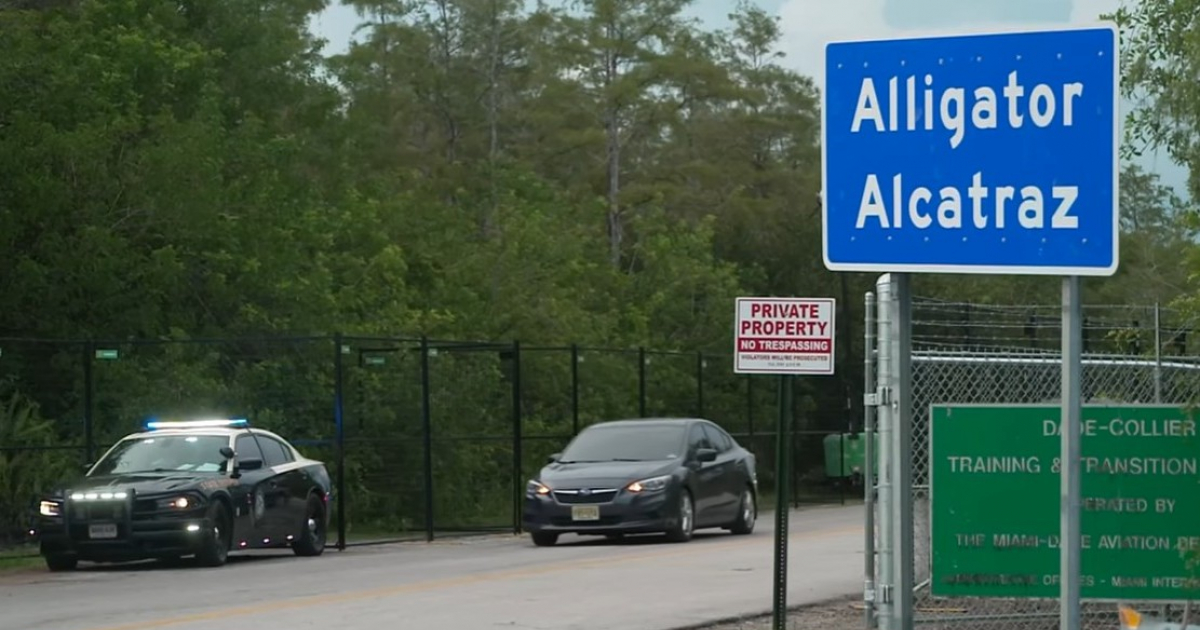
The state of Florida is once again under judicial scrutiny. A new federal lawsuit, filed by civil and immigration rights organizations, directly challenges the legality of the operation of the immigrant detention center known as Alligator Alcatraz, located in the Everglades.
The action, reported by Telemundo 51, represents the third significant legal challenge against the facility, driven by Governor Ron DeSantis as part of his immigration crackdown strategy.
The lawsuit was filed in the Middle District Court of Florida by the ACLU, the ACLU of Florida, the Community Justice Project, and the National Immigrant Justice Center.
The court document asserts that the state lacks the authority to operate an immigration detention center under 287(g) agreements, which only allow state police to receive federal training to assist with immigration tasks, but do not authorize states to detain individuals during the deportation process.
The plaintiffs argue that the camp—dubbed Alligator Alcatraz by the state officials themselves—operates outside the regulations of the Immigration and Customs Enforcement (ICE).
According to the complaint, systematic violations of the rights of detainees occur there, including detentions without formal charges, lack of custody or bail hearings, exclusion from the official detainee location system, and severe obstacles to accessing lawyers or appearing before immigration courts.
The action was filed on behalf of a detainee identified as M. A., although the advocating organizations are seeking to certify it as a class action, which would allow them to represent all immigrants held at the facility.
The plaintiffs are requesting a temporary restraining order and an injunction requiring the state to immediately suspend the detentions at the facility and to officially declare that Florida has no legal authority to operate that center.
"In the thirty years since the enactment of Section 1357(g), no state has claimed authority to operate detention centers. Florida is the first to attempt this, and it has done so without oversight, without trained personnel, and by delegating immigration functions to private contractors. This is exactly what Congress sought to prevent," the complaint states.
Background of a Center Under Judicial Fire
This new lawsuit adds to two previous legal battles.
The first was led by civil rights lawyers, who reported pressures on migrants to sign deportation orders without access to legal representation, as well as severe limitations in communicating with their defenders.
The second came hand in hand with the Miccosukee tribe and environmental groups, who filed environmental lawsuits alleging violations of federal laws and irreparable harm to endangered species in the Everglades.
Just a few days ago, federal judge Kathleen Williams ordered the permanent closure of the site, stating that its construction had caused irreversible environmental damage. The ruling requires the facilities to be dismantled within a maximum of 60 days, although the state has already announced that it will appeal.
These controversies are compounded by revelations from the Miami Herald regarding the contractors involved in the project. Five of the companies hired by Florida to build and operate Alligator Alcatraz have histories of fraud, overpricing, and misappropriation of public funds.
Among them is SLSCO, under investigation for employing armed guards without legal status during the construction of the border wall and for charging inflated rates at shelters for asylum seekers in New York.
Also appearing are Garner Environmental Services, accused of abusive billing; IRG Global Emergency Management, linked to fraudulent claims following hurricanes; and the Canadian conglomerate GardaWorld, responsible for dozens of fatal accidents involving its armored trucks.
Even CDW Government, a supplier of electronic equipment for the center, acknowledged that it is under federal investigation for alleged fraud in public contracts, after having paid more than five million dollars in 2013 to settle a similar case.
A questioned model
Since its inauguration in July 2025, Alligator Alcatraz has been presented by DeSantis and Donald Trump as a model to replicate in future immigration facilities.
However, the testimonies of detainees and lawyers paint a radically different picture: inhuman conditions, tents without ventilation, collapsed restrooms, food infested with worms, constant power outages, and swarms of mosquitoes in the sweltering heat.
Far from establishing itself as a symbol of "efficient migration control," the center has become an emblem of abuses, opacity, and mismanagement.
For environmentalists and indigenous people, the closure ordered by Judge Williams represents a historic victory.
For civil rights advocates, the new lawsuit is an opportunity to set a precedent that will curb future state attempts to manage immigration detention facilities outside the bounds of federal law.
The future of Alligator Alcatraz seems already doomed in the courts.
What is at stake now is not only the closure of a controversial center, but also the national debate over the limits of state authority in migration matters and the human, environmental, and financial costs of mass deportation policies.
Frequently asked questions about the Alligator Alcatraz detention center and its legal situation
Why has the state of Florida been sued over the Alligator Alcatraz center?
The state of Florida has been sued for operating the Alligator Alcatraz detention center without proper legal authority, which the plaintiffs claim violates the rights of the immigrants detained there. The complaints include detentions without formal charges, lack of access to court hearings, and barriers to obtaining legal representation, as well as environmental violations in the Everglades.
What are the reported conditions at the Alligator Alcatraz center?
The conditions at the Alligator Alcatraz center have been described as inhumane, including overcrowding, lack of ventilation, spoiled food, and collapsed bathrooms. Detainees and lawyers have also reported a massive presence of mosquitoes and the lack of access to basic services such as showers and medical assistance.
What environmental impact has the Alligator Alcatraz center had on the Everglades?
The Alligator Alcatraz center has caused irreparable damage to the Everglades ecosystem, according to a court order that highlights the paving of protected areas and the alteration of habitats for threatened wildlife. The absence of an environmental impact assessment prior to its construction has been one of the main criticisms from environmental groups.
What is the future of the Alligator Alcatraz detention center?
The future of the Alligator Alcatraz detention center is in the hands of the courts. A federal judge has ordered its permanent closure and the dismantling of its facilities within 60 days due to environmental impacts and violations of rights. However, the state of Florida plans to appeal the decision, which could prolong the judicial process.
Filed under: