
Related videos:
The U.S. Department of Health and Human Services (HHS) has confirmed the first human case of New World screwworm infection in U.S. territory.
It is a devastating parasitic disease that, while common in some Central and South American countries, rarely affects humans.
The infected person had recently returned from a trip to El Salvador, a country currently affected by an outbreak.
The official confirmation arrived on August 4, after the Maryland Department of Health and the Centers for Disease Control and Prevention (CDC) reviewed the case. This was reported by Andrew G. Nixon, spokesperson for HHS, in an email to the Reuters agency.
Although Reuters had previously reported that the person was from Guatemala, Nixon did not address the discrepancy in the information, which has contributed to growing uncertainty, especially in the livestock sector.
"The risk to public health in the United States from this introduction is very low," Nixon assured, trying to allay fears about a potential national outbreak.
What is the boring worm?
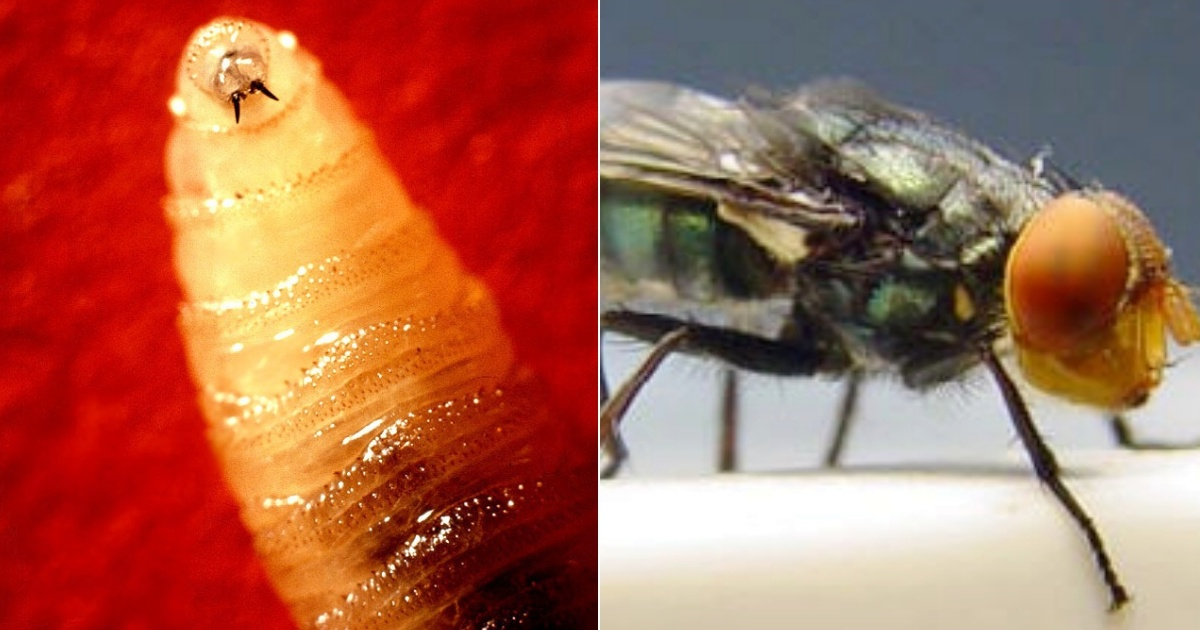
The New World screwworm is a carnivorous parasitic fly (scientific name: Cochliomyia hominivorax) whose females lay eggs in open wounds of animals or humans.
Upon hatching, the larvae use sharp mouthparts to penetrate and devour living flesh, causing infections that, if left untreated, can be fatal.
The name of this pest derives from the way the larvae enter the body, similar to a screw boring into wood.
These infections are especially devastating to livestock and wildlife.
“The treatment is not simple and requires the extraction of hundreds of larvae and thorough disinfection of the wounds,” the CDC indicates.
However, if detected early, the disease can be successfully treated.
The case in a human detected in Maryland was adequately treated, and state authorities implemented preventive measures, although the details remain confidential for privacy reasons.
Lack of transparency and concern among veterinarians
The case has caused concern in the veterinary and agricultural sectors due to the lack of transparency from the CDC.
According to Beth Thompson, South Dakota's state veterinarian, many learned about the case "through other channels" and had to pressure the CDC for information.
“They were not transparent at all. They left it up to the state to confirm anything that may have happened or been found with this traveler,” Thompson stated to Reuters.
Other state veterinarians also noted that they learned about the case through a call with the CDC, without any direct or immediate notification.
A market on high alert
The news comes at a delicate time for the U.S. livestock industry.
Livestock traders and meat producers are on edge due to a potential infestation in animals, especially now that cattle prices are reaching historical levels.
The country's livestock herd is at its lowest level in seven decades.
According to calculations from the U.S. Department of Agriculture (USDA), an outbreak of the worm could cost the Texas economy about $1.8 billion in losses due to animal deaths, labor costs, and veterinary treatments.
“We remain optimistic that, since awareness is currently limited to industry representatives and state veterinarians, the likelihood of a positive case emerging is low, minimizing the impact on the market,” wrote an executive from the Beef Alliance industrial group in an internal email obtained by Reuters.
The growing threat from Central America
The corn borer was eradicated from the United States in the 1960s through a successful program of releasing sterile male flies, a strategy that remains in use today.
However, since 2023 the plague has begun to advance once again from Central America through Mexico.
In July, Mexico reported a new case in Ixhuatlán de Madero, Veracruz, just 595 km from the U.S. border.
In response, the USDA ordered the closure of livestock trade through southern entry ports, intensifying a measure that had already been in effect since November.
Currently, there is only one operational facility for the production of sterile flies in Panama City, with the capacity to generate 100 million specimens per week.
But the USDA estimates that at least 500 million would be needed weekly to contain the spread of the pest to the south, especially towards the Darién Gap, between Panama and Colombia.
Mexico, for its part, announced in July the construction of its own plant worth 51 million dollars to produce these flies, while in the U.S., Agriculture Secretary Brooke Rollins announced plans to establish a new plant at Moore Air Force Base in Edinburg, Texas, although it will not be operational for another two or three years.
A health and political challenge
This first human case could become a political issue for Secretary Rollins and health authorities if the outbreak is not contained.
Pressure is mounting among livestock producers as the USDA faces criticism for its apparent sluggishness in expanding the production of sterile flies and securing the southern border.
Additionally, the discrepancies in information—such as the patient's country of origin (Guatemala or El Salvador)—and the unclear management by the CDC have left a bitter feeling among experts and local authorities.
Although U.S. authorities insist that the risk to the population is "extremely low," the first human case of screwworms serves as an early warning of a potential health and economic crisis if outbreaks in animals are not contained.
Historical experience shows that disease can be eradicated with well-funded and coordinated strategies. However, time is pressing, and the livestock industry—which generates billions of dollars annually—cannot afford improvisation.
"An undetected infection can kill livestock within a few weeks," warn experts from the USDA.
With traps, mounted horses patrolling the border, and fly factories under construction, the United States is trying to prevent a parasite that was once defeated from becoming established again.
Frequently Asked Questions about the Screwworm Disease in the U.S.
What is the New World screwworm?
The New World screw-worm is a carnivorous parasitic fly whose scientific name is Cochliomyia hominivorax. Females lay their eggs in open wounds of animals or humans, and upon hatching, the larvae devour living flesh, causing infections that can be fatal if not properly treated.
What is the risk of an outbreak of the burrowing worm in the U.S.?
Although a human case has been confirmed in Maryland, the risk of a national outbreak in the U.S. is considered very low by authorities. However, the situation has the livestock industry on alert due to the severe economic consequences that an infestation in cattle could entail.
How is the spread of the boll weevil being combated?
The United States eradicated the invasive worm in the 1960s through a program that released sterile male flies. This strategy is still being used today, although the capacity for producing sterile flies is insufficient to contain the advancing pest from Central America. New plants are being built to increase production.
What impact would an outbreak have on the livestock economy in the U.S.?
A outbreak of the boll weevil could have a serious economic impact. It is estimated that it could cost Texas around $1.8 billion in losses due to animal deaths, labor costs, and veterinary treatments. The livestock industry is on high alert, as it is already facing historic prices and a herd at its lowest level in seven decades.
Filed under: