The new school year in Cuba will begin on September 1st with an image that summarizes the daily struggle of thousands of families, as children will have to share one notebook between two subjects, a symbol of the precariousness and neglect facing public education as it approaches the 2025-2026 academic year.
In a Round Table broadcast on Wednesday, the Minister of Education, Naima Trujillo, acknowledged the obvious: the so-called "adjusted norm" halves the distribution of report cards.
What sounds technical in official language actually means that a primary school child will have three notebooks for six subjects, or that in secondary school they will have to cut them in half to make do. And if the family cannot pay the 200 CUP that a notebook costs on the black market, the student will have to manage as best as they can.
Uniforms: between scarcity and the black market
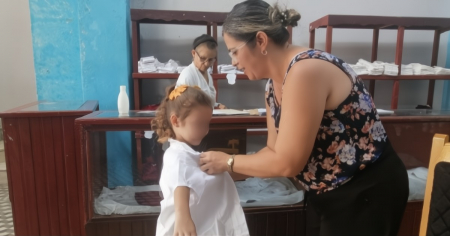
The other major blow comes with the uniforms. Of the 3.6 million garments needed, only 2.3 million were produced. The official decision was to prioritize a select few initial grades, leaving the rest of the students dependent on inherited uniforms, patched garments from sewing workshops, or the black market, where a uniform exceeds 5,000 pesos.
The ministry itself admits that barely 20% of the students will debut a new uniform in September. The rest will have to wait until October, and hopefully receive just one piece. The absurd scene is already circulating in Cuban households: a fifth-grade girl was given a size 20, intended for secondary school teenagers.
On the other hand, the authorities celebrate repairs in 816 educational institutions, but behind that figure lies an uncomfortable truth, most classrooms will open with leaking roofs, broken windows, and worn-out desks. Since 2018, it has not been possible to replace school furniture, and in some children's circles, children have to sit on the floor due to a lack of chairs.
The promise of 150,000 cold light tubes to improve classroom lighting will arrive late. On September 1st, thousands of students will start classes in dark or makeshift classrooms.
Moreover, the government triumphantly announces the arrival of new improvement books, but only students in the 2nd, 4th, and 8th grades will have them in their hands. The rest of the students will have to continue using old texts or, at best, access digital versions in a country where connecting to the internet remains a luxury.
A "party" turned into resistance
The start of the school year, which should be a celebration of learning, has become a act of resistance for parents, teachers, and students.
While the official speech extols the dedication of seamstresses and teachers, families bear the real costs of supplying notebooks, purchasing uniforms on the black market, improvising desks, and praying that it doesn't rain on classrooms in ruins.
More than a triumph, the start of the 2025-2026 school year reveals the harshness of a system unable to ensure even the most basic requirements. In Cuba, studying today demands the same creativity and sacrifice as surviving.
Filed under: