
Related videos:
More than 1.5 million Cuban students are preparing to start a new school year on September 1st amid power outages, uniform shortages, and the deterioration of educational infrastructures.
According to Cubadebate, the Minister of Education, Naima Ariatne Trujillo Barreto, acknowledged that the reopening has relied on "creative solutions" and community support.
Although he used Santiago de Cuba as an example, which he claims has 99% teacher coverage, he acknowledged that there is no uniformity across the country and that many classrooms could only be prepared thanks to cooperatives, local businesses, and families.
The textile industry also failed to meet the demand. Of the more than 3.6 million uniforms planned, only 2.2 million were produced.
The Deputy Minister of Industries, Yamilin González Milian, explained that the power outages forced factories to operate with generators in provinces such as Villa Clara and Santiago.
In light of the shortage and the inability to meet demand, the "plan" is to prioritize the early grades, preschool, 5th, and 7th, and to extend the delivery to the rest in September and October.
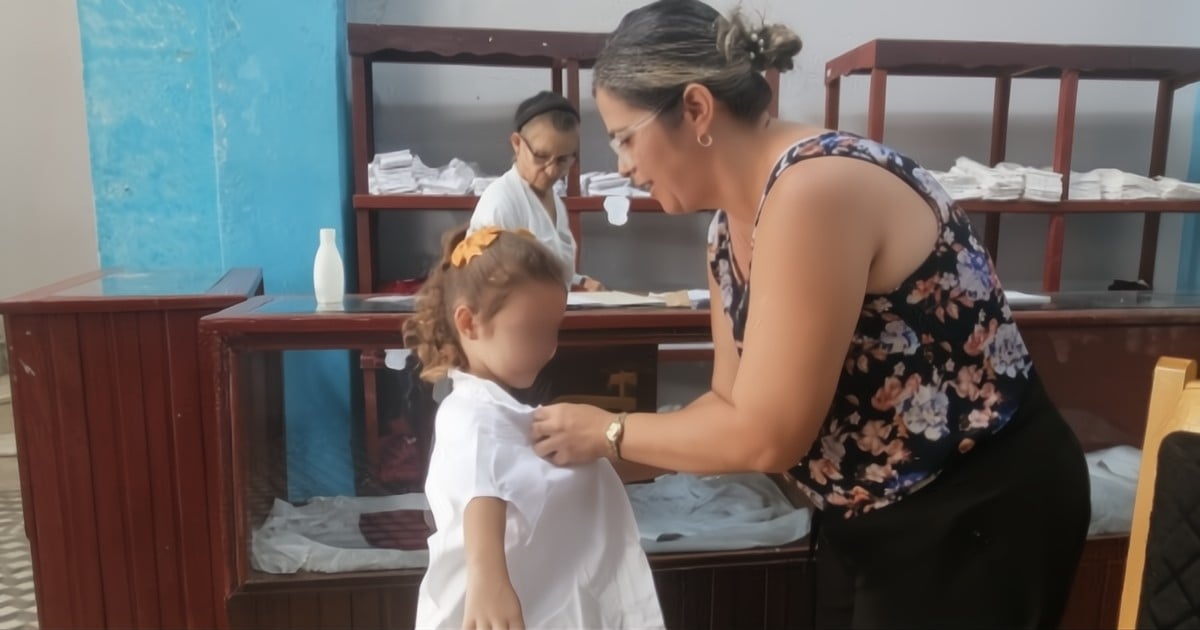
The Ministry of Interior Trade acknowledged that, for now, each student will receive only one uniform, while the second piece will be provided later.
Although sales began in July to avoid crowding, complaints regarding sizes and availability persist.
This situation is compounded by the deterioration of numerous schools and the lack of basic materials.
The minister highlighted the case of Guantánamo as a symbol, where a school destroyed by climate events was repaired in a race against time to reopen on the very first day of the school year.
However, in many communities, the reality is one of broken toilets, leaks, and insufficient furniture.
The authorities are trying to present the start of the school year as a collective achievement.
“There will be no territory that has not made the greatest effort,” said the minister, although improvisation will be the order of the day and, moreover, it does not solve the underlying problems.
Frequently Asked Questions about the Start of the School Year in Cuba Under Precarious Conditions
What are the main challenges faced at the beginning of the school year in Cuba?
The start of the school year in Cuba faces significant challenges such as power outages, a shortage of uniforms, and the deterioration of educational infrastructures. According to the Minister of Education, Naima Ariatne Trujillo Barreto, these issues have required creative solutions and community support. The scarcity of basic materials and lack of resources exacerbate the situation, directly affecting more than 1.5 million students.
How does the energy crisis affect the Cuban education system?
The energy crisis in Cuba has forced schools to adjust schedules and dress codes. Prolonged blackouts have impacted uniform factories and created a precarious environment in classrooms, where electricity, water, and food are not always available. This situation has sparked outrage among parents, who demand minimum conditions for the well-being of their children in schools.
What is the situation regarding the supply of school uniforms in Cuba?
The Cuban textile industry failed to meet the demand for school uniforms, producing only 2.2 million of the 3.6 million expected. In light of this shortage, the government's plan is to prioritize the initial grades and extend the distribution to the rest of the students in September and October. Each student will initially receive only one uniform, with the promise of a second piece to follow later.
What measures has the Cuban government taken to address the shortage of resources in schools?
The Cuban government has implemented creative solutions and relied on community support to address the scarcity of resources in schools. This includes the participation of cooperatives, local businesses, and families in preparing classrooms. However, these measures are only temporary and do not resolve underlying issues such as the deterioration of infrastructure and the lack of basic materials in schools.
Filed under: