Aleida Guevara March, daughter of the guerrilla fighter Ernesto Che Guevara (1928-1967), was recently spotted shopping at a dollar market in Havana, despite having admitted a year ago that her state salary was insufficient for living in the same Cuba where millions lack access to foreign currency.
In July 2024, the pediatrician also admitted that prices on the island have skyrocketed to levels that are unaffordable for a state salary, while she stated that hers was over four thousand pesos.
He provided concrete examples: a cheese that costs 7,000 pesos and a carton of eggs that reaches 3,000 pesos and even more, figures that highlight the severity of the crisis.
"I either eat eggs or do something else, but I can’t do everything, it’s not possible," he said, pointing out that the subsidized basic basket "is not enough to make it to the end of the month," he noted in an interview with the leftist Latin American project "Voces en la Lucha."
However, recent images of the regime defender from Havana shopping in a dollar market highlight the double standards that accompany the elite linked to power, who oscillate between speeches of sacrifice and consumption practices forbidden to the people.
The contradiction becomes even more apparent when considering that the Guevara family manages an international commercial empire from Havana under the “Che Guevara” brand, with businesses ranging from clothing and beverages to cafés and franchises, in addition to million-dollar publishing agreements with foreign groups, as revealed weeks ago by the independent media Cubanet.
The report highlighted that the “Che Guevara” franchise encompasses the Che Guevara Editorial Project, promoted by the Ocean Sur and Ocean Press groups, but is directly managed by Aleida Guevara March, who currently serves as a substitute for her almost nonagenarian mother, Aleida March, in the direction of the Che Guevara Studies Center in Havana.
All of this feeds a stream of income that contrasts with the austerity they preach in their public interventions.
The network of businesses and family properties includes travel, rentals of luxury apartments, and companies registered in Europe and the United States under the names of their descendants, which underscores the gap with the daily lives of Cubans, characterized by power outages, scarcity, and miserable wages.
Social media users pointed out that the Guevara Foundation, which she leads, generates millions from the exploitation of her father's image, income that today seems to support a lifestyle disconnected from the poverty affecting the majority in Cuba.
It is noteworthy that, in Guevara March's view, the small and medium-sized enterprises (mipymes) are not fulfilling their initial mission of producing, and he believes they are only serving to highlight social inequalities further.
Regarding this, in May 2024, he launched an attack against Cuban micro, small, and medium-sized private businesses, calling for increased oversight by the CDR, considering them a potential threat to national security.
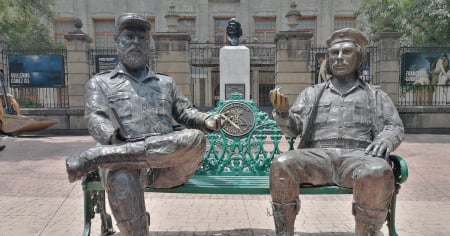
Days ago, she stated that the Mexican people have the “privilege” of having her father and the dictator Fidel Castro (1926-2016) meet in that country, amid the controversy over the removal of the statues of both figures from a public plaza in the Aztec capital.
A few days after the historic protests of July 11, 2021 (11J), described the Cubans who took to the streets as “unscrupulous people,” “fools,” and “of low caliber”.
"They are people without any morals or ethics. The lowest of society; the dirtiest people. The most hostile... What do I know! It’s such a vulgar, truly absurd thing that you realize it’s really a completely marginal thing," he stated.
Furthermore, she expressed her support for the Lebanese people and stated her desire to join the resistance against Israel, during an interview given to the Al Mayadeen channel in Spanish in Caracas, Venezuela.
In this regard, her stance is not new, as in 2023 she also offered herself as a soldier for the Palestinian cause and claimed that she shoots “pretty well.”
Frequently Asked Questions about the Dollar Market in Cuba and the Figure of Aleida Guevara
Why is it controversial for Aleida Guevara to shop at a dollar market?
The controversy arises because Aleida Guevara, a defender of the Cuban regime, has been seen shopping at a dollar market despite her previous statements about the insufficiency of her state salary to live in Cuba. This highlights a contradiction between her rhetoric and her actions, emphasizing the inequalities between the elite connected to the power and the Cuban people.
How does the sale of products in dollars relate to the economic situation in Cuba?
The sale of products in dollars in Cuba reflects a strategy by the regime to capture foreign currency in response to the country's economic collapse. However, this practice has deepened inequalities, as most Cubans do not have access to foreign currency and face high prices for basic goods, while the market in Cuban pesos remains understocked.
What is the criticism of dollar stores in Cuba?
The main criticism of the dollar stores is that they create a parallel economy accessible only to those with foreign currency, which exacerbates social inequality. These stores are well-stocked compared to those operating in national currency, leading to frustration and discontent among the population that cannot access them.
What impact does the figure of Aleida Guevara have on public perception of the Cuban elite?
Aleida Guevara is seen as a symbol of the double standards of the Cuban elite. Her involvement in commercial activities and her lifestyle contrast with the rhetoric of sacrifice and austerity that she publicly promotes, which feeds the perception of a disconnection between the elite and the daily reality of Cubans.
Filed under: