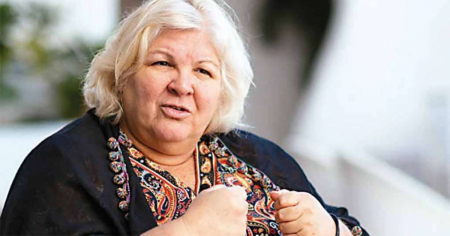
Aleida Guevara, daughter of Ernesto Che Guevara, stated that the Mexican people have the “privilege” of having her father and Fidel Castro meet in that country, amidst the controversy surrounding the removal of the statues of both figures from a public square in the Aztec capital.
In his view, what occurred at the Jardín Tabacalera, in the Cuauhtémoc borough of Mexico City, is simply a "historical reminder" that should be valued by citizens, not judged by political criteria.
Guevara assured the media outlet Publimetro that "the statues are not of great importance to the families" and argued that their installation or removal should be a decision made by the people.
He also stated that both his father and Castro "are men who transcend boundaries" and that they belong not only to Cuba or Mexico, but are "universal figures."
She was also ambiguous when asked if she would like the statues to return to their original place, limiting herself to responding: "Whatever they decide."
The statements from Aleida Guevara come after local authorities of the Cuauhtémoc mayor's office removed the sculptural ensemble, known as the Monumento Encuentro -popularly nicknamed the Che and Fidel bench- after detecting irregularities in its placement and receiving multiple complaints from residents in the area.
The measure prompted, on July 21, a protest demonstration consisting of around 150 people, including neighbors, Cuban citizens associated with the consulate, regime supporters, and shock troops of the Communist Party in Mexico.
The removal of the statues was rejected by the federal government and the president herself, Claudia Sheinbaum, who described the act as “illegal,” “intolerant,” and “hypocritical.”
Meanwhile, the central government has requested that the sculptures be delivered for their "institutional" relocation, although the underlying debate remains unresolved: why should figures associated with authoritarian regimes and unrelated to Mexico's democratic history occupy public spaces without citizen consensus?
Social media has amplified the backlash: some users have directly questioned why Aleida Guevara is being consulted on internal decisions regarding Mexico, while others have sarcastically suggested proposals such as placing the statues in her house.
The debate is far from over and continues to touch on sensitive issues related to historical memory, ideology, and public space.
Frequently asked questions about the controversy surrounding the statues of Fidel Castro and Che Guevara in Mexico
Why were the statues of Fidel Castro and Che Guevara removed in Mexico City?
The statues were removed by decision of Mayor Alessandra Rojo de la Vega due to irregularities in their placement and multiple complaints from residents. Additionally, the Cuauhtémoc mayor's office argued that there was no authorization from the Committee of Monuments and Artistic Works in Public Spaces for their installation.
What does Aleida Guevara think about the removal of the statues of her father and Fidel Castro?
Aleida Guevara expressed that the Mexican people have the "privilege" of having her father and Castro meet there and that the removal of the statues is a decision that the people must make. She was vague about whether she would like the statues to return, saying that it would depend on "what they decide."
What has been the reaction of the Mexican government to the removal of the statues?
The federal government, and particularly President Claudia Sheinbaum, described the withdrawal as "illegal," "intolerant," and "hypocritical." Furthermore, Sheinbaum requested the return of the statues for their relocation elsewhere, considering their historical significance in the relationship between Cuba and Mexico.
What has the mayor of Cuauhtémoc proposed regarding the statues of Fidel and Che?
Mayor Alessandra Rojo de la Vega has proposed to auction the sculptures so that those who admire them can purchase them with their own money. She argues that the statues should not occupy public spaces without citizen consensus and that those who value them should fund them on their own.
How has the Cuban community in Mexico reacted to this situation?
The Cuban opposition community in Mexico has expressed its support for the removal of the statues, while groups linked to the Cuban regime have voiced their disagreement. Protests have occurred, and criticisms have arisen regarding the involvement of Cuban figures in Mexico's internal decisions.
Filed under: